where \(a\text{,}\)\(b\text{,}\) and \(c\) are fixed constants, and \(\theta\) is the unknown. As a result of the periodic nature of trigonometric functions, combined with some intrinsic symmetries of the unit circle, we will see that elementary trigonometric equations will usually have infinitely many solutions; and indeed, the solutions often come in two independent infinite lists!
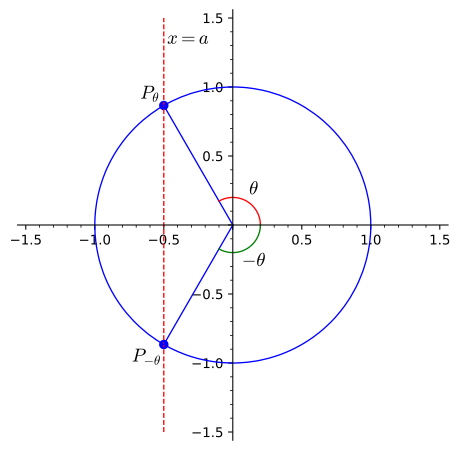
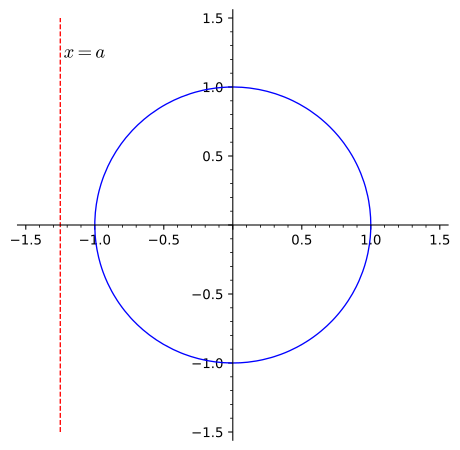
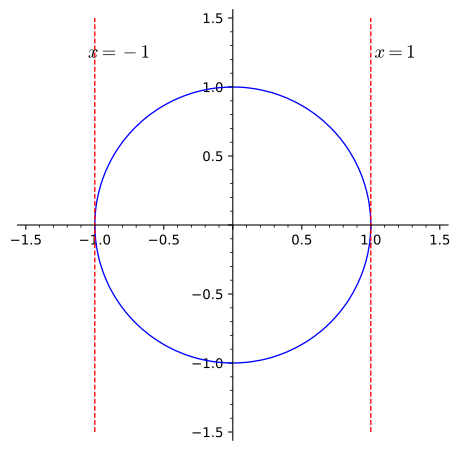
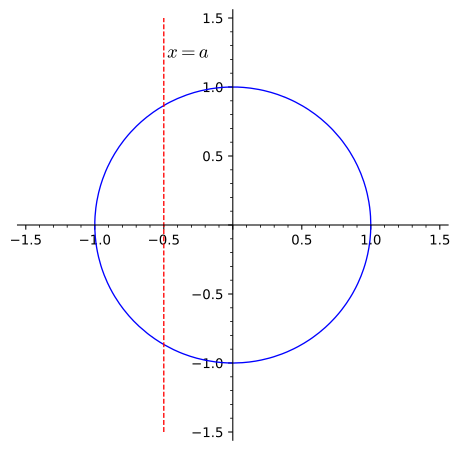
Let’s begin with the equation form \(\cos\theta=a\text{.}\) First observe that since \(\range \cos=[-1,1]\text{,}\) this equation has a solution in the unknown \(\theta\) if and only if \(-1\leq a\leq 1\text{.}\) Next, using the definition of \(\cos\theta\) as the \(x\)-coordinate of the corresponding point \(P_\theta\) on the unit circle, we see that a solution \(\theta\) corresponds to an angle \(\theta\) whose corresponding point \(P_\theta\) has \(x\)-coordinate equal to \(a\text{.}\) In other words, solutions to \(\cos\theta=a\) correspond to points on the intersection of the vertical line \(x=a\) and the unit circle \(x^2+y^2=1\text{.}\) As illustrated in Figure 2.19.1 the vertical line \(x=a\) will intersect the unit circle \(C\) either not at all (if \(a\notin [-1,1]\)), in exactly one point (if \(a=\pm 1\)), or in exactly two points (if \(a\in (-1,1)\)).
Let’s see how to solve the equation \(\cos\theta=a\) in the case when \(a\in (-1,1)\text{.}\) An angle \(\theta\) solving this equation will have associated point \(P_\theta\) lying on the intersection of the line \(x=a\) and the unit circle. From the diagram above, we see there are two such points, and by symmetry, we see that if \(P_\theta\) is one of the points, then \(P_{-\theta}\) is the other, as indicated in Figure 2.19.2
Now, imagine we have found one solution \(\theta\) to \(\cos\theta=a\text{,}\) corresponding to the point \(P_\theta\text{.}\) Any angle coterminal with \(\theta\) will intersect the unit circle in the same point \(P_\theta\text{.}\) We conclude that any angle of the form \(\theta+2\pi n\text{,}\)\(n\in\Z\text{,}\) is also a solution to \(\cos\theta=a\text{.}\) The same reasoning tells us that any angle of the form \(-\theta+2\pi n\text{,}\)\(n\in \Z\) is a solution to \(\cos\theta=a\text{.}\) From a single solution \(\theta\) to the equation, we have thus generated two independent infinite lists of solutions:
\begin{align*}
\alpha \amp =\theta+2\pi n, \ n\in \Z\\
\beta \amp = -\theta+2\pi n, \ n \in \Z\text{.}
\end{align*}
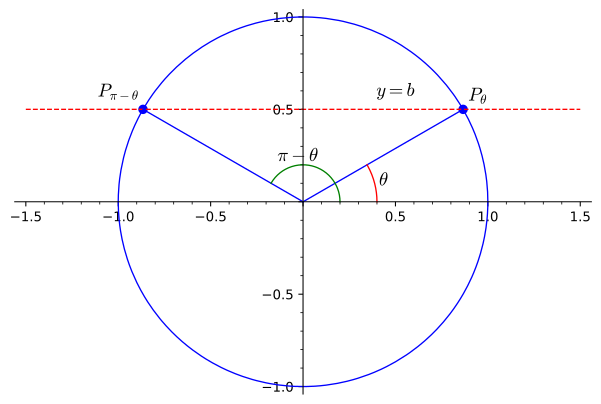
Similar reasoning applies to an elementary sine equation \(\sin\theta=b\text{.}\) Now we are looking for angles \(\theta\) for which the corresponding point \(P_\theta\) has \(y\)-coordinate equal to \(b\text{.}\) This is a point lying on the intersection of the horizontal line\(y=b\) and the unit circle. For the case when \(b\in (-1,1)\text{,}\) if \(P_\theta\) is one such point, \(P_{\pi-\theta}\) is the other.
From the unit circle picture, we see that from a single solution \(\theta\) to \(\sin\theta=b\text{,}\) we can generate two independent infinite lists of solutions:
\begin{align*}
\alpha \amp =\theta+2\pi n, \ n\in \Z\\
\beta \amp = (\pi-\theta)+2\pi n, \ n \in \Z\text{.}
\end{align*}
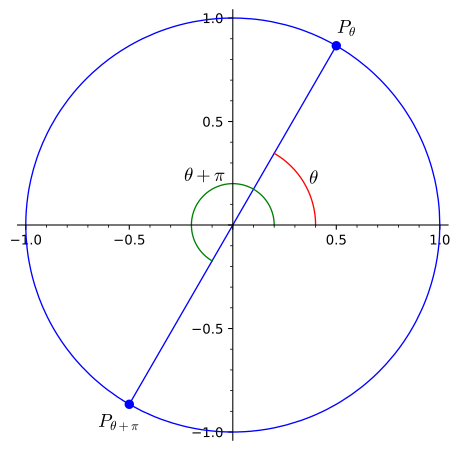
Finally, consider the the equation \(\tan \theta=c\text{.}\) Recall that \(\tan\theta\) is the slope of the terminal edge of the angle \(\theta\text{.}\) As indicated below the angles \(\theta\) and \(\theta+\pi\) have terminal edges with the same slope. It follows that if \(\theta\) is one solution to \(\tan\theta=c\text{,}\) then \(\theta+\pi n\text{,}\)\(n\in \Z\) is the set of all solutions.
Note that except for the simple equations \(\cos\theta=\pm 1\) and \(\sin\theta=\pm 1\text{,}\)Procedure 2.19.5 does not give an explicit formula for the general solution to an elementary trigonometric equation: it only describes how to get all solutions starting from a given solution\(\theta_0\text{.}\) When solving elementary trigonometric equations by hand, the way to proceed is to find one solution \(\theta_0\) corresponding to one of the 16 familiar angles, and then write all other solutions in terms of \(\theta_0\text{.}\)
First we observe that \(\theta_0=2\pi/3\) is one solution to the given equation, making use of the familiar angles in Figure 2.17.13. It follows that the complete list of solutions is
\begin{align}
\theta \amp = 2\pi/3+2\pi n, \ n\in \Z \tag{2.92}\\
\theta \amp= -2\pi/3+2\pi n, \ n\in \Z \text{.}\tag{2.93}
\end{align}
We observe that \(x_0=5\pi/4\) is one solution to the given equation, making use of the familiar angles in Figure 2.17.13. It follows that the complete list of solutions is
\begin{align}
x \amp = 5\pi/4+2\pi n, \ n\in \Z \tag{2.94}\\
x \amp= (\pi-5\pi/4)+2\pi n=(-\pi/4)+2\pi n, \ n\in \Z \text{.}\tag{2.95}
\end{align}
To find a familiar solution to \(\tan t=\sqrt{3}\text{,}\) it helps to write \(\sqrt{3}\) as \((\sqrt{3}/2)/(1/2)\text{,}\) since now we recognize the numerator as \(\sin \pi/3\) and the denominator as \(\cos\pi/3\text{.}\) It follows that \(t_0=\pi/3\) is a solution to the given equation, and thus that the complete list of solutions is
\begin{align*}
t \amp = \pi/3+\pi n, \ n\in \Z \text{.}
\end{align*}