Section 2.6 Curve sketching

In this section, we focus on sketching accurate graphs of algebraic functions by hand. To do so we will assemble a host of information about the function, starting from elementary properties like domain and intercepts, and moving to more sophisticated ones like local and global extrema, intervals of monotonicity, inflection points, and end behavior. These latter properties are revealed to us through the use of calculus tools: more specifically, from an analysis of the first and second derivatives of the function, and limits at infinity (or endpoints). ProcedureΒ 2.6.1 enumerates a fairly complete list of the details our resulting sketch should capture. The examples that follow indicate how to systematically extract all of those details through a calculus-aided investigation.

Subsection Curve sketching

Example 2.6.2. Curve sketch: polynomial.

Provide a graph of \(f(x)=3x^5-5x^3\) that includes all the details listed in ProcedureΒ 2.6.1.
Solution.
Domain and intercepts. The domain of \(f\) is \(\R=(-\infty, \infty)\text{.}\) The \(y\)-intercept of the graph of \(f\) is \((0,f(0))=(0,0)\text{.}\)
To find the \(x\)-intercepts we solve:
\begin{align*} f(x) \amp =0\\ x^3(3x^2-5) \amp =0\\ x=0 \amp\text{ or } x^2=\frac{5}{3} \\ x=0 \amp\text{ or } x=\pm\sqrt{5/3} \text{.} \end{align*}
Thus the \(x\)-intercepts are
\begin{equation*} (0,0), (\sqrt{5/3},0), (-\sqrt{5/3},0)\text{.} \end{equation*}
Endpoint behavior and vertical asymptotes. Since \(f\) is continuous at all points of \(\R\text{,}\) there are no vertical asymptotes.
For endpoint behavior, we compute
\begin{align*} \lim_{x\to \pm \infty}f(x) \amp = \lim\limits_{x\to \pm \infty}\frac{3x^5-5x^3}{1} \\ \amp = \lim\limits_{x\to \pm \infty}3x^5 \amp (\knowl{./knowl/xref/th_rational_function.html}{\text{Theorem 1.17.12}})\\ \amp = \pm \infty\text{.} \end{align*}
In particular, we see that there are no horizontal asymptotes of the graph of \(f\text{.}\)
Critical points and intervals of monotonicity. We saw in ExampleΒ 2.4.8 that the critical points of \(f\) are \(x=-1,0,1\text{,}\) that \(f(-1)\) is a local maximum value, \(f(1)\) is a local minimum value, and \(f(0)\) is neither, that \(f\) is increasing on the intervals \((-\infty, -1]\) and \([1,\infty)\) and decreasing on the interval \([-1,1]\text{.}\) All of this information is summarized by the sign diagram of \(f'\text{.}\)
Sign diagram for derivative of f
Concavity and inflection points. We analyzed the concavity of \(f\) in ExampleΒ 2.5.9. The sign diagram we produced there gives a nice summary of the situation.
Sign diagram for second derivative of f
In particular, observe that we have inflection points at the inputs \(x=-1/\sqrt{2}, 0, 1/\sqrt{2}\text{.}\)
Important points. Our analysis is more or less complete. We should first, however, make a table of values (to the best of our abilities) for all important points on our graph.
\begin{equation*} \begin{array}{r|l} x \amp f(x) \\ \hline 0\amp 0 \\ -1 \amp 2 \\ 1 \amp -2 \\ -\frac{1}{\sqrt{2}} \amp -(3(2)^{-5/2}+5(2)^{-3/2}) \\ \frac{1}{\sqrt{2}} \amp (3(2)^{-5/2}+5(2)^{-3/2}) \end{array}\text{.} \end{equation*}
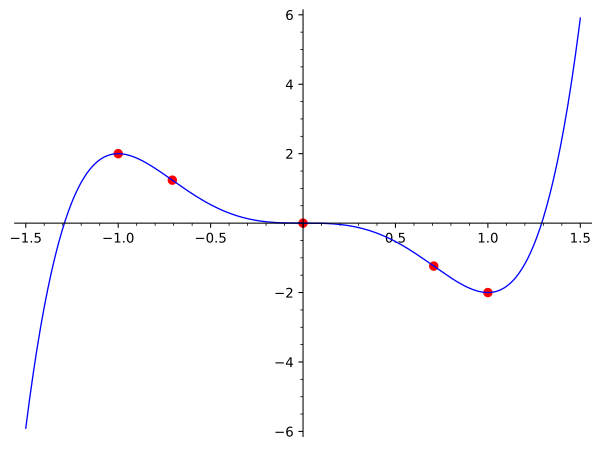
Finally we put everything together into a single sketch.
Graph of function

Example 2.6.3. Curve sketching: rational function.

Provide a graph of \(f(x)=\frac{x^2}{x^2+3}\) that includes all the details listed in ProcedureΒ 2.6.1.
Solution.
For the sake of space, our solution will be slightly more terse than in the previous example. We first observe that the domain of \(f\) is \(\R\) and that \((0,0)\) is both the \(x\)- and \(y\)-intercept.
Since \(f\) is continuous everywhere on \(\R\text{,}\) it has not vertical asymptotes. Using TheoremΒ 1.17.12, we see easily that \(\lim\limits_{x\to \pm \infty}f(x)=1\text{,}\) and thus that \(y=1\) is a horizontal asymptote of \(f\text{.}\)
Next we compute
\begin{align*} f'(x) \amp = \frac{6x}{(x^2+3)^2}\\ f''(x) \amp = \frac{18(x-1)(x+1)}{(x^2+3)^3} \text{.} \end{align*}
The sign diagrams for \(f'\) and \(f''\) are given below.
Sign diagram for derivative of f
We see then that \(f\) has a single critical point at \(x=0\text{,}\) that \(f(0)\) is a local minimum value of \(f\text{,}\) and that \(f\) is decreasing on \((-\infty, 0)\) and increasing on \((0,\infty)\text{.}\) Furthermore, \(f\) has inflection points at \(x=-1\) and \(x=1\text{,}\) is concave down on \((-\infty, -1)\) and \((1,\infty)\text{,}\) and concave up on \((-1,1)\text{.}\)
To finish our analysis we make a table of values of important points:
\begin{equation*} \begin{array}{r|l} x\amp f(x) \\ \hline 0 \amp 0 \\ -1 \amp \frac{1}{4} \\ 1 \amp \frac{1}{4} \end{array}\text{.} \end{equation*}
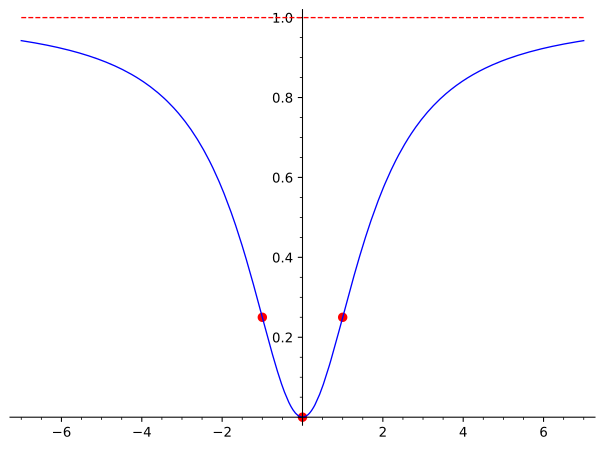
Putting everything together, we obtain a graph like the following.
Graph of function

Example 2.6.4. Curve sketching: algebraic function.

Provide a graph of \(f(x)=\frac{\sqrt{x}}{x-1}\) that includes all the details listed in ProcedureΒ 2.6.1.
Solution.
The domain of \(f\) is \(D=[0,1)\cup (1,\infty)\text{,}\) and \((0,0)\) is both the \(y\)-intercept and the sole \(x\)-intercept.
Since \(f\) is continuous at \(x=0\text{,}\) we have
\begin{equation*} \lim\limits_{x\to 0^+}f(x)=f(0)=0\text{.} \end{equation*}
Next we compute
\begin{align*} \lim\limits_{x\to \infty}f(x) \amp = \lim\limits_{x\to \infty}\frac{\sqrt{x}}{x(1-1/x)} \\ \amp =\lim\limits_{x\to \infty}\frac{1}{\sqrt{x}}\cdot \frac{1}{1-1/x} \\ \amp = \lim\limits_{x\to \infty}\frac{1}{\sqrt{x}}\lim\limits_{x\to \infty}\frac{1}{1-1/x}\\ \amp = 0\cdot \frac{1}{\lim\limits_{x\to \infty}1-\lim\limits_{x\to \infty}1/x}\\ \amp = 0\cdot 1=0\text{.} \end{align*}
Thus \(y=0\) is a horizontal asymptote of \(f\text{.}\)
The only candidate for a vertical asymptote of \(f\) is \(x=1\text{.}\) We compute
\begin{align*} \lim\limits_{x\to 1^-}\frac{\sqrt{x}}{x-1} \amp = -\infty \amp (\text{type } 1/0)\\ \lim\limits_{x\to 1^+}\frac{\sqrt{x}}{x-1} \amp = \infty \amp (\text{type } 1/0)\text{.} \end{align*}
In particular, we see that \(x=1\) is a vertical asymptote of the graph of \(f\text{.}\)
Moving on, after some careful simplification, we see that
\begin{align*} f'(x) \amp =-\frac{x+1}{2\sqrt{x}(x-1)^2} \\ f''(x) \amp = \frac{3x^2+6x-1}{4x^{3/2}(x-1)^3} \end{align*}
for all \(x> 0\text{.}\) Note that both \(f'\) and \(f''\) are both undefined at \(0\text{.}\) It follows that \(x=0\) is the only critical point of \(f\text{.}\) We now compute the sign diagram of \(f'\text{.}\)
Sign diagram for derivative of f
Not in particular that \(f\) is decreasing on its entire domain.
To produce the sign diagram of \(f''\) we first solve
\begin{align*} f''(x) \amp = 0\\ 3x^2+6x-1 \amp = 0 \\ x \amp = \frac{-6\pm \sqrt{48}}{6}\\ \amp = -1\pm \frac{2\sqrt{3}}{3}\text{.} \end{align*}
Since only \(-1+2\sqrt{3}/3\) lies in the domain of \(f\text{,}\) we obtain the following sign diagram for \(f''\text{.}\)
Sign diagram for second derivative of f
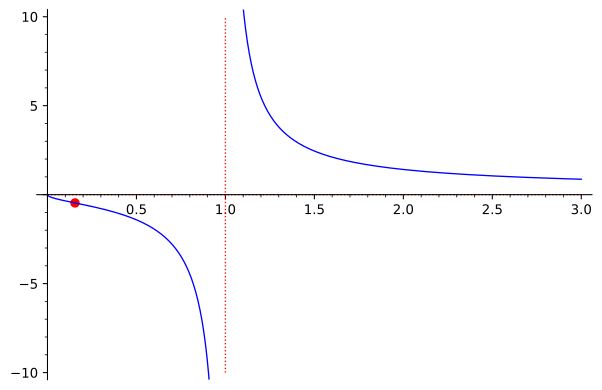
Putting it all together, we get a graph like the following.
Graph of f
Observe how easy it would be to overlook the inflection point (the sole point plotted above in red) without our careful analysis.

Subsection Curve sketching from derivative

As the proceeding examples amply illustrate, the shape of the graph of a function is essentially determined by the behavior of its first and second derivatives \(f'\) and \(f''\text{.}\) In more detail, \(f'\) tells us where the function \(f\) is increasing or decreasing, and where it has critical points and local maxima and minima; and \(f''\) tells us where the function is concave up or down. That information allows us to give a fairly accurate account of the shape of the graph of \(f\text{.}\) The only thing it is missing are actual values of \(f\) that allow us to β€œpin” our curve to the coordinate system at an actual plotted point. The next examples illustrate this.

Example 2.6.5.

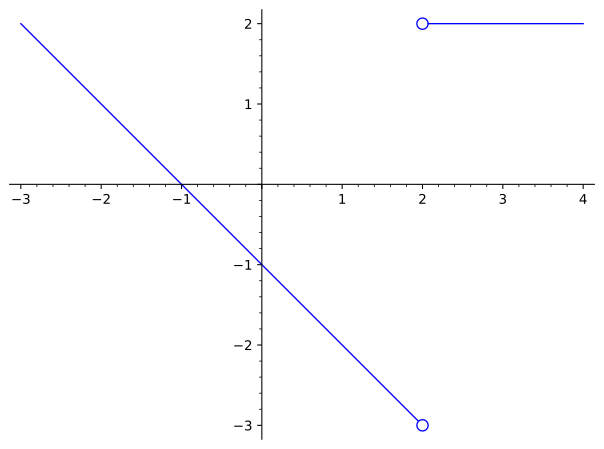
Let \(g\) be a continuous function with domain \(D=\R\) whose derivative \(g'\) is shown in FigureΒ 2.6.6.
Figure 2.6.6. Graph of \(g'\text{,}\) the derivative of \(g\text{.}\)
Produce a sketch of \(g\) that correctly reflects where \(g\) is increasing or decreasing, where it has critical points and local extrema, and where it is concave up, concave down, or neither.
Solution.
Let us make some organized deductions from the graph of \(g'\text{.}\)
  • Since \(g'\) is positive on the intervals \((-\infty, -2)\) and \((2,\infty)\text{,}\) the function \(g\) is increasing there; similarly, since \(g'\) is negative on \((-2,2)\) the function \(g\) is decreasing there.
  • Since \(g'\) has a zero at \(x=-2\text{,}\) the function \(g\) has a critical point at \(x=2\text{.}\) Furthermore, since \(g'\) is positive for \(x< -2\) and negative for \(x> -2\text{,}\) \(f\) has a local maximum value at \(x=2\text{.}\)
  • Since \(g'\) is not defined at \(x=2\text{,}\) we see that \(g\) is not differentiable at \(x=2\text{,}\) making this another critical point of \(g\text{.}\) As above, since \(g'\) is negative to the left of \(x=2\) and positive to the right, we see that \(g\) has a local minimum at \(x=2\text{.}\)
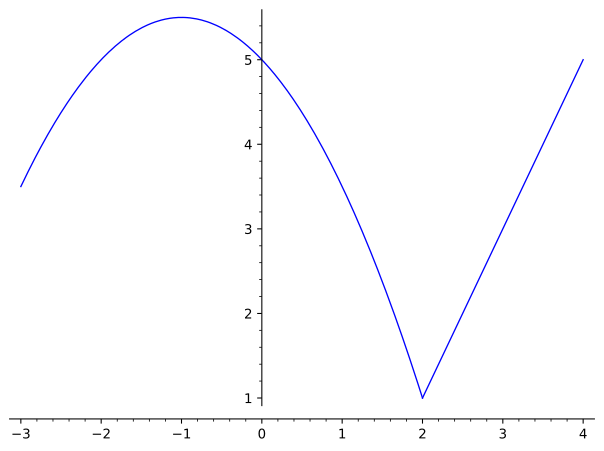
  • By definition, \(g\) is concave up on all intervals where \(g'\) is increasing, and concave down on all intervals where \(g'\) is decreasing. Looking at the graph of \(g'\text{,}\) we see that it is decreasing on \((-\infty, 2)\text{,}\) and constant on \((2,\infty)\text{;}\) in particular, \(g'\) is never increasing. We conclude that \(g\) is concave down on \((-\infty, 2)\text{.}\) The fact that \(g'(x)=2\) for all \(x> 2\) tells us that \(g\) is linear on \((2,\infty)\) with constant slope \(2\text{.}\)
Putting our observations about \(g\) together, we produce the following sketch of the graph of \(g\text{.}\)
Graph of g
Figure 2.6.7. A possible graph of \(g\)
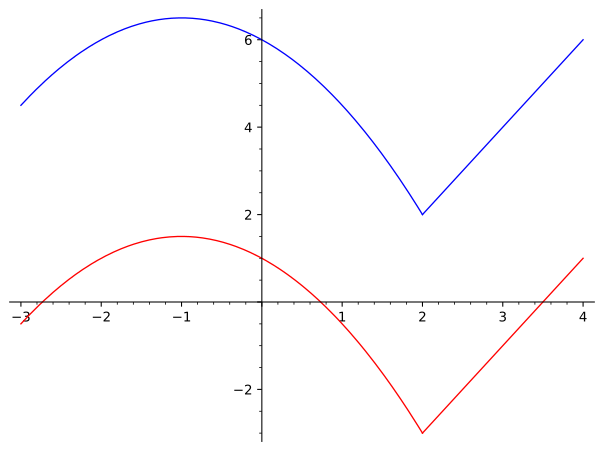
Note that our graph of \(g\) is not the only one with a derivative \(g'\) satisfying the given conditions. Indeed, if \(g\) is one solution to our problem, so is \(h(x)=g(x)+C\) for any constant \(C\text{.}\) Graphically, speaking this is just the fact that shifting our given graph of \(g\) up or down does not change the shape of its graph, only its location in the \(xy\)-plane. In FigureΒ 2.6.8 we provide two more possible graphs of functions whose derivatives would be equal to \(g'\text{.}\)
Graph of g shifted up and down
Figure 2.6.8. Two possible graphs of \(g\) with derivative as in FigureΒ 2.6.6