Section 2.9 Exponential functions: limit and graphical properties

Subsection Limit properties

Having introduced the basic definitions and properties of exponential functions, we now introduce some proper calculus notions into our analysis, starting with continuity. As with algebraic functions, it turns out that exponential functions are continuous everywhere on their domains. Although we are not in a position to give a formal proof of this fact, continuity of these functions is plainly evident from the graphs we have examined so far, which have no breaks or holes.

Example 2.9.2. Exponential limit.

Compute \(\lim\limits_{x\to 3}3\, (25)^{-x/2}+1\text{.}\) Your answer should be expressed as a rational number. Justify your reasoning.
Solution.
First observe that since the function \(f(x)=3\, (25)^{-x/2}+1\) is the result of combining various continuous functions using multiplication, addition and composition, it is itself continuous on all of \(\R\text{,}\) and thus satisfies
\begin{align*} \lim\limits_{x\to c}f(x)\amp =f(c) \end{align*}
for any \(c\in \R\text{.}\) Thus
\begin{align*} \lim\limits_{x\to 3} 3\, (25)^{-x/2}+1 \amp =3\, (25)^{-3/2}+1\\ \amp =\frac{3}{(25^{1/2})^3}+1\\ \amp =\frac{3}{5^3}+1\\ \amp =\frac{3}{125}+1\text{.} \end{align*}
Continuing with our limit analysis, we next examine the β€œend behavior” of an exponential function \(f\text{:}\) that is, we wish to compute \(\lim\limits_{x\to \pm \infty}f(x)\text{.}\)
To start, let’s consider the two basic exponential functions \(f(t) = 2^t\) and \(g(t) = \left(\frac{1}{2}\right)^t\) and their respective values at \(t=10, t=20\text{,}\) and \(t=30\text{.}\)
Table 2.9.3. Table of values for \(2^x\) and \((1/2)^x\)
\(x\) \(10\) \(20\) \(30\)
\(2^x\) \(1024\) \(1,048,576\) \(1,073,741,824\)
\((1/2)^x\) \(\approx 0.00098\) \(\approx 0.00000095\) \(\approx 9.3 \times 10^{-10}\)
For the increasing function \(f(t) = 2^t\text{,}\) we see that the output of the function gets very large very quickly. In addition, there is no upper bound to how large the function can be. Indeed, we can make the value of \(f(t)\) as large as we’d like by taking \(t\) sufficiently big. We thus say that as \(t\) increases, \(f(t)\) increases without bound and conclude
\begin{equation*} \lim_{t\to\infty}2^t = \infty \end{equation*}
For the decreasing function \(g(t) = \left(\frac{1}{2}\right)^t\text{,}\) we see that the output \(g(t)\) is always positive but getting closer and closer to 0. Indeed, because we can make \(2^t\) as large as we like, it follows that we can make its reciprocal \(\frac{1}{2^t} = \left(\frac{1}{2}\right)^t\) as small as we’d like. We thus say that as \(t\) increases, \(g(t)\) approaches 0: i.e.,
\begin{equation*} \lim_{t\to\infty}\left(\frac{1}{2}\right)^t = 0\text{.} \end{equation*}
What about the limits of these functions at \(-\infty\text{?}\) It turns out these limits are essentially equal to the reciprocal of the limits at \(\infty\text{,}\) thanks to the exponential property \(b^{-x}=1/b^x\text{.}\) Assuming our results from above, we have
\begin{align} \lim\limits_{x\to -\infty} 2^x \amp = \lim\limits_{x\to \infty}2^{-x} \amp (\lim\limits_{x\to -\infty}f(x)=\lim\limits_{x\to \infty}f(-x)) \tag{2.9}\\ \amp = \lim\limits_{x\to \infty}(1/2)^x\tag{2.10}\\ \amp = 0\tag{2.11}\\ \lim\limits_{x\to -\infty}(1/2)^x \amp = \lim\limits_{x\to \infty}(1/2)^{-x} \amp (\lim\limits_{x\to -\infty}f(x)=\lim\limits_{x\to \infty}f(-x))\tag{2.12}\\ \amp = \lim\limits_{x\to \infty}2^x \tag{2.13}\\ \amp = \infty\text{.}\tag{2.14} \end{align}
Our analysis above, examining the special cases \(b=2\) and \(b=1/2\) generalizes easily to arbitrary positive bases \(b\text{.}\) The crucial feature of \(b\) is whether it is greater than or less than \(1\) as the following theorem articulates.
We have established (or at least stated) two important results about exponential functions.
  • Exponential functions \(f(x)=b^x\) are continuous on their domain \(\R\text{;}\)
  • One limit at infinity of an exponential function \(f(x)=b^x\) is \(\infty\text{,}\) and the other is \(0\text{.}\)
From these two facts, we can deduce a third important fact about the range of an exponential theorem, using our old friend, the intermediate value theorem: namely, \(\range f=(0,\infty)\) for any exponential function \(f(x)=b^x\text{.}\)
Let’s see why. Assume \(f(x)=b^x\) with \(b> 1\text{.}\) (The case \(0< b< 1\) is exactly similar.) Given any positive \(d\in \R\text{,}\) since \(\lim\limits_{x\to \infty}f(x)=\infty\text{,}\) we can find a positive \(b\in \R\) such that \(f(b)> c\text{;}\) similarly, since \(\lim\limits_{x\to -\infty}f(x)=0\) we can find a negative \(a\in \R\) such that \(f(a)< d\text{.}\) We thus have \(a< b\text{,}\) \(f\) continuous on \([a,b]\) (since \(f\) is continuous everywhere), and \(f(a)< d < f(b)\text{.}\) We conclude that there exists some \(c\in (a,b)\) such that \(f(c)=d\text{.}\) The argument shows that for any positive \(d\in (0,\infty)\text{,}\) we have \(d\in \range g\text{.}\) Since furthermore \(\range f\subseteq (0,\infty)\text{,}\) we conclude that \(\range f=(0,\infty)\text{.}\)
Subsection Graphing exponential functions

We now combine our accumulated results about basic exponential functions \(f(x)=b^x\) to yield a detailed description of their graphical properties.
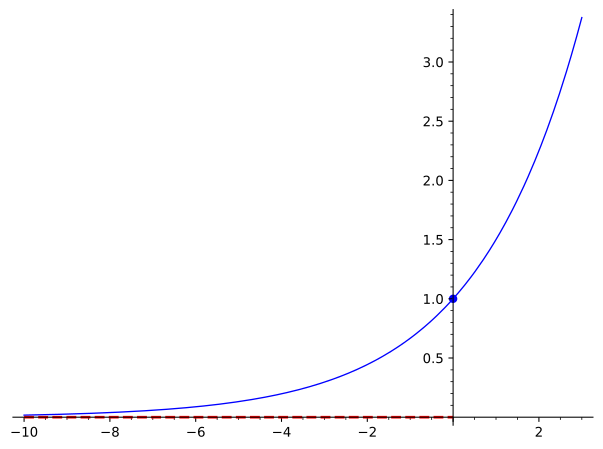
As a result of TheoremΒ 2.9.5, it is now straightforward to provide a convincing sketch of a basic exponential function \(f(x)=b^x\text{:}\)
  • Plot at least the \(y\)-intercept \((0,1)\text{.}\)
  • In the case \(b> 1\text{,}\) draw a curve passing through \((0,1)\) that is increasing and concave up, that approaches \(\infty\) as \(x\to \infty\text{,}\) and that has a horizontal asymptote of \(y=0\) as \(x\to -\infty\text{.}\)
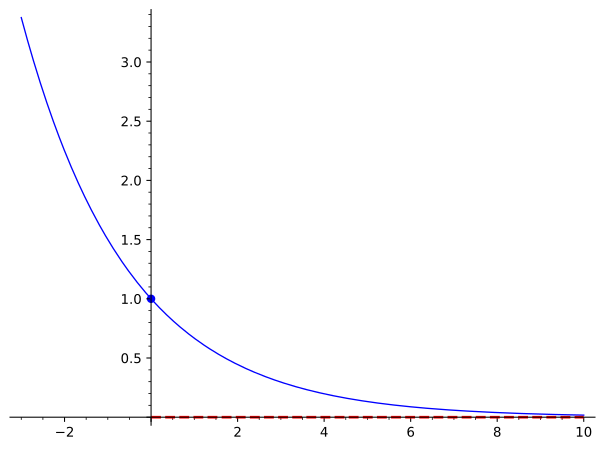
    Similarly, in the case \(0< b< 1\text{,}\) draw a curve passing through \((0,1)\) that is decreasing and concave up, that approaches \(\infty\) as \(x\to -\infty\text{,}\) and that has a horizontal asymptote of \(y=0\) as \(x\to \infty\text{.}\)
Exponential growth function
(a) \(f(x)=b^x\text{,}\) \(b> 1\)
Exponential decay function
(b) \(f(x)=b^x\text{,}\) \(0\lt b\lt 1\)
Figure 2.9.6. Graph of \(f(x)=b^x\)
From our detailed graphical understanding of basic exponential functions \(f(x)=b^x\text{,}\) we can easily graph a more general exponential function \(g(x)=A\, b^x+C\) using shifting and scaling analysis. (See SectionΒ 1.6.) In more, detail, we obtain the graph of \(g\) from the graph of \(f\) by first scaling vertically by the factor \(A\text{,}\) and then shifting vertically by \(C\text{.}\) Let’s look at how this sequence of transformations affects the graph:
  • Scale by \(A\).
    Consider the first transformation, from \(f(x)=b^x\) to \(h(x)=A\, b^x\text{.}\)
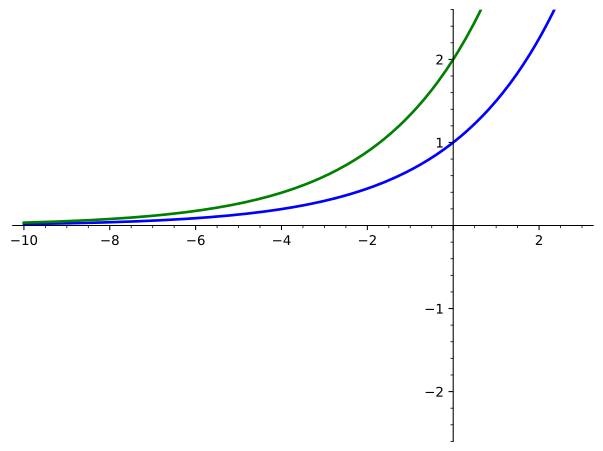
    If \(A> 0\text{,}\) then qualitatively the graphs of \(f\) and \(h\) are essentially the same: the positive scaling factor \(A\) simply alters how quickly the graph approaches 0 and \(\infty\) at either ends of its domain.
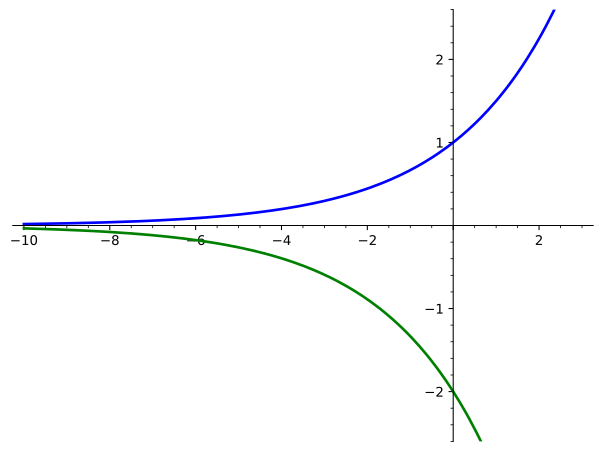
    On the other hand, if \(A=-\abs{A}< 0\text{,}\) we first reflect across the \(x\)-axis, and then scaled vertically by \(\abs{A}\text{.}\) In this case the graph of \(h\) still has a horizontal asymptote at \(y=0\text{,}\) but approaches this asymptote from below. Furthermore, at the other end of the domain, the graph approaches \(-\infty\text{.}\)
    Exponential growth function scaled by positive factor
    (a) \(f(x)=b^x\) and \(h(x)=A\, b^x\text{,}\) \(A> 0\)
    Exponential growth function scaled by negative factor
    (b) \(f(x)=b^x\) and \(h(x)=A\, b^x\text{,}\) \(A< 0\)
    Figure 2.9.7. Comparing graphs of \(f(x)=b^x\) and \(h(x)=A\, b^x\)
  • Shift by \(C\).
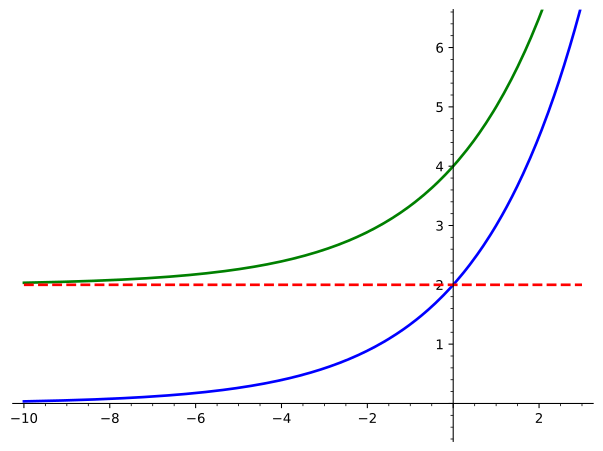
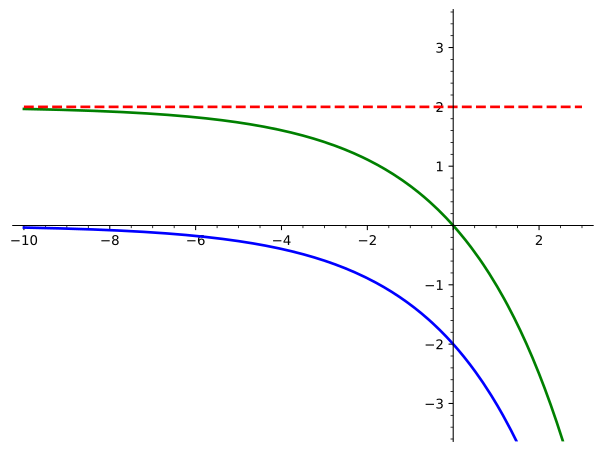
    Now consider transforming \(h(x)=A\, b^x\) to \(g(x)=A\, b^x+C\text{.}\) In this case we simply shift vertically by \(C\text{.}\) As usual the shift is upwards if \(C> 0\) and downwards if \(C< 0\text{.}\) Importantly, this transforms the vertical asymptote of \(h\) in the same way, resulting in the graph of \(g\) having a horizontal asymptote at \(y=C\text{.}\)
    Exponential function shifted up
    (a) \(h(x)=A\, b^x\) and \(g(x)=A\, b^x+C\text{,}\) \(A,C> 0\)
    Exponential function with negative scale and positive shift
    (b) \(h(x)=A\, b^x\) and \(g(x)=A\, b^x+C\text{,}\) \(A> 0, C< 0\)
    Figure 2.9.8. Comparing graphs of \(h(x)=A\, b^x\) and \(g(x)=A\, b^x+C\)

Example 2.9.9. Graph of general exponential function.

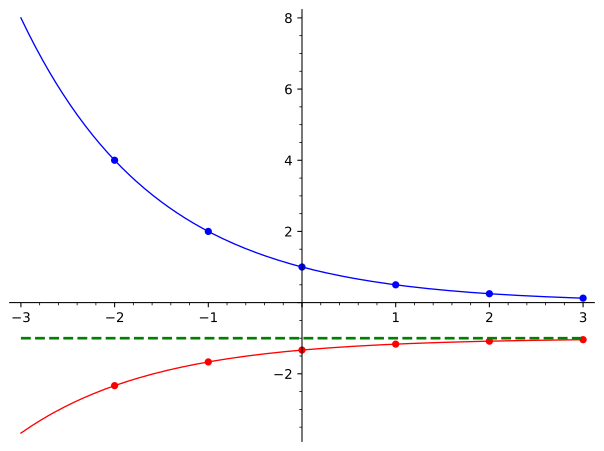
Let \(f(x)=2^{-x}\) and \(g(x)=-\frac{1}{3}2^{-x}-1\text{.}\)
Plot \(f\) and \(g\) on the same coordinate system.
Solution.
Note first that \(f(x)=2^{-x}=1/2^x=(1/2)^x\text{,}\) a basic exponential function whose graph we sketched in great detail in ExampleΒ 2.8.22. We obtain a graph of \(g\) by taking this graph, reflecting it over the \(x\)-axis, scaling vertically by \(1/3\text{,}\) and then shifting down by \(1\text{.}\) The resulting graph has a vertical asymptote at \(y=-1\text{.}\)
Graph of an exponential function and its transformation

Exercises Exercises

2.

Find a formula for \(P = f(t)\text{,}\) the size of the population that begins in year \(t = 0\) with \(2100\) members and decreases at a \(3.3\) % annual rate. Assume that time is measured in years.
\(P = f(t) =\)
Answer.
\(2100\cdot 0.967^{t}\)
Solution.
SOLUTION\(a=2100\text{.}\)\(r=-3.3\)\(= -0.033\text{,}\)\(b=1+r=0.967\text{.}\)\(P = 2100\cdot 0.967^{t}\text{.}\)

3.

(a) The annual inflation rate is \(3.4\)% per year. If a movie ticket costs $9.00 today, find a formula for \(p\text{,}\) the price of a movie ticket \(t\) years from today, assuming that movie tickets keep up with inflation.
\(P = f(t) =\)
(b) According to your formula, how much will a movie ticket cost in \(30\) years?
Answer 1.
\(9\cdot 1.034^{t}\)
Answer 2.
\(24.5391\)
Solution.
SOLUTION\(p\)\(p=ab^t\text{.}\)\(a=9.00\)\(b=1+r=1.034\text{.}\)\(p\)
\begin{equation*} p = 9.00(1.034)^t. \end{equation*}
\(30\)\(t=30\)\(p = 9.00(1.034)^{30} \approx 24.54\text{.}\)

4.

A population has size 5000 at time \(t = 0\text{,}\) with \(t\) in years.
(a) If the population decreases by 50 people per year, find a formula for the population, \(P\text{,}\) at time \(t\text{.}\)
\(P(t) =\)
(b) If the population decreases by 4% per year, find a formula for the population, \(P\text{,}\) at time \(t\text{.}\)
\(P(t) =\)
Answer 1.
\(5000-50t\)
Answer 2.
\(5000\cdot 0.96^{t}\)
Solution.
SOLUTION\(P(t) = 5000 - 50 t\text{.}\)\(P(t) = 5000 (1- 0.04)^t=5000(0.96)^t\)