SubsectionSide lengths of two special right triangles
Our in-depth study of the unit circle is motivated by our desire to better understand the behavior of circular functions. Recall that as we traverse a circle, the height of the point moving along the circle generates a function that depends on distance traveled along the circle. Wherever possible, we’d like to be able to identify the exact height of a given point on the unit circle. Two special right triangles enable us to determine precisely an important collection of points on the unit circle.
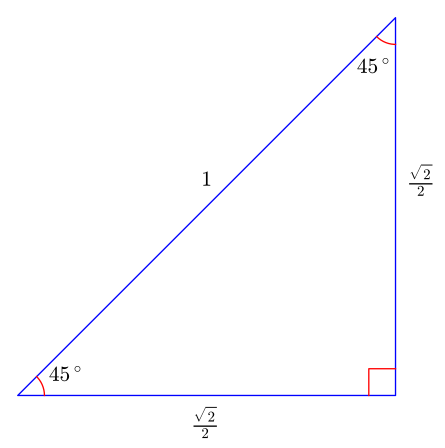
Let \(T\) be a triangle with angles 45,45, and 90 degrees. If the hypotenuse of \(T\) has length \(1\text{,}\) then the two remaining sides of \(T\) have length \(\sqrt{2}/2\text{.}\)
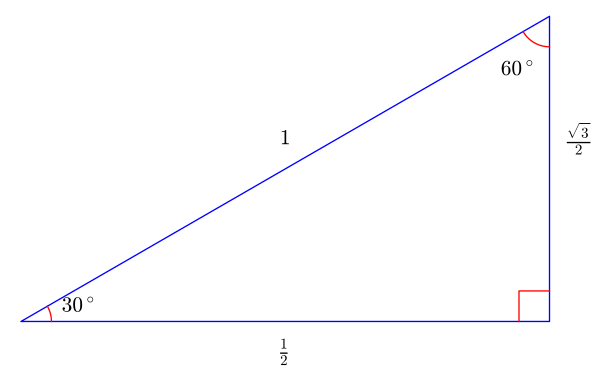
Let \(T\) be a triangle with angles 30,60, and 90 degrees. If the hypotenuse of \(T\) has length \(1\text{,}\) then the side of \(T\) opposite the 30-degree angle has length \(1/2\text{,}\) and the side of \(T\) opposite the 60-degree angle has length \(\sqrt{3}/2\text{.}\)
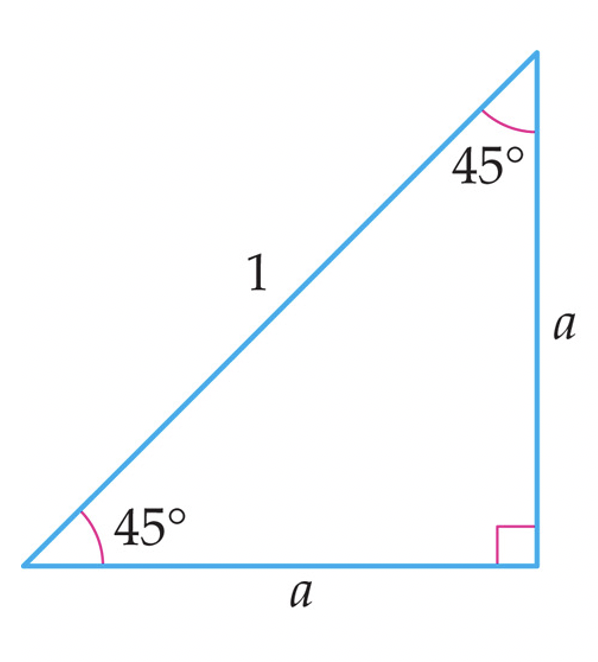
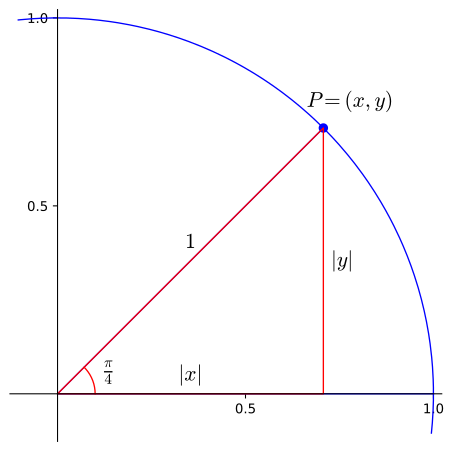
Let’s start with the 45-45-90 triangle. Suppose a right triangle with a hypotenuse of length 1 has two angles of 45 degrees. Then the triangle is an isosceles triangle; that is, its two legs have the same length \(a\text{,}\) as shown in Figure 2.17.3:
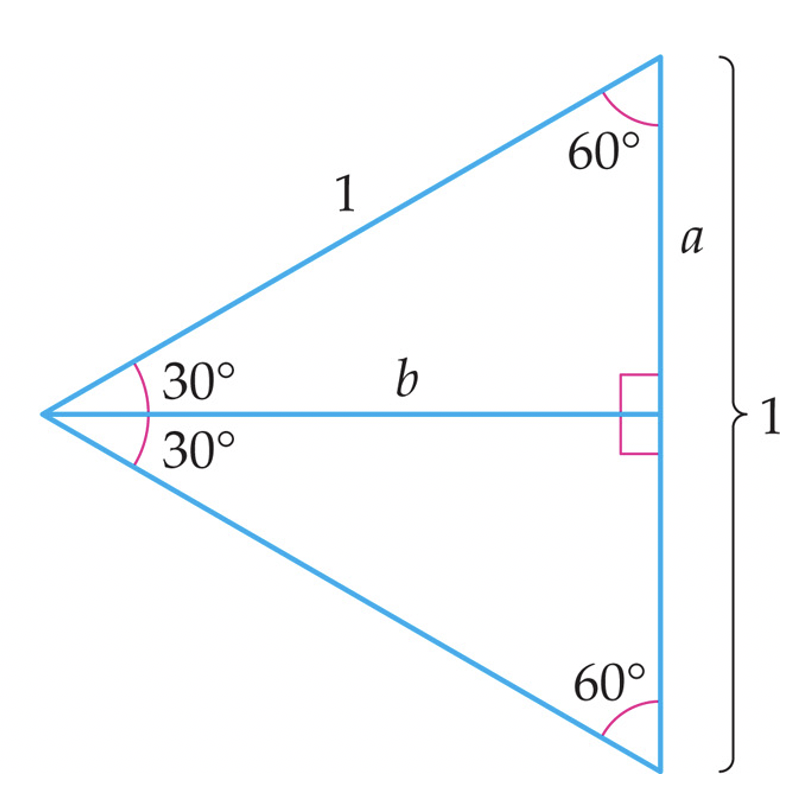
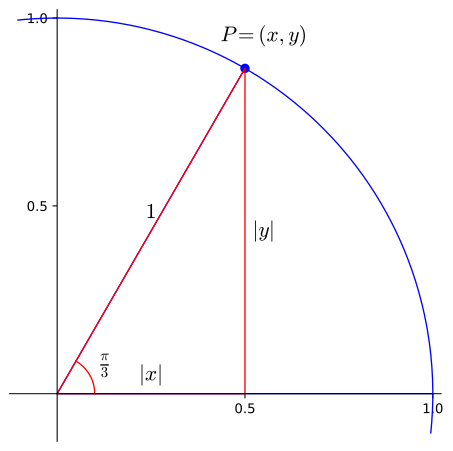
Now suppose that a right triangle has a hypotenuse of length 1, and angles of 30, 60, and 90 degrees. Let \(a\) be the length of the leg across from the 30-degree angle, and let \(b\) be the length of the leg across from the 60-degree angle. Two of these triangles together make the equilateral triangle in Figure 2.17.4 below:
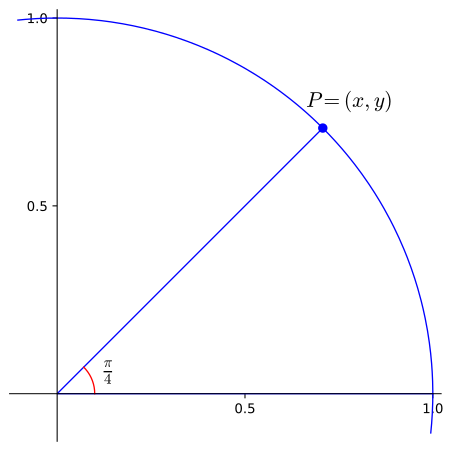
We now endeavor to use Theorem 2.17.1 to compute values of \(\cos\theta\) and \(\sin\theta\) for \(\theta=\pi/3, \pi/4, \pi/6\) radians (equivalently, \(\theta=30, 45, 60\) degrees). The method will be to add an appropriate right triangle to the unit circle picture described in Step 1 of Procedure 2.16.23.
The reference triangle will now allow us to determine the coordinates of the point \(P\text{.}\) Let’s see why. Note that the hypotenuse here has length 1, as it is a radius of the unit circle \(x^2+y^2=1\text{.}\) The two legs of the right triangle, on the other hand, have length equal to the magnitudes of the \(x\)- and \(y\)-coordinates of the point \(P=(x,y)\text{:}\) that is, \(\abs{x}\) and \(\abs{y}\text{,}\) respectively. In this case, since \(x\) and \(y\) are both positive, we happen to have \(\abs{x}=x\) and \(\abs{y}=y\text{.}\) Since the angle at the origin is \(\pi/4=45^\circ\text{,}\) it follows that we are working with a 45-45-90 triangle. We conclude that
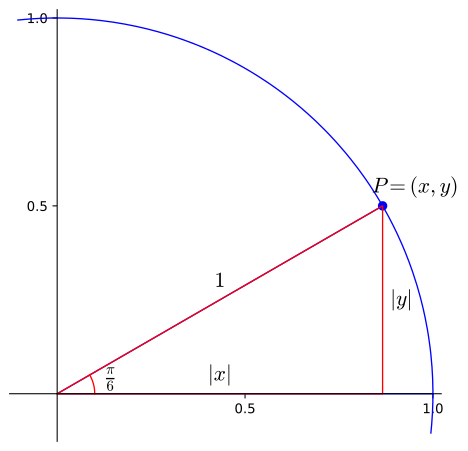
The same technique can be used for any angle that appears in one of our two special triangles. The angle \(\pi/6=30^\circ\text{,}\) for example, has unit circle picture as depicted below, where we have added a useful right triangle.
Since the angle of the right triangle at the origin is \(\pi/6=30^\circ\text{,}\) the angle at \(P\) is \(\pi/3=60^\circ\text{.}\) Using our knowledge of 30-60-90 triangles, we conclude
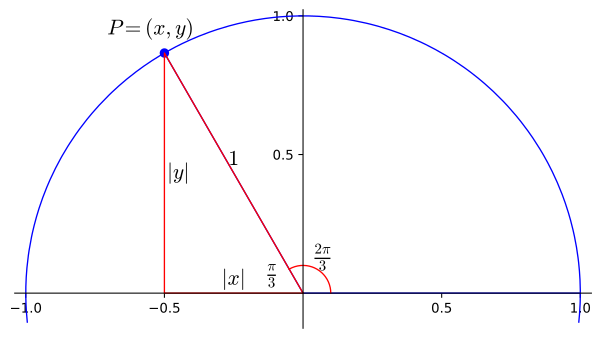
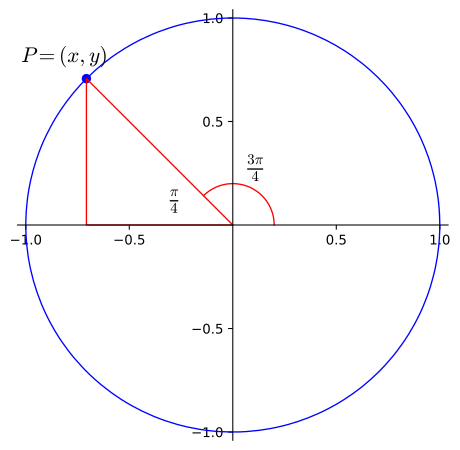
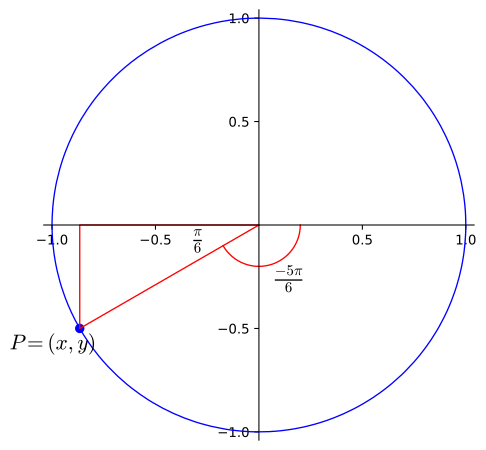
In the three examples above, since the point \(P=(x,y)\) resided in the first quadrant of the plane, both its coordinates were positive, and as a result the values of \(\cos\) and \(\sin\) were also positive. When the angle \(\theta\) is such that \(P\) lies in any other coordinate, we need to take account of the sign the coordinates of \(P\text{.}\) Consider \(\theta=5\pi/6=150^\circ\text{.}\) The unit circle with right triangle picture of this angle is shown below.
The angle of our right triangle is \(\pi/3=\pi-2\pi/3\text{,}\) or \(30\) degrees, making the angle at \(P\) equal to 60 degrees. We thus have a 30-60-90 triangle, and conclude that
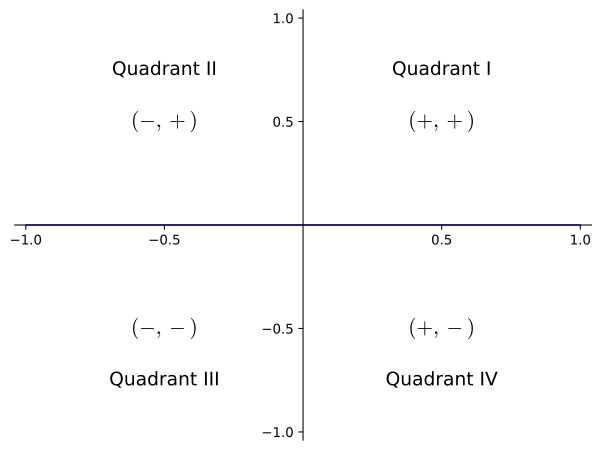
This example makes clear the important difference between the values of the coordinates (\(x\) and \(y\)), and their magnitudes (\(\abs{x}\) and \(\abs{y}\)). We label the sides of the triangles with the magnitudes because these give the lengths of the sides. However, the outputs of \(\cos\) and \(\sin\) are the actual coordinate values themselves, and not just their magnitudes. Since these values can be positive or negative as the point \(P\) makes its way around the unit circle, we need to take careful account of the signs when computing values of \(\cos\) and \(\sin\text{.}\) The diagram in Figure 2.17.5 is a useful schema for this type of sign accounting.
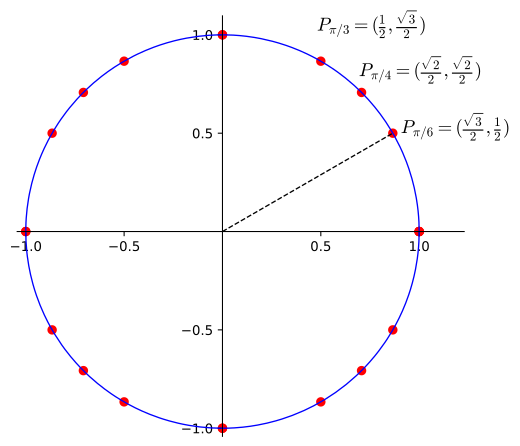
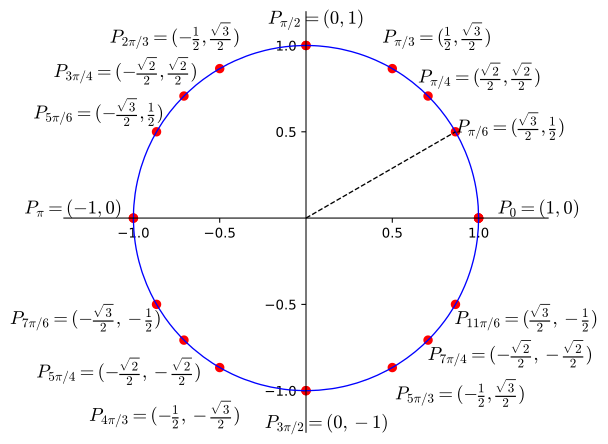
In the diagram below we have specified the coordinates of the three points \(P_\theta\) on the unit circle corresponding to the angles \(\theta=\pi/6, \pi/4, \pi/3\text{,}\) as computed in the examples above.
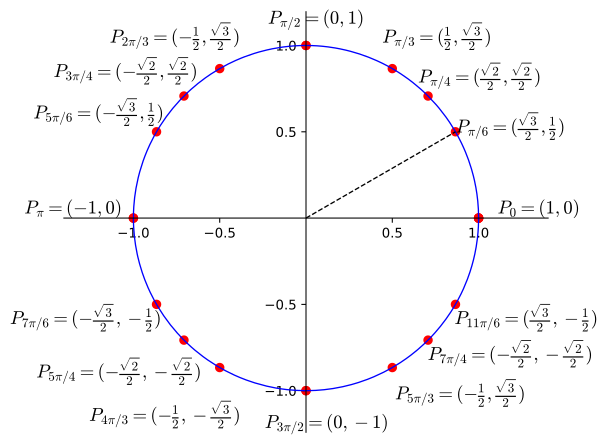
Use symmetry to complete the diagram. In more detail, label each of the remaining points as \(P_\theta\text{,}\) where \(\theta\) indicates the radian measure of the central angle corresponding to the point, and provide explicit coordinates for each point.
SubsectionComputing with angles \(\theta\) outside of \([0,2\pi]\)
You may have noticed that all of our examples of computations of \(\cos\theta\) and \(\sin\theta\) involved angles \(\theta\) between \(0\) and \(2\pi\text{.}\) And yet, by definition of these functions, \(\theta\) is allowed to be any real number. How dow we compute these values values of \(\cos\) and \(\sin\) for \(\theta=35\pi/2\text{,}\) or \(\theta=-100\pi/3\text{?}\)
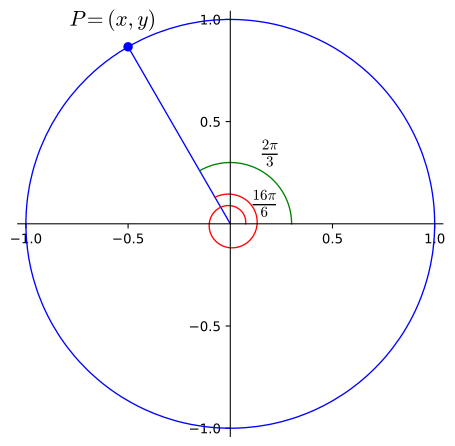
Since \(\theta\) is between \(2\pi\) and \(4\pi\text{,}\) we visualize \(\theta\) as an angle that makes a one full rotation around the unit circle (\(2\pi\)) followed by some extra rotation between \(0\) and \(2\pi\text{.}\) Algebraically, we identify this extra rotation by expressing \(\theta\) as follows:
It follows that the terminal edge of the angle \(\theta=16\pi/6\text{,}\) is the same as the terminal edge of the angle \(2\pi/3\text{.}\) Graphically, we indicate the angle \(\theta\) as a counterclockwise spiralling arc ending at the terminal edge corresponding to \(2\pi/3\text{.}\)
Since the angles \(16\pi/6\) and \(2\pi/3\) have the same terminal edge, the associated point \(P=(x,y)\) on the unit circle for each angle is the same. Thus we have
Two angles are called coterminal if they have the same terminal edge. The technique above can be summarized as follows: to compute \(\cos\theta\) and \(\sin\theta\) for an arbitrary angle \(\theta\text{,}\) find a “covenient” angle \(\alpha\) that is coterminal with \(\theta\text{,}\) in which case
A “convenient” angle usually means an angle \(\alpha\) (positive or negative) with \(\abs{\alpha}\in [0,2\pi]\text{,}\) since these angles are the most familiar to us. The algebraic trick to finding such a convenient coterminal angle is to locate the arbitrary angle \(\theta\) between two consecutive multiples of \(2\pi\text{,}\) and choose \(\alpha\) to be the difference between \(\theta\) and either one of these multiples.
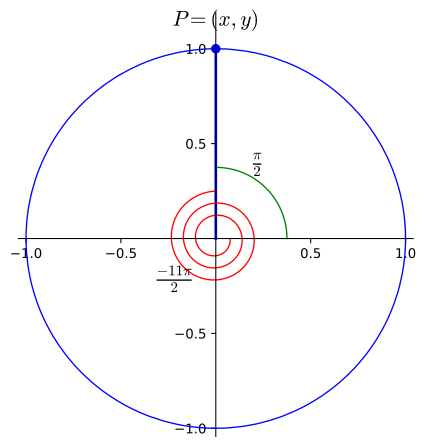
Let’s try this with a large negative angle. Consider \(\theta=-11\pi/2\text{.}\) Identifying the nearest multiples of \(2\pi\) to the left and right of \(-11\pi/2\text{,}\) we see that
The last equation tells us that the angle \(\theta=-11\pi/2\) is the result of taking 2 full clockwise rotations around the circle (the \(-4\pi\) term), followed by an extra clockwise rotation of \(3\pi/2\) (the \(-3\pi/2\) term). As illustrated below, the angle of \(-3\pi/2\) is coterminal in turn to the angle \(\pi/2\text{.}\)
Procedure2.17.9.Computing trigonometric values by hand.
Let \(\theta\in \R\text{.}\) To compute \(\cos\theta\) and \(\sin\theta\) by hand, proceed as follows.
Find convenient coterminal angle.
Find an angle \(\alpha\) with \(\abs{\alpha}\in [0,2\pi]\) such that \(\theta=2\pi n +\alpha\) for some \(n\text{.}\) The angles \(\theta\) and \(\alpha\) are coterminal.
Make a unit circle picture of the coterminal angles \(\theta\) and \(\alpha\) that inludes the point \(P\) where the terminal edge intersects the unit circle.
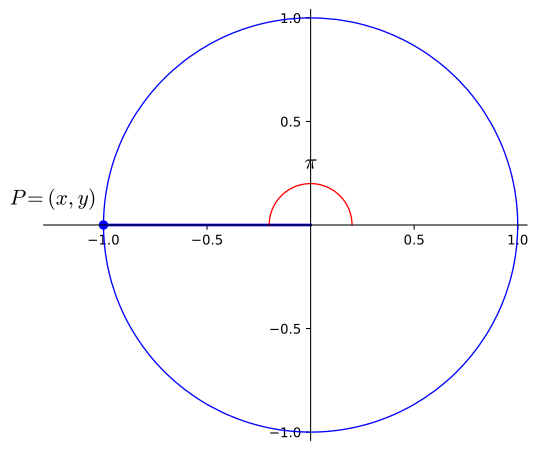
These equations tell us that \(\theta\) is coterminal to \(-\pi\) and \(\pi\text{.}\) We can use either one of these angles to compue compute \(\cos\theta\text{.}\) We choose \(\pi\text{:}\)
Remark2.17.12.Computing values of \(\cos\) and \(\sin\) by hand.
In order to complete \(\cos\) and \(\sin\) computation using Procedure 2.16.23, we need the reference triangles introduced to have side lengths that we can compute by hand. This means that, for the moment we are only able to compute \(\cos\theta\) and \(\sin\theta\) by hand for angles \(\theta\) that are coterminal with one of the sixteen angles included in Figure 2.17.13. We will refer to these angles as the familiar angles. If in Step 1 of Procedure 2.16.23 we find that \(\theta\) is coterminal to an angle \(\alpha\) that is not one of these familiar angles, then (at the moment) we are not able to compute \(\cos\theta\) and \(\sin\theta\) by hand.
For example, the angle \(\theta=1\) (measured in radians) lies within the interval \([0,2\pi]\text{.}\) But clearly \(1\) is not equal to any of the familiar angles in Figure 2.17.13, and thus we are not able to give a simple explicit expression for \(\cos 1\) and \(\sin 1\) by hand. Of course, it is possible use technology to estimate such values with a decimal approximation: e.g.,
This means that if we were to add the point \(P_1\) for \(\theta=1\) to the unit circle picture in Figure 2.17.13, it would be located between \(P_{\pi/4}\) and \(P_{\pi/3}\text{.}\) But then, for example, the \(x\)-coordinate of \(P_1\) would be greater than the \(x\)-coordinate of \(P_{\pi/3}\) and less than the \(x\)-coordinate of \(P_{\pi/4}\text{.}\) Since the value of \(\cos\) at these angles is equal to this \(x\)-coordinate, we conclude that