Section 2.4 Monotonicity and first derivative test

Definition 2.4.1. Increasing, decreasing, monotonic.

Assume \(f\) is defined on the interval \(I\text{.}\)
  • \(f\) is increasing on \(I\) if \(a< b\) implies \(f(a)< f(b)\) for all \(a,b\in I\text{.}\)
  • \(f\) is decreasing on \(I\) if \(a< b\) implies \(f(a)> f(b)\) for all \(a,b\in I\text{.}\)
  • \(f\) is monotonic on \(I\) if it is either increasing on \(I\) or decreasing on \(I\text{.}\)

Proof.

Statement (1) is identical to CorollaryΒ 2.2.5, which we have already proved.
The proofs of (2) and (3) are nearly identical. We prove (2). Assume \(f'(x)> 0\) for all interior points \(x\in I\text{.}\) Suppose \(a,b\in I\) satisfy \(a< b\text{.}\) Since the function \(f\) is continuous on \([a,b]\) and differentiable on \((a,b)\text{,}\) the mean value theorem implies
\begin{equation*} f'(c)=\frac{f(b)-f(a)}{b-a} \end{equation*}
for some \(c\in (a,b)\text{.}\) But then, after a little algebra, we see that
\begin{equation*} f(b)=f'(c)(b-a)+f(a)> f(a)\text{,} \end{equation*}
since \(f'(c)> 0\) by assumption. Thus we have shown
\begin{equation*} a< b\implies f(a)< f(b) \end{equation*}
for all \(a,b\in I\text{.}\) In other words, \(f\) is increasing on \(I\text{.}\)
Before putting TheoremΒ 2.4.2 to good analytic work on some example functions, we first illustrate that we cannot apply the theorem if the underlying set is not an interval.

Example 2.4.3. Monotonicity: reciprocal.

Let \(f(x)=\frac{1}{x}\) with domain \(D=\R-\{0\}\text{.}\) Observe that \(f'(x)=-1/x^2\) is negative for all \(x\in D\text{.}\) However it is not true that \(f\) is decreasing on its entire domain \(D\text{:}\) indeed, we have \(-1< 1\text{,}\) and yet \(-1=f(-1)\not> f(1)=1\text{.}\)
What went wrong here? Why couldn’t we apply TheoremΒ 2.4.2? The answer is that \(D\) is not an interval! In fact we have
\begin{equation*} D=\underset{I_1}{(-\infty, 0)}\cup \underset{I_2}{(0,\infty)}\text{,} \end{equation*}
a union of two intervals. We are permitted to apply TheoremΒ 2.4.2 to \(I_1\) and \(I_2\) separately to conclude that \(f\) is decreasing on each of these intervals, but this does not imply that it is increasing on their union.
According to TheoremΒ 2.4.2 determining the sets on which a function \(f\) is increasing/decreasing essentially amounts to solving the inequalities \(f'(x)> 0\) and \(f'(x)< 0\text{.}\) This is most efficiently done using a sign diagram of \(f'\text{,}\) as illustrated in the next example and defined more precisely in ProcedureΒ 2.4.5.

Example 2.4.4. Monotonicity: polynomial.

Let \(f(x)=3x^5-5x^3\text{.}\) Find all intervals where \(f\) is increasing, and all intervals where \(f\) is decreasing.
Solution.
We compute
\begin{equation*} f'(x)=15x^4-15x^2=15x^2(x^2-1)=15x^2(x-1)(x+1)\text{.} \end{equation*}
Since \(f'\) is continuous, and since \(0,1,-1\) are the only roots of \(f'\text{,}\) the intermediate value theorem implies that \(f'\) is either always positive or always negative on each of the resulting intervals \((-\infty,-1),(-1,0),(0,1),(1,\infty)\text{.}\) This means we can determine the sign of \(f'\) on each interval by evaluating it at one test point. It is easy to see that
\begin{align*} f'(-2) \amp > 0\\ f'(-1/2) \amp < 0 \\ f'(1/2) \amp < 0\\ f'(2) \amp > 0\text{.} \end{align*}
Thus the sign of \(f'\) for various portions of the real line is described by the following sign diagram.
Sign diagram for derivative of f
Note that underneath the information about the sign of \(f'\text{,}\) we have indicated the implied increasing/decreasing behavior of \(f\text{.}\)
From the sign diagram we conclude that \(f\) is increasing on the intervals \((-\infty, -1]\) and \([1,\infty)\text{,}\) and decreasing on the interval \([-1,1]\text{.}\)
Let’s give a formal description of the technique used in the example above.

Example 2.4.8. Classifying critical points: polynomial.

Let \(f(x)=3x^5-5x^3\text{.}\) Find all critical points of \(f\text{,}\) and for each critical point \(a\) classify \(f(a)\) as a local maximum value of \(f\text{,}\) a local minimum value of \(f\text{,}\) or neither.
Solution.
In the course of the sign diagram from ExampleΒ 2.4.4 we saw that \(x=-1,0,1\) were the critical points of \(f\text{.}\) Since the sign of \(f'\) switches from positive to negative at \(-1\text{,}\) \(f(-1)\) is a local maximum value of \(f\text{;}\) since the sign of \(f'\) switches from negative to positive at \(1\text{,}\) \(f(1)\) is a local minimum value of \(f\text{.}\) Since \(f'(x)\ne 0\) for \(x\) close to \(0\) and since the sign of \(f'\) does not switch at \(x=0\text{,}\) we see that \(f(0)\) is neither a local maximum nor a local minimum value.

Example 2.4.9. Monotonicity and critical points: rational.

Let \(f(x)=\tfrac{x^2+10x+1}{x-2}\text{.}\)
  1. Find all critical points of \(f\text{,}\) and for each critical point \(a\) classify \(f(a)\) as a local maximum value of \(f\text{,}\) a local minimum value of \(f\text{,}\) or neither.
  2. Apply ProcedureΒ 2.4.7 to find the intervals of monotonicity of \(f\text{.}\)
Solution.
First observe that the domain of \(f\) is \(D=\R-\{2\}\text{.}\)
  1. The derivative of \(f\) is
    \begin{equation*} f'(x)=\frac{x^2-4x-21}{(x-2)^2}=\frac{(x-7)(x+3)}{(x-2)^2}\text{.} \end{equation*}
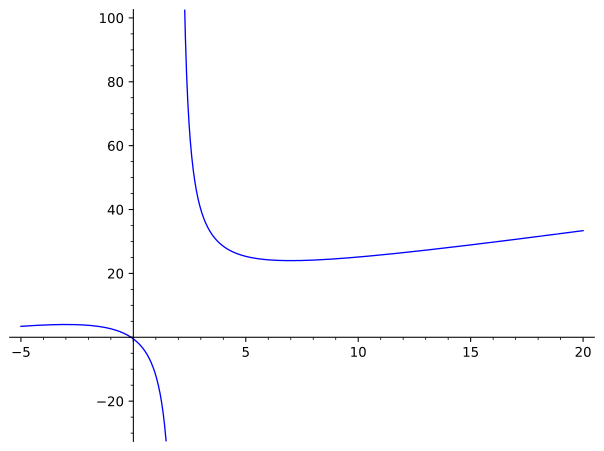
    From the formula for \(f'\) we see that \(f\) is differentiable everywhere, and thus that its only critical points are the solutions to \(f'(x)=0\text{.}\) From the factorization of the numerator, we see easily that \(x=7\) and \(x=-3\) are the critical points of \(f\text{.}\) To classify these critical points we produce a sign diagram of \(f'\text{.}\)
    From the sign diagram, we see that \(f\) has a loca maximum value at \(x=-3\) and a local minimum value at \(x=7\text{.}\)
  2. The sign diagram above further reveals that \(f\) is increasing on the intervals \((-\infty, -3)\) and \((7,\infty)\text{,}\) and decreasing on the intervals \((-3,2)\) and \((2,7)\text{.}\)
Our analysis above is born out by the graph of \(f\) given below.
Graph of rational function f

Example 2.4.10. Monotonicity and critical points: radical.

Let \(f(x)=x\, \sqrt{7-x^2}\text{.}\) Find all critical points of \(f\text{,}\) and for each critical point \(a\) classify \(f(a)\) as a local maximum value of \(f\text{,}\) local minimum value of \(f\text{,}\) or neither.
Solution.
Note first that the implied domain \(D\) of \(f\) is
\begin{equation*} D=\{x\in \R\colon 7-x^2\geq 0\}=\{x\in \R\colon -\sqrt{7}\leq x\leq \sqrt{7}\}=[-\sqrt{7},\sqrt{7}]\text{.} \end{equation*}
Following ProcedureΒ 2.4.7, we first determine the critical points of \(f\text{.}\) Note first that in this case \(f\) is not differentiable at \(\pm \sqrt{7}\text{,}\) making these critical points. Next, for all \(x\ne \pm \sqrt{7}\text{,}\) we compute \(f'(x)\) using the product and chain rules:
\begin{align*} f'(x) \amp =\sqrt{7-x^2}-\frac{x^2}{\sqrt{7-x^2}} \\ \amp =\frac{1}{\sqrt{7-x^2}}(7-x^2-x^2)\\ \amp \frac{7-2x^2}{\sqrt{7-x^2}}\text{.} \end{align*}
It follows that we have \(f'(x)=0\) if and only if \(7-2x^2=0\text{,}\) or equivalently, \(x=\pm \sqrt{7/2}\text{.}\) We conclude that there are in total four critical points: \(x=\pm \sqrt{7}\) (where \(f\) is not differentiable), and \(x=\pm\sqrt{7/2}\text{.}\)
Sign diagram for derivative of example function
This diagram was the result of the following test point evaluations of \(f'\text{:}\)
\begin{align*} f'(-2) \amp = -\frac{1}{\sqrt{3}}< 0 \\ f'(0) \amp = \frac{7}{\sqrt{7}}> 0\\ f'(2) \amp = -\frac{1}{\sqrt{3}}< 0 \text{.} \end{align*}
Note that \(\sqrt{7/2}< 2< \sqrt{7}\text{.}\)
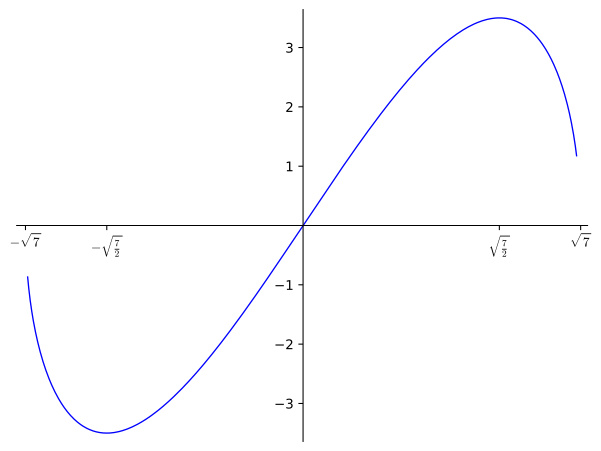
We conclude that \(f(-\sqrt{7})\) and \(f(\sqrt{7/2})\) are local maximum values, and \(f(-\sqrt{7/2}\) and \(f(\sqrt{7}\) are local minimum values. These conclusions are verified by the actual graph of \(f\text{.}\)
Graph of the original function of the example
Figure 2.4.11. Graph of \(f(x)=x\, \sqrt{7-x^2}\)