SubsectionThe natural exponential function and its derivative
Our previous investigation into exponential functions yields some valuable qualitative information about their derivatives, as we now summarize. Let \(f(x)=b^x\text{.}\)
Exponential growth: \(b> 1\).
If \(b> 1\text{,}\) then \(f\) is an increasing function on \(\R\text{,}\) and hence \(f'(x)> 0\) for all \(x\in \R\text{.}\)
Moreover, since \(f\) is concave up on \(\R\text{,}\) we have \(f''(x)> 0\) for all \(x\in \R\text{,}\) and thus \(f'\) is positive and gets more positive as \(x\) increases. This last quality can be also be seen as a consequence of the fact that exponential growth functions model percent growth: for each input \(x\text{,}\) the rate at which \(f\) is growing is proportional to its current value \(f(x)=b^x\text{.}\)
Similar reasoning shows that if \(0 < b < 1\text{,}\) then because \(f\) is a decreasing and concave up function on \(\R\text{,}\) we have \(f'(x)< 0\) and \(f''(x)> 0\) for all \(x\in \R\text{,}\) which means \(f'\) is negative but becomes less negative as \(x\) increases.
Thus, qualitatively we have a good grip on \(f'(x)\) for an exponential function \(f(x)=b^x\text{.}\) But can we derive an actual derivative formula? Recall that exponential functions \(f(x)=b^x\text{,}\) where the input variable appears in the exponent, are not to be confused with power functions \(g(x)=x^r\text{,}\) where the input appears in the base. In particular, we cannot make use of the power rule \(g'(x)=rx^{r-1}\) to differentiate an exponential function \(f(x)=b^x\text{.}\) As such we must rely on the limit definition of the derivative. Let’s see how far we get with this. We have
Interesting! Note that \(b^x\) is just \(f(x)\text{,}\) and the remaining limit expression in the last line is precisely \(f'(0)\text{,}\) assuming the limit actually exists. As such, assuming the derivative exists, we conclude that
Let’s reflect a moment on what this discovery means. Setting \(f'(0)=c\) for some \(c\in \R\text{,}\) we see that \(f'(x)=cf(x)\text{.}\) In terms of rate of change language, this means that the rate of change \(f'\) is proportional to the current value \(f(x)\text{.}\) This is exactly as we expected from our percent growth interpretation of the exponential function!
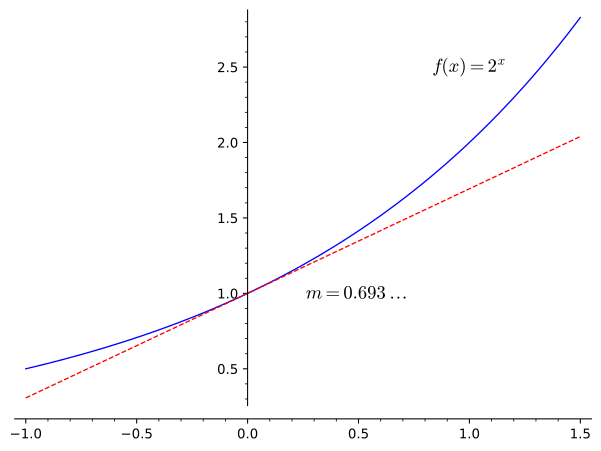
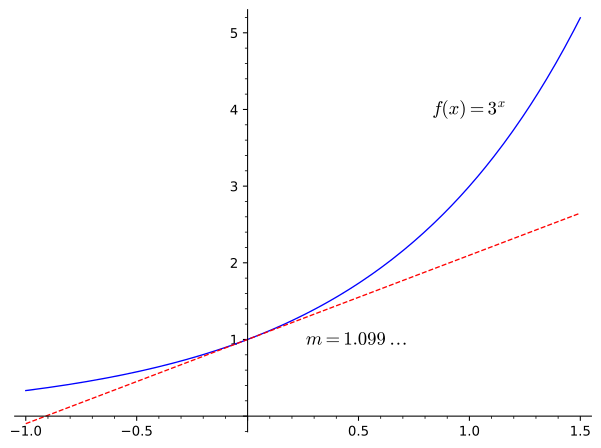
is not one we can analytically compute with tools currently at our disposal. We can, however, estimate its value for various choices of base \(b\text{.}\) We do so below for the choices \(b=2\) and \(b=3\text{.}\)
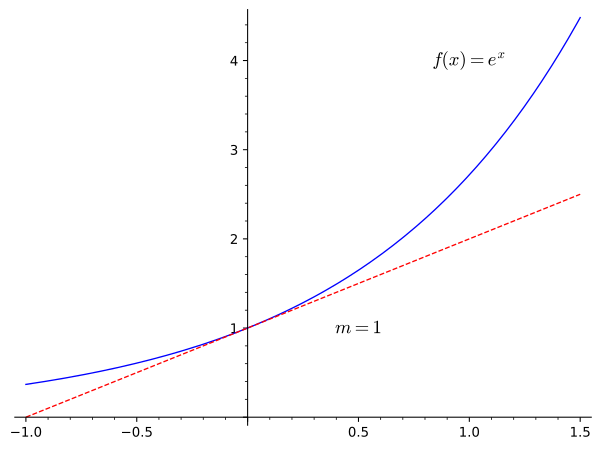
So far this is pretty mysterious. Recall that, assuming that the limits exist, we have \(\lim\limits_{h\to 0}\frac{b^h-1}{h}=f'(0)\text{,}\) where \(f(x)=b^x\text{.}\) Graphically speaking, this value represents the slope of the tangent line to the graph of \(f\) at the point \((0,1)\text{.}\) For \(b=2\) this slope is approximately \(0.693\text{,}\) a little less than one. It is no surprise that for \(b=3\) the slope at \(x=0\) is larger, approximately \(1.099\text{,}\) since we have seen already that as we increase \(b\text{,}\) the graph of the exponential function \(f(x)=b^x\) gets steeper at each point. This suggests that perhaps there is a base \(b\) between \(2\) and \(3\) for which the corresponding exponential function \(f(x)=b^x\) satisfies \(f'(0)=1\text{.}\) And indeed there is such a base \(b\text{:}\) this mysterious number is called \(e\) and has approximate value \(e\approx 2.71828\text{.}\)
The real number \(e\) is named in honor of the great Swiss mathematician Leonard Euler (1707-1783). Like \(\pi\text{,}\)\(e\) is an irrational number that cannot be written as a ratio of integers, and whose decimal expansion never repeats. Of its many remarkable properties, the one that is of most value to us is its connection to exponential functions \(f(x)=b^x\text{.}\) Namely, since we showed earlier that
Interestingly, the derivative formula for \(f(x)=e^x\) is so simple, that sometimes the need to use the chain rule is obscured. Accordingly, we add a chain rule-enhanced version of the exponential derivative formula.
It is not difficult to generalize our base-\(e\) exponential derivative formula to arbitrary bases \(b\text{.}\) This is done by first observing that for any \(b> 0\text{,}\) we have \(b=e^{k}\text{,}\) where \(k=\log_e b\text{,}\) and thus
Because the notation for the natural logarithm is significantly different from the standard \(\log_b\) notation, we will do well to make note of what the various logarithmic identities mean in terms of \(\ln=\log_e\text{.}\) We collect them all below.
The slope of the tangent line to the graph of \(f\) at a point \((a,f(a))\) is given by \(f'(a)=\ln(2) 2^a\text{.}\) To find \(a\) where this slope is equal to \(3\text{,}\) we thus solve \(\ln(2)2^{a}=3\text{:}\)
Certain pieces of antique furniture increased very rapidly in price in the 1970s and 1980s. For example, the value of a particular rocking chair is well approximated by
\begin{equation*}
V = 70 (1.6)^t,
\end{equation*}
where \(V\) is in dollars and \(t\) is the number of years since 1975. Find the rate, in dollars per year, at which the price is increasing.