In order to derive continuity and derivative results for the trigonometric functions, we will need to make use of a somewhat technical limit rule called the squeeze theorem. We will often reach for this tool in situations where our basic limit rules might not suffice to compute a given limit is when the function \(f\) in question is unreasonably complicated, making its behavior near a point difficult to pin down. The squeeze theorem potentially gives a technique for getting around this issue. You can think of it as a means of replacing the complicated function \(f\text{,}\) whose behavior is a mystery to us, with two simpler “bounding” functions \(g\) and \(h\text{,}\) whose behavior we understand. It is called the squeeze theorem as the necessary inequality \(g(x)\leq f(x)\leq h(x)\) has \(f\) “squeezed” between the functions \(g\) and \(h\text{.}\)
Fix a point \(a\in \R\) and suppose that functions \(f,g,h\) satisfy \(g(x)\leq f(x)\leq h(x)\) for all \(x\ne a\) lying in an open interval containing \(a\text{.}\) If
This theorem, like the other limit rules we have discussed, can be proved in a straightforward manner using Definition 1.14.1, the epsilon-delta definition of the limit.
Making use of the sandwich theorem requires carrying out a number of steps (with justification). The following procedure will be useful for doing this in an organized manner.
As the examples below will illustrate, the art of using Procedure 2.20.2 lies in being able to find useful bounding functions \(g\) and \(h\text{.}\) Use these examples as a model for your own use of Procedure 2.20.2. Note in particular how
the explanations make explicit the two conditions that the bounding functions must satisfy;
giving the bounding functions names (e.g., \(g\) and \(h\)), as opposed to just providing formulas (e.g., \(1-x^2/4\text{,}\)\(1+x^2/4\)), makes these explanations more concise.
We follow the steps of Procedure 2.20.2. In this case our bounding functions \(g(x)=1-x^2/4\) and \(h(x)=1+x^2/4\) are provided for us, making life much easier. By assumption our mystery function \(f\) satisfies
for all \(x\ne 0\text{.}\) Since \(x^2\geq 0\) for all \(x\text{,}\) the inequalities in (2.97) still hold after multiplying each expression by \(x^2\text{:}\) that is
The next result is a useful consequence of the squeeze theorem that can be used in the special case where we want to show \(\lim\limits_{x\to a}f(x)=0\) for some function \(f\text{.}\)
The first implication follows almost immediately from the epsilon-delta definition of the limit. If \(\lim\limits_{x\to a}f(x)=0\text{,}\) then for all \(\epsilon > 0\text{,}\) there is a \(\delta> 0\) such that
Now consider the second implication. We will assume \(\lim\limits_{x\to a}\abs{f(x)}=0\) and prove that \(\lim\limits_{x\to a}f(x)=0\) using the squeeze theorem. Recall that for any \(b\in \R\) we have \(-\abs{b}\leq b\leq \abs{b}\text{.}\) It follows that
We use the sandwich theorem to prove this limit formula. Our choice of bounding functions will rely on an important inequality involving the sine function: namely
for all \(\theta\in \R\text{.}\) The proof of this inequality (given at the end of this section) is nontrivial, but also instructive: it appeals to some of the unit circle geometry that goes into the definition of the trigonometric functions. In any case, we will simply assume (2.100) holds for the purpose of this proof. With that in place, our result is an easy consequence of the sandwich theorem. Indeed, setting \(g(\theta)=-\abs{\theta}\) and \(h(\theta)=\abs{\theta}\text{,}\) we have
As promised in the proof of Theorem 2.20.7, we provide a proof of the inequality \(-\abs{\theta}\leq \sin \theta\leq \abs{\theta}\text{,}\) or equivalently, \(\abs{\sin \theta}\leq \abs{\theta}\) for all \(\theta\in \R\text{.}\) You are not responsible for understanding this proof, but you might find the argument instructive nonetheless.
Thus the function \(f(\theta)=\abs{\sin \theta}\) is even. Since \(g(\theta)=\abs{\theta}\) is also even, it suffices to prove (2.101) for all \(\theta\geq 0\text{.}\) Furthermore, since
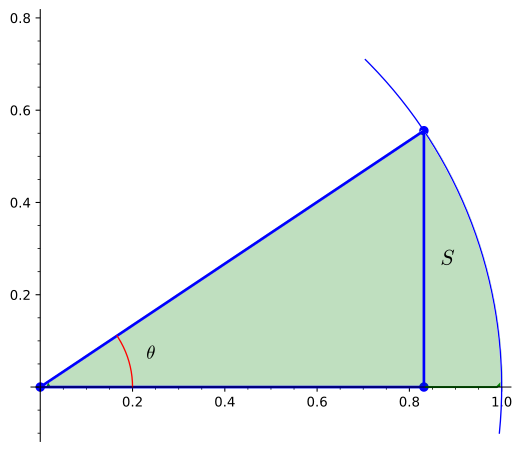
and since \(\sin(0)=0\text{,}\) it suffices to show (2.101) for all \(\theta\in (0,\pi/2)\text{.}\) To this end, take any \(\theta\in (0,\pi/2)\) and consider the usual reference triangle \(T\) for the central angle \(\theta\text{.}\) As shown below \(T\) lies completely within the interior \(S\) of the angle \(\theta\text{.}\)
Elementary trigonometry tells us that \(\operatorname{area} T=\frac{1}{2}\sin \theta\text{;}\) elementary geometry tells us that \(\operatorname{area} S=\pi\cdot \frac{\theta}{2\pi}=\frac{\theta}{2}\text{.}\) We conclude that
Since \(\sin(0)=0\) and \(\cos(0)=1\text{,}\) the limit equalities of Theorem 2.20.7 can be reinterpreted as follows:
\begin{align*}
\lim\limits_{x\to 0}\sin x \amp =\sin(0) \\
\lim\limits_{x\to 0}\cos x \amp = \cos(0) \text{.}
\end{align*}
In other words, \(\sin\) and \(\cos\) are both continuous at \(x=0\text{.}\) Amazingly, with the help of the sum and difference identities stated below, we will be able to deduce that \(\sin\) and \(\cos\) are continuous at all inputs \(a\text{.}\)
With these identities in hand we will prove that \(\lim_{x\to a}\sin x=\sin(a)\) and \(\lim\limits_{x\to a}\cos(x)=\cos(a)\) using the following trick: for any function \(f\text{,}\) we have \(\lim\limits_{x\to a}f(x)=\lim\limits_{x\to 0}f(x+a)\text{.}\) We now compute our two limits simultaneously:
\begin{align*}
\lim\limits_{x\to a}\sin x \amp = \lim\limits_{x\to 0}\sin(x+a) \amp \lim\limits_{x\to a}\cos x \amp = \lim\limits_{x\to 0}\cos(x+a)\\
\amp = \lim\limits_{x\to 0}\sin x\cos a + \cos x\sin a \amp \amp = \lim\limits_{x\to 0}\cos x\cos a - \sin x\sin a \\
\amp = \sin(0)\cos(a)+\cos(0)\sin(a) \amp \amp = \cos(0)\cos(a)-\sin(0)\sin(a) \\
\amp = \sin(a) \amp \amp = \cos(a) \text{.}
\end{align*}
We have thus shown that \(\cos\) and \(\sin\) are continuous on their entire domain. Since the remaining trigonometric functions are defined as quotients and reciprocals of these two functions, we see that all of the trigonometric functions are continuous.
Lastly, we treat differentiability of the trigonometric functions. Not surprisingly, the situation here is as good as could be hoped for: the trigonometric functions are differentiable everywhere on their domain. We begin with \(\cos\) and \(\sin\text{.}\)
The tangent line to a point \(P=(x,f(x))\) on the graph of \(f\) is horizontal when its slope \(f'(x)=0\text{.}\) Thus we need to find all \(x\) such that
\begin{equation*}
x=\frac{3\pi}{4}+\pi n,
\end{equation*}
where \(n\) is an integer. The corresponding points on the graph are
\begin{equation*}
P=\left(\frac{3\pi}{4}+\pi n, f\left(\frac{3\pi}{4}+\pi n\right)\right)
= \begin{cases}
\left(\frac{3\pi}{4}+\pi n, -\sqrt{2}\right) \amp \text{if } n \text{ is even}\\
\left(\frac{3\pi}{4}+\pi n, \sqrt{2}\right) \amp \text{if } n \text{ is odd}\\
\text{.}\end{cases}
\end{equation*}
Example2.20.13.Curve sketching with trigonometric functions.
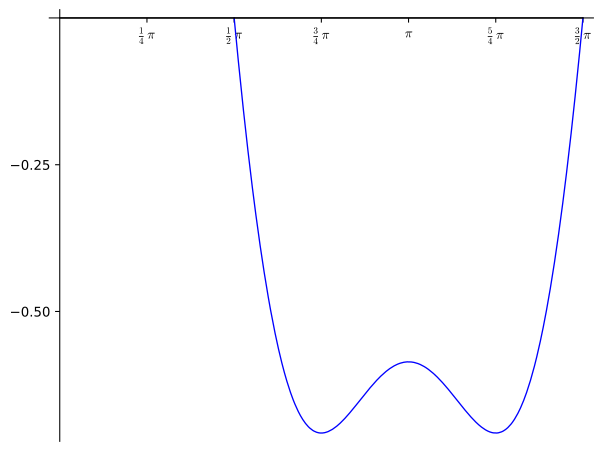
Let \(f(x)=2\cos x+\sqrt{2}\cos^2 x\) and let \(I=[\pi/2, 3\pi/2]\text{.}\)
Find all critical points of \(f\text{,}\) and for each critical point \(a\) classify \(f(a)\) as a local maximum value of \(f\text{,}\) a local minimum value of \(f\text{,}\) or neither.
Since \(f\) is differentiable everywhere, critical points of \(f\) are solutions to \(f'(x)=0\text{.}\) We thus solve:
\begin{align*}
f'(x) \amp =0\\
-2\sin x(1+\sqrt{2}\cos x) \amp = 0\\
\sin x =0 \amp\text{ or } 1+\sqrt{2}\cos x=0 \\
\sin x =0 \amp \text{ or } \cos x=-\frac{1}{\sqrt{2}} \text{.}
\end{align*}
We have \(\sin x=0\) if and only if \(x=\pi n\) for some integer \(n\in \Z\text{.}\) Only one of these solutions lies in \(I=[\pi/2,3\pi /2]\text{:}\) namely, \(x=\pi\text{.}\) Next, observing that \(1/\sqrt{2}=\sqrt{2}/2\text{,}\) and recalling facts about the unit circle, we see that \(x\) solves \(\cos x=-1/\sqrt{2}=-\sqrt{2}/2\) if and only if
\begin{equation*}
x=\frac{3\pi }{4}+2\pi n \text{ or } x=\frac{5\pi }{4}+2\pi n
\end{equation*}
for some integer \(n\in \Z\text{.}\) There are exactly two such solutions lying in \([\pi/2, 3\pi/2]\text{:}\) namely, \(x=3\pi/4\) and \(x=5\pi /4\text{.}\) In conclusion, the critical points of \(f\) are \(3\pi/4, \pi, 5\pi/4\text{.}\)
It follows that \(f(3\pi/4)\) is a local minimum value, \(f(\pi)\) is a local maximum value, and \(f(5\pi/4)\) is a local minimum value of \(f\text{.}\)
Furthermore, we see that within the interval \([\pi,3\pi/2]\) the function \(f\) is increasing on \([\pi,3\pi/4]\) and \([\pi, 5\pi /4]\text{,}\) and decreasing on \([3\pi/4, \pi]\) and \([5\pi/4, 3\pi /2]\text{.}\)
and thus that \(f(5\pi/6)=5\pi/6-\sqrt{3}\) is the absolute minimum value of \(f\) on \(I\text{,}\) and \(f(2\pi)=2\pi+2\) is the absolute maximum value of \(f\) on \(I\text{.}\) Below you find a graph of \(f\) that bears out our analysis.