\begin{align*}
5x^2-6xy(x)+2(y(x))^2=1 \\
\frac{d}{dx}(5x^2-6xy(x)+2(y(x))^2)\amp =\frac{d}{dx}(1) \amp \\
10x-6(x\, y(x))'+4y(x)y'(x)\amp =0\\
10x-6(y+xy'(x))+4yy'(x)=0\text{.}
\end{align*}
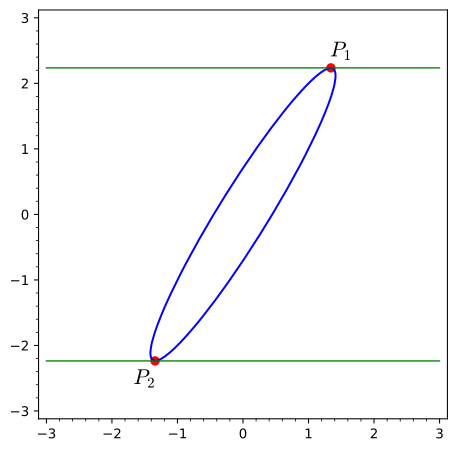
We look for points \(P=(x,y)\) where \(y'(x)=0\text{,}\) making the tangent line horizontal. To see which points satisfy this, we setting \(y'(x)=0\) in the equation above and see what it says:
\begin{align*}
10x-6(y+0)+0 \amp =0 \\
10x-6y \amp =0 \\
y \amp =\frac{5}{3}x\text{.}
\end{align*}
Thus, if \(P=(x,y)\) is a point on \(\mathcal{C}\) where the tangent line is horizontal, then we must have \(y=5x/3\text{.}\) Substitution this expression for \(y\) back into the defining equation, we have
\begin{align*}
5x^2-6x(5x/3)+2(5x/3)^2\amp =1 \amp \\
\frac{5}{9}x^2\amp =1 \\
x \amp =\pm\frac{3}{\sqrt{5}}\text{.}
\end{align*}
The choice \(x=\frac{3}{\sqrt{5}}\) gives rise to the point
\begin{equation*}
P_1=\left( \frac{3}{\sqrt{5}}, \frac{5}{\sqrt{5}}\right)\text{.}
\end{equation*}
The choice \(x=-\frac{3}{\sqrt{5}}\) gives rise to the point
\begin{equation*}
P_2=\left(-\frac{3}{\sqrt{5}}, -\frac{5}{\sqrt{5}}\right)\text{.}
\end{equation*}
We conclude that \(P_1\) and \(P_2\) are the points where the tangent line to \(\mathcal{C}\) is horizontal.