Section 2.3 Linearization

Recall our graphical interpretation of the derivative of a function \(f\) at an input \(x=a\text{:}\) namely, \(f'(a)\) is the slope of the tangent line \(\ell\) to the graph of \(f\) at the point \(P=(a,f(a))\text{.}\)
Linearizations of a quadratic function
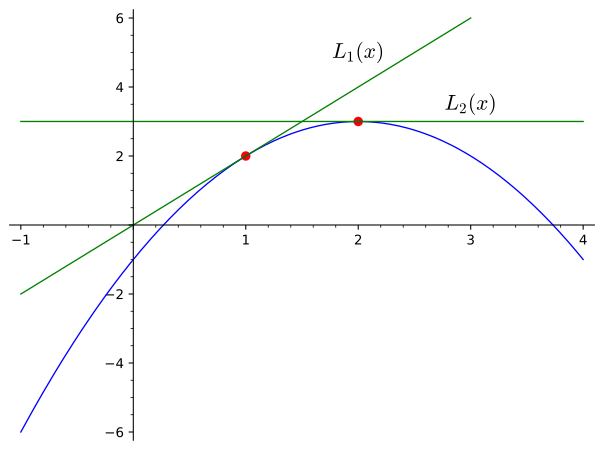
Figure 2.3.1. Two tangent lines to the graph of a function \(f\)
In this section we revisit this interpretation from a slightly different standpoint. Namely, we consider the tangent line \(\ell\) as an approximation of the graph of \(f\) near \(P=(a,f(a))\text{.}\) We can get an idea of how this works by looking at the example in FigureΒ 2.3.1. The line \(\ell_1\) is the tangent line to the graph of \(f\) at the point \(P=(1,2)\text{.}\) For inputs \(x\) close to \(a=1\text{,}\) the point \((x,f(x))\) on the graph of \(f\) is close to the point on \(\ell_1\) with the same \(x\)-coordinate. In this sense \(\ell_1\) is a decent approximation of the graph of \(f\text{,}\) but only for points \((x,f(x))\) where \(x\) is close to \(a=1\text{.}\) For example, the line \(\ell_1\) visibly does not do a good job of approximating the graph of \(f\) near the other depicted point \((2,3)\text{.}\) In contrast, the tangent line \(\ell_2\) at \((2,3)\) does approximate the graph of \(f\) well for points near \((2,3)\text{.}\)
We now recast this whole discussion in the language of functions and their approximations. Recall that as a consequence of the graphical interpretation of \(f'(a)\text{,}\) we know that the tangent line \(\ell\) to the graph of \(f\) at a point \((a,f(a))\) has equation
\begin{equation*} y-f(a)=f'(a)(x-a)\text{,} \end{equation*}
or equivalently,
\begin{equation*} y=f'(a)(x-a)+f(a)\text{.} \end{equation*}
Put another way, the tangent line \(\ell\) is the graph of the function
\begin{equation*} L(x)=f(a)+f'(a)(x-a)\text{.} \end{equation*}
As a result, treating \(\ell\) as an approximation of the graph of \(f\) is equivalent to treating the linear function \(L(x)=f(a)+f'(a)(x-a)\) as an approximation of the function \(f\) near the input \(x=a\text{.}\) We call \(L\) the linearization of \(f\) at \(a\text{.}\)

Definition 2.3.2. Linearization of a function.

Assume \(f\) is differentiable at the input \(a\text{.}\) The linearization of \(f\) centered at \(a\) is the linear function \(L(x)\) defined as
\begin{equation} L(x)=f'(a)(x-a)+f(a)\text{.}\tag{2.5} \end{equation}

Remark 2.3.3. Linearization.

It is important to observe the β€œcentered at \(a\)” modifier in DefinitionΒ 2.3.2. In other words, the function \(L(x)\) defined in (2.5) depends both on \(f\) and the specific input \(a\text{.}\)

Example 2.3.4. Linearization: quadratic.

Let \(f(x)=3-(x-2)^2\text{.}\) Compute the linearization \(L_1\) of \(f\) centered at \(a=1\text{,}\) and the linearization \(L_2\) of \(f\) centered at \(b=2\text{.}\)
Solution.
First compute \(f'(x)=-2(x-2)\text{.}\) Using (2.5), we have
\begin{align*} L_1(x) \amp = f'(a)(x-a)+f(a)\\ \amp = 2(x-1)+2 \amp (f'(1)=2, f(1)=2)\\ L_2(x) \amp = f'(b)(x-b)+f(b)\\ \amp = 0(x-2)+3 \amp (f'(2)=0, f(2)=3)\\ \amp = 3\text{.} \end{align*}
Thus the linearization of \(f\) centered at \(1\) is \(L_1(x)=2(x-1)+2\text{,}\) and the linearization centered at \(2\) is the constant function \(L_2(x)=3\text{.}\)

Remark 2.3.5. Linearization and tangent lines.

You may have noticed a resemblance to the formula for the linearization \(L\) of \(f\) centered at \(a\text{,}\) and the tangent line to the graph of \(f\) at \(x=a\text{.}\) To be precise: the graph of the linearization function \(L\) is precisely the tangent line to the graph of \(f\) at the point \(P=(a,f(a))\text{.}\)
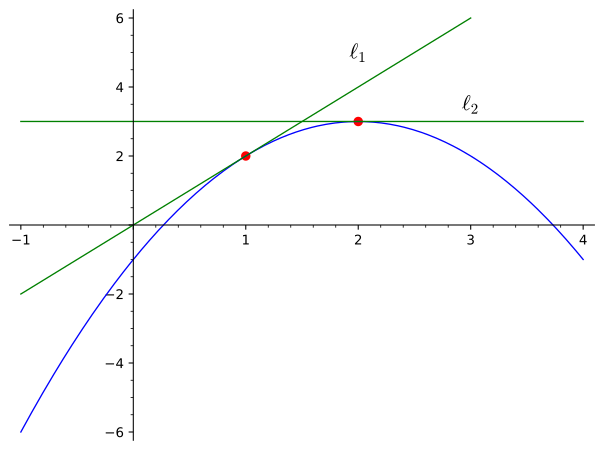
By way of illustration, we graph the function \(f(x)=3-(x-2)^2\) in ExampleΒ 2.3.4 along with the linearizations \(L_1\) and \(L_2\) centered at \(1\) and \(2\text{,}\) respectively.
Linearizations of a quadratic function
Figure 2.3.6. Linearizations of \(f(x)=3-(x-2)^2\)

Remark 2.3.7. Linear approximation.

Assume \(f\) is differentiable at \(a\text{,}\) and let \(L(x)=f'(a)(x-a)+f(a)\) be the linearization of \(f\) centered at \(a\text{.}\) As we can show, the differentiability of \(f\) at \(a\) ensures that values of the linearization \(L\) are close to values of \(f\) for inputs \(x\) near \(a\text{.}\) Indeed, we have
\begin{align*} f'(a)=\lim_{x\to a}\frac{f(x)-f(a)}{x-a} \amp \implies 0=\lim_{x\to a}\frac{f(x)-f(a)}{x-a}-\lim\limits_{x\to a}f'(a) \amp \left(\lim\limits_{x\to a}f'(a)=f'(a)\right)\\ \amp \implies \lim_{x\to a}\frac{f(x)-f(a)-f'(a)(x-a)}{x-a}=0\\ \amp \implies \lim_{x\to a}\frac{f(x)-L(x)}{x-a}=0 \amp (L(x)=f'(a)(x-a)-f(a))\text{.} \end{align*}
Consider what the limit statement
\begin{equation} \lim_{x\to a}\frac{f(x)-L(x)}{x-a}=0\tag{2.6} \end{equation}
tells us. Since \(\lim\limits_{x\to a}x-a=0\text{,}\) the numerator \(f(x)-L(x)\) must be close to zero for \(x\) close to \(a\text{.}\) Furthermore, we must have \(f(x)-L(x)\) approaching zero faster than \(x-a\) approaches zero. More precisely, invoking the epsilon-delta definition of the limit, we can show that for any \(\epsilon > 0\text{,}\) we have
\begin{equation*} \abs{f(x)-L(x)}< \epsilon \abs{x-a} \end{equation*}
for all \(x\) sufficiently close to \(a\text{.}\) After we introduce the mean value theorem, we will be able to give an even better quantitative description of just how good an approximation \(L(x)\) is to \(f(x)\text{.}\)

Example 2.3.9. Linear approximation: quadratic.

Let \(f(x)=3-(x-2)^2\text{.}\)
  1. Use the linearization \(L_1(x)\) of \(f\) centered at \(1\) to estimate \(f(0.5)\text{.}\)
  2. Compare your estimate of \(f(0.5)\) with the actual value. How close are the two?
Solution.
  1. Recall that we computed \(L_1(x)=2(x-1)+2\text{.}\) Thus we have
    \begin{align*} f(1/2) \amp \approx L_1(1/2)\\ \amp = 2(-1/2)+2\\ \amp = 1\text{.} \end{align*}
  2. The exact value is \(f(1/2)=3-(1/2-2)^2=3-9/4=3/4\text{.}\) Thus our estimate is off by \(1/4\text{:}\) i.e., \(\abs{L_1(1/2)-f(1/2)}=1/4\text{.}\)

Example 2.3.10. Linear approximation: cube-root.

Use linear approximation to estimate \(\sqrt[3]{8.05}\text{.}\)
Solution.
To use linear approximation, we need to compute the linearization of a function \(f\) centered at some input \(a\text{.}\) We take \(f(x)\sqrt[3]{x}\text{,}\) and \(a=8\text{.}\) Why \(a=8\text{?}\) I can compute \(f(8)\) and \(f'(8)\) easily by hand, and \(8.05\) is reasonably close to \(8\text{.}\) We first compute
\begin{align*} f'(x) \amp =(x^{1/3})'\\ \amp =\frac{1}{3}x^{-2/3}\text{.} \end{align*}
The linearization of \(f\) centered at \(a=8\) is then
\begin{align*} L(x) \amp = f'(8)(x-8)+f(8)\\ \amp =\frac{1}{12}(x-8)+2 \amp (8^{1/3}=2, 8^{-2/3}=1/(\sqrt[3]{8})^2=1/4) \end{align*}
Lastly, we estimate
\begin{align*} f(8.05) \amp \approx L(8.05)\\ \amp = \frac{1}{12}\cdot 0.05+2\\ \amp \frac{1}{240}+2 \amp (0.05=1/20)\\ \amp = \frac{481}{240}\text{.} \end{align*}
Using technology we see that
\begin{align*} f(8.05) \amp = 2.0041580\dots \\ \frac{481}{240} \amp = 2.0041666\dots\text{.} \end{align*}
Our estimate ended up being pretty close!
Example 2.3.11. Linear approximation: trig.

Let \(f(x)=\tan(\pi x)\text{.}\) Use linear approximation to estimate \(f(0.251)\text{.}\)
Solution.
We compute the linearization \(L\) of \(f\) centered at \(a=\frac{1}{4}=0.25\text{.}\) First we compute the derivative of \(f\text{:}\)
\begin{align*} f'(x) \amp = \sec^2(\pi x) (\pi x)' \amp \text{(chain)}\\ \amp = \pi \sec^2(\pi x)\text{.} \end{align*}
It follows that the linearization centered at \(\frac{1}{4}\) is
\begin{align*} L(x) \amp = f'(1/4)(x-1/4)+f(1/4)\\ \amp = 2\pi(x-1/4)+1 \amp (\tan(\pi/4)=1, \sec^2(\pi/4)=1/(\sqrt{2}/2)^2=2) \text{.} \end{align*}
Lastly we estimate
\begin{align*} f(0.251) \amp \approx L(0.251)\\ \amp = 2\pi (0.251-0.25)+1 \amp (1/4=0.25)\\ \amp = 2\pi(0.001)+1\\ \amp = \frac{\pi}{500}+1\text{.} \end{align*}

Example 2.3.12. Linear approximation: marshmallow.

Dudley places a cylindrical marshmallow in the microwave, causing it to expand such a manner that the ratio of its height and radius is preserved. Initially the height and radius of the marshmallow are both equal to 2 centimeters; when Dudley removes the marshmallow the height and radius are both equal to 2.1 centimeters.
  1. Use linear approximation to estimate the change in volume of the marshmallow.
  2. Compare your estimate with the actual change in volume.
Solution.
Since the radius \(r\) and height \(h\) of the marshmallow are initially equal, and since the marshmallow expands in such a way that the ratio of radius to height is preserved, we see that we always have \(r=h\text{,}\) and thus
\begin{equation*} V=\pi r^2 h=\pi x^3\text{,} \end{equation*}
where \(x=r=h\text{.}\) We thus treat volume \(V=f(x)=\pi x^3\) as a function of the common dimension \(x\) specifying both radius and height.
  1. To estimate the change in volume, we compute the linearization \(L\) of \(V=f(x)\) centered at \(2\text{.}\) Since \(f'(x)=3\pi x^2\text{,}\) we have
    \begin{equation*} L(x)=f'(2)(x-2)+f(2)=12\pi (x-2)+8\pi\text{.} \end{equation*}
    It follows that the change of volume \(\Delta V=f(2.1)-f(2)\) can be estimated as
    \begin{align*} \Delta V \amp = f(2.1)-f(2)\\ \amp \approx L(2.1)-f(2) \amp (L(2.1)\approx f(2.1)\\ \amp = 12\pi(0.1)=\frac{12\pi }{10}=1.2\, \pi \end{align*}
  2. The exact change of volume is
    \begin{align*} f(2.1)-f(2) \amp = \pi (2.1)^3-8\pi \\ \amp = (1.261) \pi \text{.} \end{align*}