In this section we apply our optimization techniques to real-world problems. Optimization problems occur in real life when we have a quantity \(q\) that is given as a function \(q=f(a)\) as some other quantity \(a\text{,}\) and whose value we wish to either maximize or minimize (or just “optimize” for short). As with the related rates problems we discussed in Section 1.24, the most challenging aspect of these “applied optimization” problems it to take the given scenario, described in plain English, and modeling it with mathematical functions that we can run through our optimization techniques. Let’s begin with an example and then try and describe the general steps to solving one of these problems with a procedure.
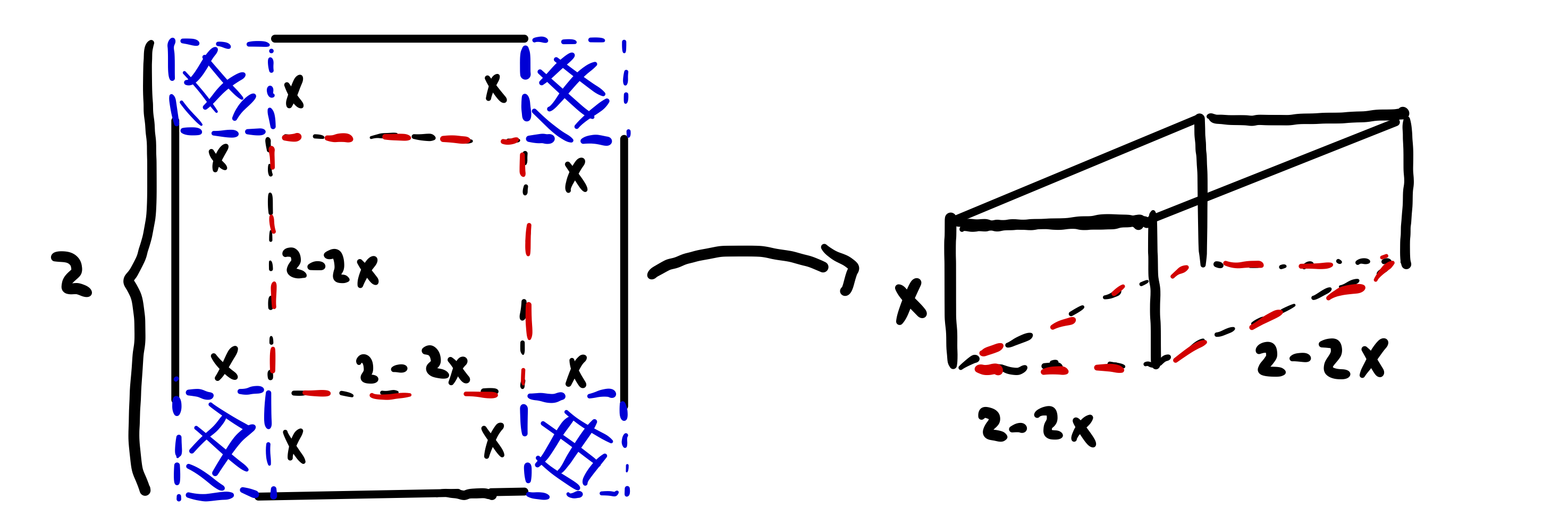
A square piece of cardboard of dimension \(2\) meters is made into a box by cutting squares of equal dimension out of each corner and folding up the sides. (See Figure 2.7.2.) Find the dimension of the cutout squares that maximizes the volume of the resulting box.
Let \(x\) be the dimension of the cutout squares. The resulting box would have height \(x\text{,}\) and width and length both equal to \(2-2x\text{.}\) Its volume would thus be
Since the cutout square dimension \(x\) can range from \(0\) to \(1\text{,}\) we see that we wish to find the minimal value of \(V=f(x)\) on the interval \([0,1]\text{.}\) We have reduced the question to an extreme value theorem problem!
From this factored form we see easily that the critical points of \(f\) are \(x=1\) and \(x=\frac{1}{3}\text{.}\) Now evaluate \(f\) at the endpoints of \([0,1]\) and the critical points:
Express the quantity we wish to optimize as a function \(q=f(x)\) of exactly one variable.
If the quantity appears to be given as a function of more than one independent variable, look for a constraint equation that allows us to reduce to exactly one independent variable.
Translate the given word problem as one of our types of optimization problems (e.g., EVT, find/classify critical points, curve sketching, etc.) for the function \(q=f(x)\text{.}\)
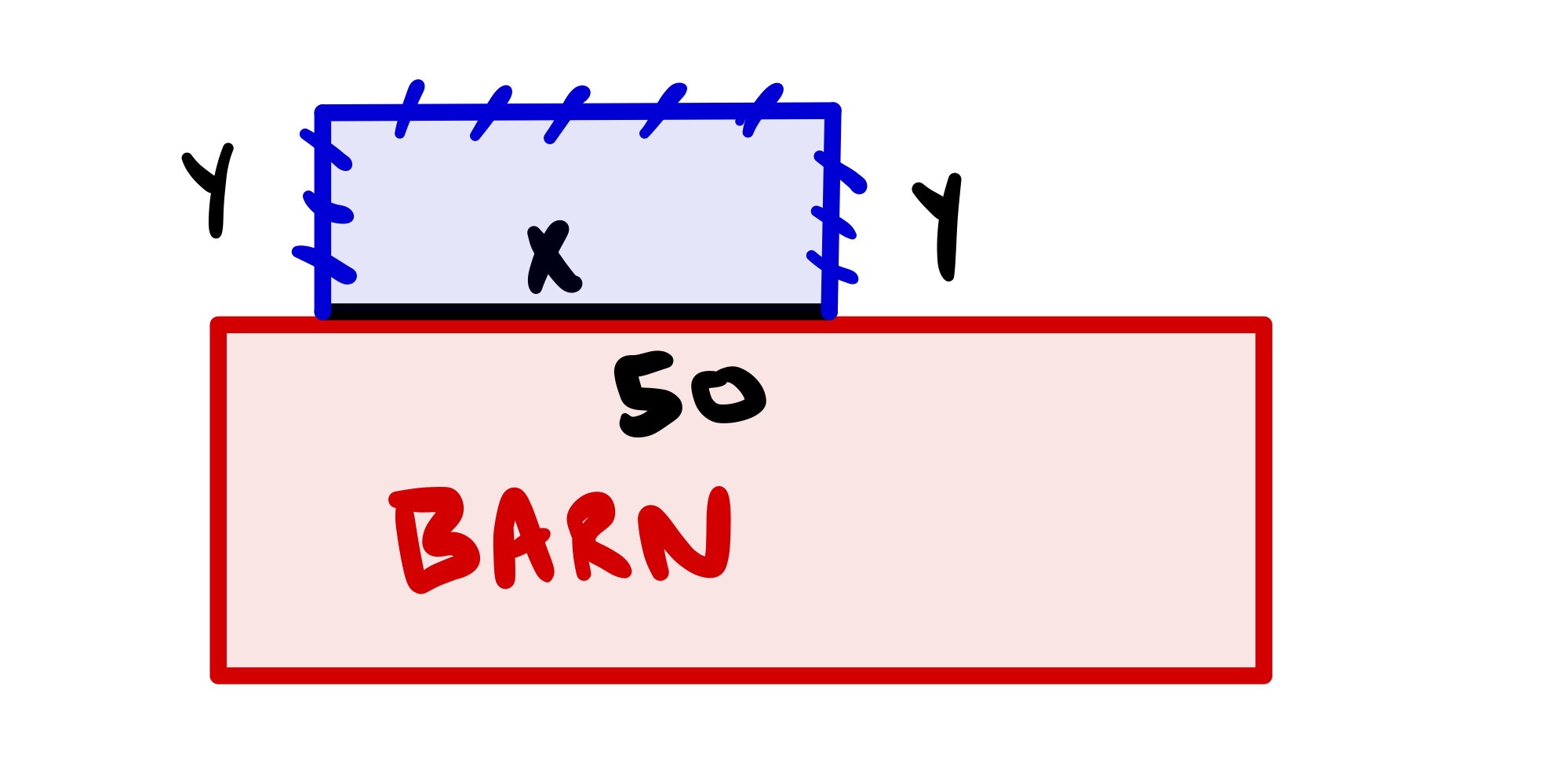
Farmer Dudley is building a rectangular pen for his iguanas. He will use the 50 meter long side of his barn as one side of the pen, and will construct fencing for the remaining three sides of the pen. The pen must have a total area of 200 m\(^2\text{.}\) What is the minimum length of fencing Dudley must build to create an iguana pen matching these specifications.
Let \(x\) and \(y\) be the dimensions of the pen, where \(x\) is the length of the barn that Dudley makes use of. Since the area \(A=xy\) of the pen must be 200 m\(^2\text{,}\) we see that \(x\) and \(y\) must satisfy
Lastly, the constraint equation implies that \(x\) cannot be equal to zero; and since Dudley is using the barn side as one edge of his pen, we must have \(x\leq 50\text{.}\) Thus, we wish to find the minimal value of \(L=f(x)\) on the domain \(D=(0,50]\text{.}\)
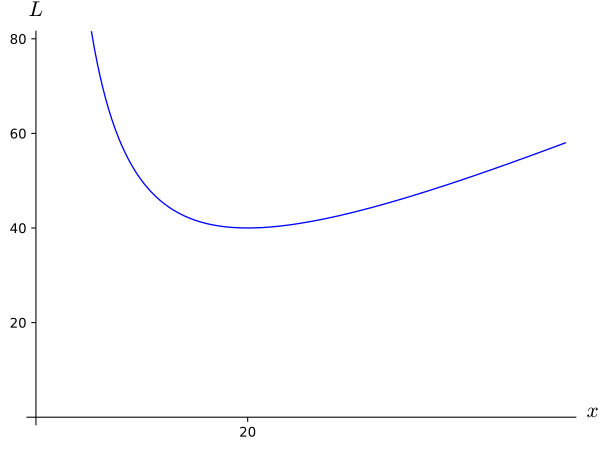
Thus the only critical point of \(f\) lying in \(D\) is \(x=20\text{.}\) The question now, is whether \(f(20)\) is the absolute minimum value of \(f\) on \(D\text{.}\) Note that we cannot apply Procedure 2.1.13 to answer this question, since our domain \(D\) is not a finite closed interval! Instead we look at the sign diagram of \(f'\text{.}\)
From this sign diagram we conclude that \(f\) is decreasing on the interval \((0,20]\) and increasing on the interval \([20,50]\text{.}\) It follows that
\begin{equation*}
f(20)=20+20=40
\end{equation*}
must be the absolute minimum value of \(f\) on \(D\text{,}\) since for any other \(x\in D\text{,}\) we have \(f(x)> f(20)\text{.}\) We conclude that minimal length of fencing Dudley can build to make his pen is \(40\) meters.
We conclude with a graph of \(f\text{,}\) the simple shape of which makes more tangible our logic above in arguing that \(f\) attains its absolute minimum value at \(x=20\text{.}\)
As we saw in the last example it is often the case that the domain \(D\) of the function we wish to optimize is not of the simple form \([a,b]\text{,}\) where Procedure 2.1.13 applies. In Example 2.7.5, we were optimizing a function on the interval \((0,50]\text{,}\) and had to rely on our wits a bit to convince ourselves that we have found an absolute extreme value. The following generalization of the extreme value theorem gives a more systematic procedure for finding absolute extreme values in such situations.
Let \(I\) be an interval of any sort (i.e., \(I\) can be open, closed, or neither, and \(I\) can be finite or infinite), and let \(a\) and \(b\) be the (possibly infinite) left and right endpoints of \(I\text{.}\) Assume \(f\) is continuous on \(I\text{.}\) To investigate whether \(f\) attains a maximum or minimum value on \(I\text{,}\) proceed as follows.
Identify candidate inputs.
The candidate inputs where \(f\) potentially attains a local maximum or minimum value consist of the (i) any finite endpoints of \(I\) that are elements of \(I\text{,}\) and (ii) any critical points of \(f\) lying in \(I\text{.}\)
Evaluate the two endpoint limits \(\lim\limits_{x\to a^+}f(x)\) and \(\lim\limits_{x\to b^-}f(x)\text{.}\) (In the case where the given endpoint is infinite, the one-sided limit is understood simply as the corresponding limit at infinity.)
Compare \(m\text{,}\)\(M\text{,}\) and endpoint limits.
Assume that each limit in Step 3 either exists or is infinite.
If neither of the endpoint limits from Step 3 is less than \(m\) or equal to \(-\infty\text{,}\) then \(m\) is the absolute minimum value of \(f\) on \(I\text{.}\) Otherwise, there is no absolute minimum value.
If neither of the endpoint limits from Step 3 is greater than \(M\) or equal to \(\infty\text{,}\) then \(M\) is the absolute maximum value of \(f\) on \(I\text{.}\) Otherwise, there is no absolute maximum value.
Let’s use Procedure 2.7.7 to complete the last steps of our argument in Example 2.7.5. We were trying to find the absolute minimum value of \(f(x)=x+\frac{400}{x}\) on the half-open interval \(I=(0,50]\text{,}\) and had determined that \(x=20\) was the sole critical point of \(f\text{.}\)Procedure 2.7.7 instructs us to evaluate \(f\) at \(x=20\) and \(x=50\text{,}\) and compute the limit at \(0\text{:}\)
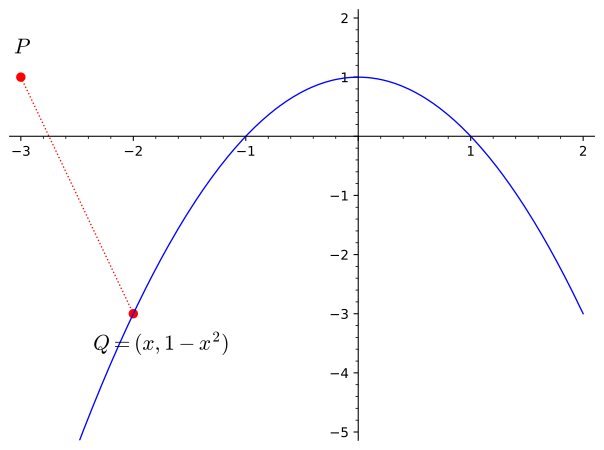
Find the \(Q\) on the parabola \(y=1-x^2\) whose distance to \(P=(-3,1)\) is the smallest possible. The distance between two points \(P_1=(x_1,y_1)\) and \(P_2=(x_2,y_2)\) in \(\R^2\) is defined as
Since the \(x\)-coordinate of \(Q\) can be any real number, we wish to find the minimum value of \(f\) on \(\R=(-\infty, \infty)\text{.}\) We follow Procedure 2.7.7.
Let \(g(x)=4x^3+2x+6\text{.}\) In general it is not so easy to find roots of a cubic polynomial. However, recall the fact that if \(g\) has an integer root, it must be a divisor of \(6\text{.}\) Trying a few divisors (\(\pm 1, \pm 2, \pm 3, \pm 6\)), we easily see that \(g(-1)=0\text{,}\) and hence that \((x+1)\) is a factor of \(g(x)\text{,}\) Using polynomial long division, we see that
Furthermore, using the quadratic formula, we see that the \(4x^2-4x-3\) has no real roots. Thus the root of \(g\) (and only critical point of \(f\)) is \(x=-1\text{.}\)
According to Procedure 2.7.7, to investigate extreme values of \(f\) on \((-\infty, \infty)\) we should evaluate \(f\) at \(x=-1\) and compute the limits of \(f\) at \(\pm \infty\text{:}\)
We conclude that \(f(-1)=\sqrt{5}\) is the absolute minimum value of \(f\text{,}\) and thus that \(Q=(-1,0)\) is the point on \(\mathcal{C}\) closest to \(P\text{.}\)
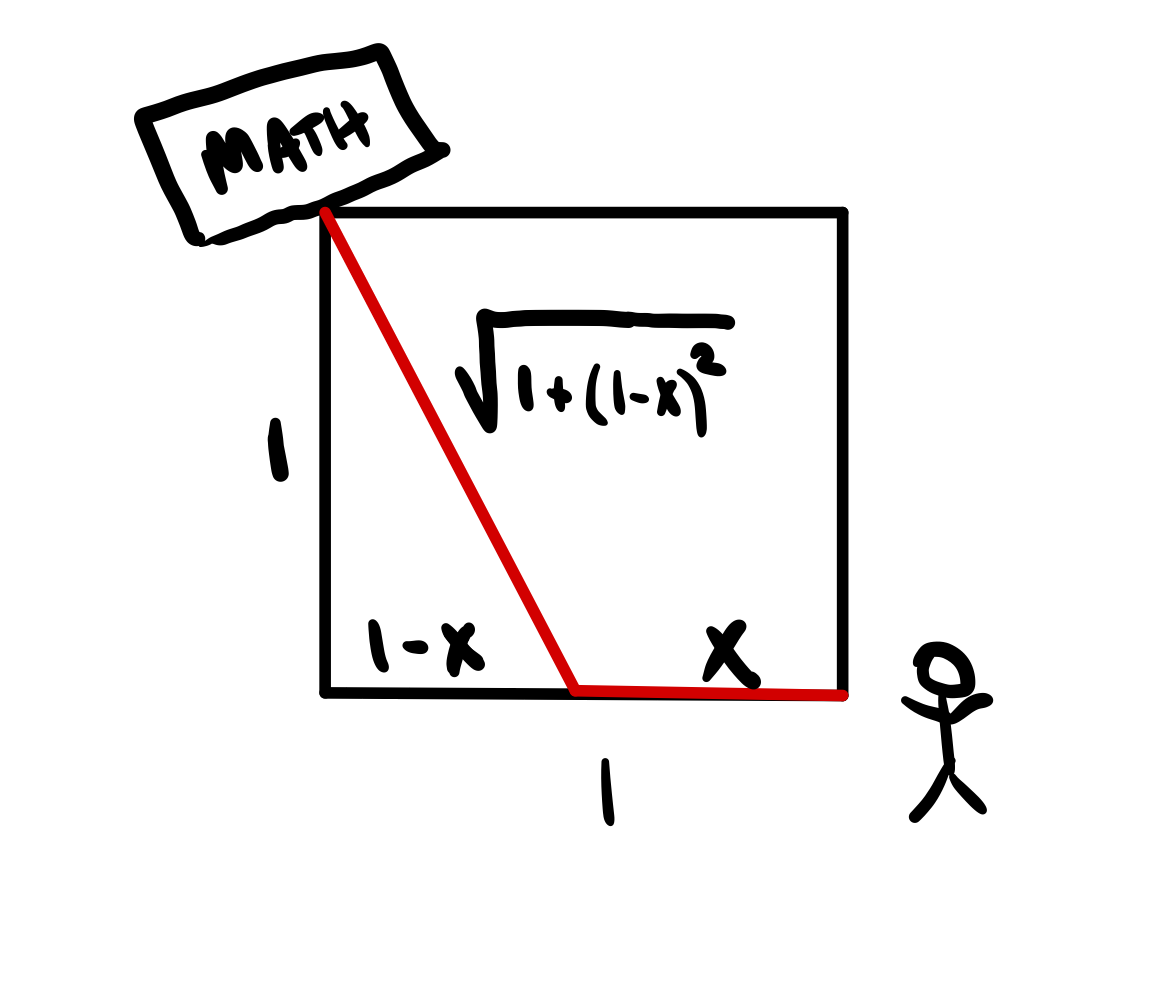
Dudley stands at the southeast corner of a 1 km\(^2\) square field on campus that is currently covered in snow. He is hurrying to get to his calculus course taking place in the mathematics building at the northwest corner of the field. Dudley plans on first walking (at constant speed) along some portion of the ploughed east-west path that runs along the southern border of the field, and then cutting across the snowy field to head directly toward the mathematics building (at constant speed). Because of the snowy conditions, Dudley can move twice as fast on the ploughed path than he can when walking across the field. If Dudley wants to get to the mathematics building as quickly as possible, how far along the ploughed path should he walk before cutting across the field?
Let \(x\) be the distance Dudley walks along the east-west ploughed path, in which he walks a distance of \(\sqrt{1+(1-x)^2}\) through the snowy field. Let \(s\) be the constant speed at which Dudley can walk through the snowy field; it follows that he moves at maximum speed \(2s\) along the ploughed path. Using the (distance)=(rate)\(\times\)(time) formula for objects traveling at constant speed, we see that the total time \(T\) it takes for Dudley to get to the math building taking such a path is
We wish to find the minimum value of \(f\) on the interval \([0,1]\text{.}\) We follow Procedure 2.1.13. Since \(f\) is differentiable everywhere, its critical points are the solutions to \(f'(x)=0\text{.}\) We solve (treating \(s\) as a constant):
Thus the only critical point of \(f\) in \([0,1]\) is \(1-\frac{1}{\sqrt{3}}\text{.}\) After evaluating \(f\) at the critical point and the endpoints and doing some careful algebra, we see that
from whence it follows that \(f(1-1/\sqrt{3})\) is the minimal value of \(T=f(x)\) on \([0,1]\text{.}\) Thus Dudley should travel a distance of \(1-1/\sqrt{3}\) km along the ploughed path before heading across the snowy field. Godspeed, Dudley!
The starting price of a certain model of television is $450. At this price point there are 1000 weekly sales of the television. A marketing team discovers that for each discount of $10 applied to the TV price, the number of weekly sales increases by 100 per week. How should the company price the television in order to maximize weekly revenue?
Let \(d\) be the number of ten-dollar discounts applied to the starting price. According to our marketers, the number of weekly sales \(S\) if applying \(d\) ten-dollar discounts to the price is
We wish to maximize the function \(R=f(d)=(1000+100d)(450-10d)\) for \(d\in [0, 45]\text{.}\) (We have \(d\leq 45\) as we do not want the price of the television to be negative!)
Thus revenue is maximized when offering \(35/2\) ten-dollar discounts to the price of the televion. In other words, the television should be offered at a price of