We saw in Theorem 2.8.21 that exponential growth functions are increasing on their entire domain, and that exponential decay functions are decreasing. As a result, an exponential function \(f\) satisfies an important property: given two distinct inputs \(x_1\) and \(x_2\) (i.e., \(x_1\ne x_2\)), we the outputs \(f(x_1)\) and \(f(x_2)\) are distinct (i.e., \(f(x_1)\ne f(x_2)\)). Why is this true? Take the case where \(f\) is an exponential growth function, so that in particular it is increasing on its domain. If \(x_1\ne x_2\text{,}\) then one of the two inputs is greater than the other. Without loss of generality, we may assume \(x_1< x_2\text{.}\) But then since \(f\) is increasing, we have \(f(x_1)< f(x_2)\text{,}\) which implies \(f(x_1)\ne f(x_2)\text{.}\)
A function \(f\) is one-to-one on its domain \(D\) if \(f(x_1)\ne f(x_2)\) for all \(x_1, x_2\in D\) with \(x_1\ne x_2\text{.}\) Using logical shorthand:
Before proceeding in our investigation of one-to-one functions, we hasten to point out that not all functions satisfy this property, as the next example illustrates.
The function \(f(x)=x^2\) with domain \(D=[0,\infty)\text{,}\) by contrast, is one-to-one! To see why we examine more carefully what it means for \(f(x_1)=f(x_2)\) for arbitrary elements \(x_1,x_2\in \R\text{.}\) We have
Thus \(f(x_1)=f(x_2)\) if and only if \(x_1=\pm x_2\text{.}\) It follows that given distinct elements \(x_1,x_2\in D=[0,\infty)\text{,}\) we cannot have \(f(x_1)=f(x_2)\text{,}\) because we cannot have \(x_1=-x_2\text{.}\)
As the previous illustrates, the role of the domain \(D\) of a function is essential in determining whether the function is one-to-one or not. As we saw there, the function \(f(x)=x^2\) with domain \(D=\R\) is not one-to-one (e.g., \(f(-1)=f(1))\text{,}\) but it is one-to-one on the subset \(I=[0,\infty)\text{.}\)
In Example 2.10.2 we used algebra to decide whether a given function was one-to-one. The horizontal line test provides a convenient graphical method for doing the same. The simple principle of this test can be summarized as follows.
If \(f\) is not one-to-one, then we can find two distinct inputs \(x_1\) and \(x_2\) whose outputs are equal: i.e., \(f(x_1)=f(x_2)\text{.}\)
Graphically, this means that the points \(P=(x_1,f(x_1))\) and \(Q=(x_2,f(x_2))\) on the graph of \(f\) are distinct (they have different \(x\)-coordinates), but have the same \(y\)-coordinate \(y_0=f(x_1)=f(x_2)\text{.}\)
Conversely, if some horizontal line \(y=y_0\) intersects the graph of \(f\) in at least two distinct points \(P=(x_1,f(x_1))\) and \(Q=(x_2,f(x_2))\text{,}\) then we must have \(f(x_1)=f(x_2)=y_0\text{,}\) showing that \(f\) is not one-to-one.
Remark2.10.6.Horizontal versus vertical line test.
The horizontal line test probably reminds you of another line test introduced long ago in this course: namely, the vertical line test (Theorem 1.1.36). Make sure you do not conflate the two! Recall that the vertical line test is used to determine whether a given curve in the plane was in fact the graph of a function. By contrast, when using the horizontal line test, we know already that the curve \(\mathcal{C}\) is the graph of a function \(f\text{,}\) and wish to ascertain whether that function is one-to-one or not.
Similarly to the vertical line test, it might be useful to envision the horizontal line test as a scanning procedure. Imagine scanning your graph \(\mathcal{C}\) with a device that produces a green horizontal line \(L\) that we move up and down across the entire plane.
If at some moment during the scan our horizontal line \(L\) hits two or more points, then our scanner emits a loud error beep, indicating that \(f\) has failed the horizontal line test, and is thus is not one-to-one.
If, on the other hand, we are able to scan the entire vertical range of \(\mathcal{C}\) without hearing the error beep, then \(f\) has passed the horizontal line test, and thus is one-to-one.
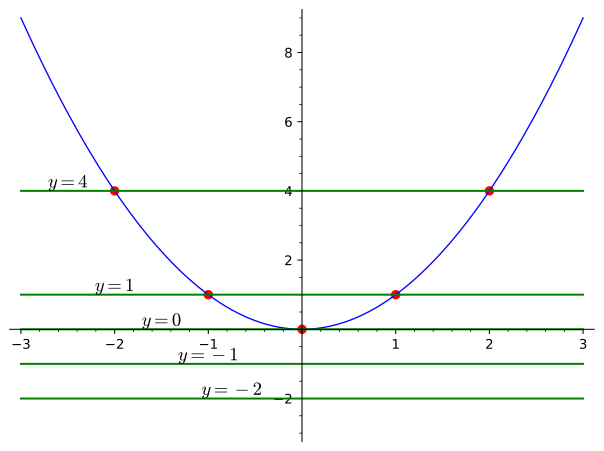
Let’s see how this scanning analogy works when applying the horiztonal line test to \(f(x)=x^2\text{.}\) As illustrated in Figure 2.10.8, for lines \(y=c\) with \(c\leq 0\text{,}\) our scanner emits no error beep, since such lines intersect the graph of \(f\) in at most one point. However, as soon as our scanner line moves above the \(x\)-axis, it starts emitting error beeps, as each such line intersects the graph of \(f\) in two points. We conclude that \(f\) is not one-to-one, just as we did in Example 2.10.2.
Returning to our discussion about exponential functions at the beginning of this section, we observe that we were able to deduct the one-to-one property from another property of exponential functions: namely, their monotonicity. To repeat that argument, if \(f\) is increasing (or decreasing) on a subset \(I\) of its domain, then clearly it is one-to-one on that set: in the increasing case, values of \(f\) increase as the input values increase, thus distinct inputs have distinct outputs; similarly, in the decreasing case, values of \(f\) decrease as the input values increase, thus again distinct inputs have distinct outputs. We have thus established the following theorem.
It is important to observe that being one-to-one is not in general equivalent to being monotonic. However, in the special case where the function \(f\) is continuous and the relevant set \(I\) is an interval, then the two conditions are in fact equivalent. Since we deal almost exclusively with continuous functions, you will find that showing a function is monotonic is often the most convenient way to show it is one-to-one.
As an exercise, come up with a noncontinuous function that is one-to-one on its domain \(D\text{,}\) but not monotonic. Hint: as always, a piecewise defined function usually is a good place to start!
As we have seen before, linear functions with nonzero slope are monotonic. Indeed, in the case given we have \(f'(x)=a\) which is either always positive (if \(a> 0\)) or always negative (if \(a< 0\)). We conclude that \(f\) is either increasing or decreasing on its entire domain, and thus one-to-one by Theorem 2.10.9.
We might just as well use the vertical line test here, recalling what graphs of power functions \(f(x)=x^n\) look like when \(n\) is an odd positive integer. (See Figure 1.5.1.) However, we use a monotonicity argument instead by way of illustration. We have
Since \(n\) is odd, \(n-1\) is even, which means that \(f'(a)> 0\) for all \(a\ne 0\text{.}\) As a result \(f\) is increasing on the intervals \((-\infty, 0)\) and \((0,\infty)\text{.}\) Since furthermore \(f\) is strictly negative on \((-\infty,0)\text{,}\) is zero at \(x=0\text{,}\) and is strictly positive on \((0,\infty)\text{,}\) we conclude that \(f\) is increasing on \(\R\text{.}\)
Since \(x^{1/n}\) and \(x^{-1}\) are both negative for \(x< 0\) and both positive for \(x> 0\text{,}\) we see that \(f'(x)> 0\) for all \(x\ne 0\text{.}\) (Note that \(f'\) is not defined at \(x=0\text{.}\)) As above we conclude that \(f\) is increasing on the intervals \((-\infty, 0)\) and \((0,\infty)\text{,}\) and since \(f\) is strictly negative on \((-\infty,0)\text{,}\) is zero at \(x=0\text{,}\) and is strictly positive on \((0,\infty)\text{,}\) we conclude that \(f\) is increasing on \(\R\text{.}\)
Unfortunately, we use the same superscript notation for an inverse of a function \(f^{-1}\) that we use for the reciprocal of a number \(a^{-1}\text{.}\) It is extremely important that you do not conflate these two operations! In particular, the inverse of a function \(f^{-1}\) is not the same thing as its reciprocal function: that is,
As a simple counterexample, consider the function \(f(x)=2x\text{.}\) You can easily verify for yourself that the function \(f^{-1}(x)=\tfrac{1}{2}x\) satisfies
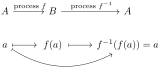
Suppose \(f\colon A\rightarrow B\) is invertible with inverse \(f^{-1}\text{.}\) It is instructive to think of the defining equations (2.24) and (2.25) as saying that the function \(f^{-1}\) “undoes” whatever \(f\) does to an input \(a\in A\text{,}\) and conversely that \(f\) “undoes” whatever \(f^{-1}\) does to an input \(b\in B\text{.}\)
In more detail, think of \(f\) as an operation that takes inputs \(a\in A\) and transforms them into the element \(f(a)\in B\text{.}\) Similarly, think of \(f^{-1}\) as another process that takes inputs \(b\in B\) and transforms them into the element \(f^{-1}(b)\in A\text{.}\) The identity \(f^{-1}(f(a))=a\text{,}\) can then be understood as saying that if we first apply the process \(f\text{,}\) yielding \(f(a)\text{,}\) and then apply the process \(f^{-1}\) to this result, yielding \(f^{-1}(f(a))\text{,}\) we get back our original input \(a\text{.}\) In other words, the process \(f^{-1}\)reverses (or undoes) the process \(f\text{.}\) And conversely, the process \(f\) reverses (or undoes) the process \(f^{-1}\text{.}\)Figure 2.10.15 gives a schematic representation of this idea of a process and its reverse.
According to Definition 2.10.12, to show that a given function \(f\colon A\rightarrow B\) is invertible, we must prove that an inverse function \(f^{-1}\colon B\rightarrow A\) exists. If the starting function \(f\) is simple enough, we are often able to find a formula for an inverse function \(f^{-1}\) via algebra, as the next example illustrates.
For the given function \(f\colon A\rightarrow B\text{,}\) show that \(f\) is invertible by providing an explicit inverse function \(f^{-1}\colon B\rightarrow A\text{.}\)
For a function \(f^{-1}\) to satisfy the inverse equations (2.24) given any output \(y=f(x)=(-2)x+5\text{,}\) we need \(f^{-1}(y)=x\text{.}\) We can determine the formula for \(f^{-1}(y)\) by starting with the equation \(y=(-2)x+5\text{,}\) which expresses \(y\) in terms of \(x\text{,}\) and solving it for \(x\) in terms of \(y\text{:}\)
\begin{align*}
y \amp =(-2)x+5 \\
y-5 \amp =(-2)x\\
x \amp = \frac{y-5}{-2}=-\frac{1}{2}y+\frac{5}{2}\text{.}
\end{align*}
Thus our inverse function \(f^{-1}\) should be defined as
for all \(y\in \R\text{.}\) Observe that \(y\) is just the name of a variable here, so we are free now to replace it with the more standard variable name \(x\text{,}\) and write \(f^{-1}(x)=-\tfrac{x}{2}+\tfrac{5}{2}\text{.}\)
Interestingly, we have shown that (a) all non-constant linear functions are invertible, and (b) the inverse of a linear function is again a linear function!
We use the same algebraic technique as in (a). That is, we start with the equation \(y=f(x)=(x+2)^3-7\) and try to solve for \(x\) in terms of \(y\text{.}\) The resulting expression in \(y\) yields a formula for \(f^{-1}(y)\text{.}\) Here goes:
\begin{align*}
y \amp =(x+2)^3-7\\
y+7 \amp =(x+2)^3\\
\sqrt[3]{y+7} \amp = x+2\\
x \amp = \sqrt[3]{y+7}-2\text{.}
\end{align*}
Thus we have \(f^{-1}(y)=\sqrt[3]{y+7}-2\text{.}\) If you prefer, we can replace the variable name \(y\) with \(x\) and write \(f^{-1}(x)=\sqrt[3]{x+7}-2\text{.}\) Again, for the sake of illustration, it is worthwhile that our function \(f^{-1}\) does indeed satisfy the inverse equations (2.24) and (2.25). We have
\begin{align*}
f^{-1}(f(x)) \amp = f^{-1}((x+2)^3-7)\\
\amp = \sqrt[3]{(x+2)^3-7+7}-2\\
\amp = \sqrt[3]{(x+2)^3}-2\\
\amp = x+2-2 \amp (\sqrt[3]{t^3}=t \text{ for all } t\in \R)\\
\amp = x
\end{align*}
As hinted at above, when the starting invertible function \(f\) is complicated enough, the algebra that goes into Procedure 2.10.17 is often too complicated for us to successfully find an explicit formula for the inverse function \(f^{-1}\text{.}\) Accordingly, it pays to have some alternative methods for determining whether a given function is invertible. The next theorem does exactly this by linking invertibility to the one-to-one property.
Assume \(f\) is one-to-one. By definition of \(C=\range f\text{,}\) for every \(c\in C\) there is some \(a\in A\text{,}\) such that \(f(a)=c\text{.}\) Since furthermore \(f\) is one-to-one, there is in fact exactly one \(a\in A\) such that \(f(a)=c\text{.}\) Thus we can define a function \(f^{-1}\colon C\rightarrow A\) as follows: given \(c\in C\text{,}\)\(f^{-1}(c)=a\) where \(a\) is the unique element of \(A\) satisfying \(f(a)=c\text{.}\) It is now straightforward to verify that \(f^{-1}\) satisfies the inverse equations (2.24) and (2.25).
It is worthwhile observing where the one-to-one property comes into play in this argument. If we didn’t know that \(f\) was one-to-one, then there would be no guarantee that for each \(c\in C=\range f\) there was one and only one \(a\in A\) satisfying \(f(a)=c\text{:}\) there could be two such elements, or even more! In that case, our proposed definition of \(f^{-1}(c)\) as the element of \(a\) satisfying \(f(a)=c\) would not be well defined.
Connecting invertibility with the one-to-one property allows us to show a given function is invertible without necessarily having to find an explicit inverse function. For example, each of the functions in Example 2.10.16 can be shown to be invertible simply by showing that they are monotonic, and hence one-to-one.
Of equal importance is the fact that Theorem 2.10.18 gives us alternative means for showing that a function \(f\) is not invertible. If we only had the definition of invertibility at your disposal, to do this we would have to prove somehow that no inverse function \(f^{-1}\) exists. That can be quite an onerous task, when you consider the fact that there are infinitely many functions out there that could serve as \(f^{-1}\text{.}\) By contrast, using xref="th_inv_equivalence"/>, we can show that \(f\) is not invertible simply by showing that (a) \(f\) is not one-to-one, or (b) \(\range f \ne B\text{.}\)
We have \(p'(x)=6x^2+6x+6=6(x^2+x+1)\text{.}\) Since \(x^2+x+1=(x+1/2)^2+3/4\text{,}\) we see that \(p'(x)> 0\text{,}\) and hence that \(p\) is increasing on \(\R\text{.}\) It follows that \(p\) is one-to-one.
Since \(\lim_{x\to \infty}p(x)=\infty\) and \(\lim_{x\to -\infty}p(x)=-\infty\text{,}\) and since \(p\) is continuous, it follows that \(\range p=\R\text{.}\) Indeed, given any \(d\in \R\text{,}\) the limit statements imply that there are numbers \(a, b\) with \(a< b\) satisfying \(p(a)< d < p(b)\text{.}\) By the intermediate value theorem, there is an element \(c\in (a,b)\) satisfying \(p(c)=d\text{,}\) as desired.
Although the function \(g\) is one-to-one (see Example 2.10.2), it is not invertible since \(\range g=[0,\infty)\) is not equal to the given codomain \(\R\text{.}\)
The function \(h\colon [0,\infty)\rightarrow [0,\infty)\) is one-to-one and satisfies \(\range h=[0,\infty)\text{.}\) Thus \(h\) is invertible. Indeed, it is easy to see that its inverse function is \(h^{-1}(x)=\sqrt{x}\text{.}\)
The function \(p(x)=2x^3+3x^2+6x+5\) is a good example of a function that we are able to show is invertible using Theorem 2.10.18 , but for which it is very difficult to find an explicit formula for the inverse function \(f^{-1}\text{.}\) Indeed, in order to solve the equation
\begin{align*}
y \amp =2x^3+3x^2+6x+5
\end{align*}
for \(x\) in terms of \(y\text{,}\) we would need some sort of cubic analogue of the quadratic formula. As it turns out, there is such a formula, called Cardano’s formula, but it is complicated enough that you in all likelihood have never seen it before. Indeed, even making sense of how to use Cardano’s formula requires knoweledge of the complex numbers!
Note that by definition the given function has domain \(\{-1,0,1,2\}\) and codomain \(\{-1,0,1,2\}\text{.}\) It is easily verified from the table that \(f\) is one-to-one and that furthermore \(\range f=\{-1,0,1,2\}\text{.}\) Thus \(f\) is invertible.
In this case we cannot say for sure whether \(f\) is invertible or not. The information from the given table only tells us that \(f\) is one-to-one on the subset \(\{-1,0,1,2\}\) of its domain \(\R\text{;}\) it is still possible that \(f\) is not one-to-one on all of \(\R\text{.}\) Additionally, the information from the table does not permit us to determine whether \(\range f=\R\text{.}\) Indeed, it only tells us that \(\{-1,0,1,2\}\subseteq \range f\text{.}\)
Not surprisingly, if \(f\) is an invertible function, then there are many close connections between properties of \(f\) and properties of its inverse function \(f^{-1}\text{,}\) starting with the fact that
The next theorem compiles a bunch of these similarities for your convenience. A guiding principle here is that we move back and forth between information about \(f\) and information about \(f^{-1}\) by reversing the roles of inputs and outputs. This is most transparently seen in statement (3) below. Statement (4) is seen to be a direct consequence of (3) once you know that reflecting a point \((x,y)\) through the line \(y=x\) yields the point \((y,x)\text{,}\) which is not entirely obvious.
The function \(f(x)=2^x\) is increasing on its domain, and hence one-to-one. Furthermore, we saw in the previous section that \(\range f= (0,\infty)\text{.}\) Thus \(f\) is invertible by Theorem 2.10.18.
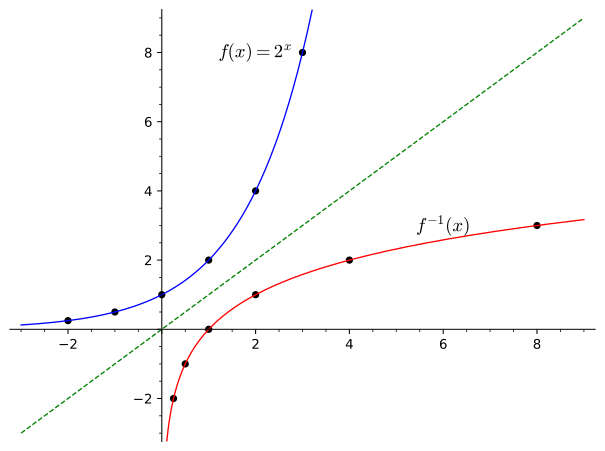
To obtain a table of values for \(f^{-1}\) we simply reverse the roles of input and output. Equivalently, we simply swap the order of the entries in all rows below the header.
We now use the tables for \(f\) and \(f^{-1}\) to plot graphs for both functions. You find the result in Figure 2.10.29. Our diagram includes the line \(y=x\text{.}\) Observe that the two graphs are indeed reflections of one another through this line, as predicted by Theorem 2.10.25.
The cost (in dollars) of producing \(x\) air conditioners is \(C = g(x) = 580 + 50 x\text{.}\) Find a formula for the inverse function \(g^{-1}(C)\text{.}\)
The gross domestic product (GDP) of the US is given by \(G(t)\) where \(t\) is the number of years since 1990, and the units of \(G\) are billions of dollars. Match the meaning of each of the mathematical expressions below with the correct description below.