Let \(n\) be a nonnegative integer. A topological \(n\)-manifold is a topological space \(M\) satisfying the following properties:
Hausdorff.
\(M\) is Hausdorff.
Second countable.
\(M\) is second countable: i.e., \(M\) has a countable basis.
Locally Euclidean.
\(M\) is locally Euclidean of dimension \(n\text{:}\) i.e., every \(m\in M\) has an open neighborhood \(U\) that is homeomorphic to an open subset of \(\R^n\text{.}\) (We define \(\R^0=\{\boldzero\}\text{.}\))
A \(1\)-manifold is called a curve; a \(2\)-manifold is called a surface.
Remark2.9.2.
You might be wondering whether an \(m\)-manifold could also be an \(n\)-manifold. The answer is no, but hinges on the fact that \(\R^m\) is not homeomorphic to \(\R^n\) (invariance of domain), which is difficult to prove in full generality. However, we do know that invariance of domain holds for \(\R^1\) and \(\R^2\) (homework exercise), so the \(n\) in \(n\)-manifold is well-defined at least for \(n=1,2\text{.}\)
Example2.9.3.Sphere, projective 2-space, torus.
Show that \(S^2\text{,}\)\(\PP^2\text{,}\) and \(T\) are surfaces.
Solution.
Definition2.9.4.Euclidean balls.
Let \(M\) be an \(n\)-manifold. A Euclidean ball is an open set \(B\subseteq M\) that is homeomorphic to an open ball of \(\R^n\text{.}\)
A Euclidean ball \(B\subseteq M\) is regular if there is a Euclidean ball \(B'\) such that (i) \(\overline{B}\subseteq B'\) and (ii) there is a homeomorphism of \(\phi\colon B'\rightarrow B_{2r}(\boldzero)\subseteq \R^n\) for some \(r> 0\text{,}\) such that \(\overline{B}=\phi^{-1}(\overline{B}_r(\boldzero))\text{.}\)
Definition2.9.5.Connected sum of surfaces.
For each \(i\in \{1,2\}\) let \(M_i\) be a surface and let \(B_i\subseteq M_i\) be a regular Euclidean ball. Furthermore, let \(\phi\colon \partial \overline{B_1}\rightarrow \partial \overline{B_2}\) be a homeomorphism. The connected sum of \(M_1\) and \(M_2\) is the quotient space \(M_1\# M_2\) obtained from the disjoint union \((M_1-B_1)\coprod (M_2-B_2)\) by identifying \(m\) and \(\phi(m)\) for all points \(m\in \partial\overline{B_1}\text{.}\)
It is possible to show that \(M_1\# M_2\) is itself a surface.
Example2.9.6.Double torus.
The double torus (or 2-holed torus) is the connected sum \(T\# T\) obtained by excising two circular patches on two copies of \(T\) and glueing the two surfaces together along the circular boundaries. Make this description more precise, using the quotient description of the torus.
Solution.
Let \(T\) be the torus realized as the quotient of \(I\times I\) by the relation \((0,y)\sim (1,y)\) and \((x,0)\sim (x,1)\) for all \(x,y\in I\text{,}\) and let \(T_1, T_2\) be copies of \(T\)
Example2.9.7.Fundamental group of the figure eight.
Let \(X\) be your favorite incarnation of the figure eight space.
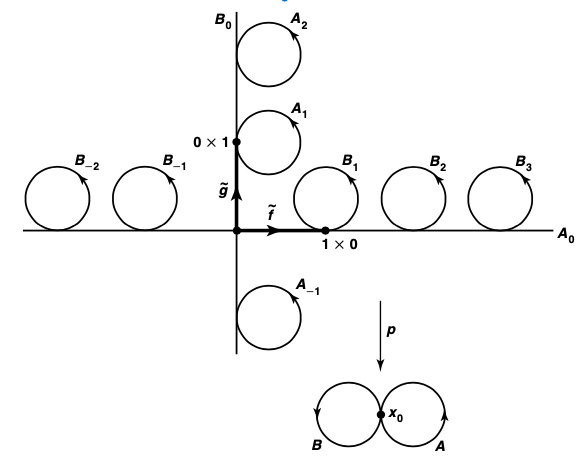
Show that the diagram below describes a covering map of \(X\text{.}\) Your argument can be somewhat informal (since no formulas are provided).
Let \(x_0\) be the intersection of the two circles in the figure eight, and let \(f,g\in P(X; x_0,x_0)\) be the simple paths traversing the left and right hoops of \(X\text{,}\) with orientation as in the diagram. Use the lifting correspondence to show that \([f]*[g]\ne [g]*[f]\text{,}\) and hence that \(\pi_1(X,x_0)\) is a nonabelian group.
Example2.9.8.Double torus fundamental group.
Give an informal, yet convincing argument that there is a retraction \(r\colon T\#T\rightarrow X\) from the double torus \(T\#T\) to the figure eight space \(X\text{.}\) Explain why this implies \(\pi_1(T\#T, x_0)\) is nonabelian.
Theorem2.9.9.Some non-homeomorphic surfaces.
The following surfaces are pairwise non-homeomorphic: \(S^2, T, \PP^2, T\#T\text{.}\)