\((1)\implies (2)\text{.}\) If
\(G\) is free abelian, there is an isomorphism
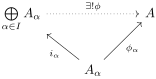
\(\phi\colon \bigoplus_{\alpha\in I}\Z\rightarrow G\text{.}\) Let
\(\phi_\alpha=\phi\circ i_\alpha\) and let
\(g_{\alpha}=\phi_\alpha(1)\text{.}\) From
(2.12.2) we have
\begin{align*}
\phi((m_\alpha))\amp = \sum_{\alpha\in I} \phi_\alpha(m_\alpha) \\
\amp = \sum_{\alpha\in I}m_\alpha\phi_\alpha(1) \amp (\phi_\alpha \text{ a homo.})\\
\amp =\sum_{\alpha\in I}m_\alpha g_\alpha\text{.}
\end{align*}
\((2)\implies (3)\text{.}\) This is clear.
\((3)\implies (4)\text{.}\) Since for any \(g\) we can write \(g=\sum_{\alpha\in I}m_\alpha g_\alpha\text{,}\) given a homomorphism \(\phi\colon G\rightarrow A\) we have
\begin{align*}
\phi(g) \amp =\phi\left( \sum_{\alpha\in I}m_\alpha g_\alpha\right)\\
\amp = \sum_{\alpha\in I}m_\alpha\phi(g_\alpha)\text{.}
\end{align*}
Thus \(\phi\) is completely determined by its values \((\phi(g_\alpha))_{\alpha\in I}\text{.}\) Furthermore, given any tuple \((a_\alpha)_{\alpha\in I}\) it is easy to see that the function \(\phi\colon G\rightarrow A\) defined as
\begin{equation*}
\phi(g)=\phi \left( \sum_{\alpha\in I}m_\alpha g_\alpha\right)=\sum_{\alpha\in I}m_\alpha a_\alpha
\end{equation*}
is well-defined and a group homomorphism.
\((4)\implies (1)\text{.}\) Given such a tuple \((g_\alpha)_{\alpha\in I}\text{,}\) we define group homomorphisms \(\phi_\alpha\colon \Z\rightarrow G\) as \(\phi_{\alpha}(m)=mg_\alpha\text{.}\) This gives rise to a group homomorphism \(\phi\colon \oplus_{\alpha\in I}\Z\rightarrow G\) satisfying
\begin{equation*}
\phi_\alpha=\phi\circ i_\alpha
\end{equation*}
for all \(\alpha\in I\text{.}\) Next, for all \(\alpha\in I\) let \(\bolde_\alpha=i_\alpha(1)\text{:}\) this is the tuple in \(\bigoplus_{\alpha\in I}\Z\) whose \(\alpha\)-th component is \(1\text{,}\) and whose every other component is 0. The property described in (4) guarantees that there is a unique homomorphism \(\psi\colon G\rightarrow \bigoplus_{\alpha\in I}\Z\) sending \(g_\alpha\) to \(\psi(g_\alpha)=\bolde_\alpha\text{.}\) We will show that \(\phi\) and \(\psi\) are inverses of each other, and hence that \(G\cong \bigoplus_{\alpha\in I}\Z\text{.}\)
\(\psi\circ\phi=\id\text{.}\) We have \(\psi\circ\phi\colon \bigoplus \Z\rightarrow \bigoplus \Z\text{.}\) Using the universal mapping property of \(\bigoplus_{\alpha\in I} \Z\text{,}\) if we show that \((\psi\circ\phi)\circ i_\alpha=i_\alpha\) for all \(\alpha\in I\text{,}\) we conclude that \(\psi\circ\phi=\id\text{.}\) For any \(m\in \Z\) we have
\begin{align*}
(\psi\circ\phi)\circ i_\alpha (m) \amp=\psi(\phi\circ i_\alpha(m)) \\
\amp =\psi(\phi_\alpha(m))\\
\amp=\psi(mg_\alpha) \\
\amp =m\psi(g_\alpha)\\
\amp =mi_\alpha(1)\\
\amp =i_\alpha(m)\text{.}
\end{align*}
This shows that \((\psi\circ\phi)\circ i_\alpha=i_\alpha\text{,}\) and thus \(\psi\circ\phi=\id\text{,}\) as desired.
\(\phi\circ\psi=\id\text{.}\) Since \(\phi\circ\psi\colon G\rightarrow G\text{,}\) using the uniqueness condition in the property described in (4), we need only show that \(\phi\circ \psi (g_\alpha)=g_\alpha\) for all \(\alpha\in I\text{.}\) We have
\begin{align*}
\phi\circ \psi (g_\alpha) \amp=\phi(\psi (g_\alpha)) \\
\amp =\phi(i_\alpha(1))\\
\amp = g_\alpha\text{,}
\end{align*}
as desired.