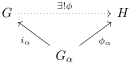
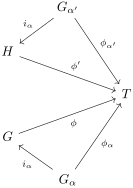
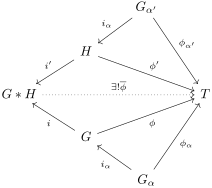
It is easy to see that the trivial word \(()\) is an identity element with respect to \(*\text{.}\) Furthermore, if \(w=(g_1,g_2,\dots, g_n)\) is a reduced word of length \(n\geq 1\text{,}\) the word \(w^{-1}=(g_n^{-1}, \dots, g_1^{-1})\) clearly satisfies \(w^{-1}u=()\) if and only if \(u=w\text{.}\) It follows that every element of \(G\) has a two-sided inverse with respect to \(*\text{.}\) The only diffficult thing to show is that \(*\) is associative, as mentioned above. This is where the trick of van der Waerden comes in.
Let \(S_G\) be the set of all permutations of \(G\text{.}\) In other words, \(S_G\) is the set of all bijections \(\sigma\colon G\rightarrow G\text{:}\) a group under function composition. We will define an injection \(i\colon G\hookrightarrow S_G\) that satisfies \(i(w*u)=i(w)\circ i(u)\) for all reduced words \(w,u\in G\text{.}\) Since composition \(\circ\) is an associative operation on \(S_G\text{,}\) it will then follow that \(*\) is an associative operation on \(G\text{.}\)
Before getting to the function \(i\text{,}\) we first define for any \(g\in G_\alpha\) a map \(\sigma_g\colon G\rightarrow G\) as follows.
\(\displaystyle \sigma_e=\id_G\)
\(\sigma_g(())=(g)\) if \(g\ne e\text{.}\)
\(\sigma_g((g_{\alpha_1},g_{\alpha_2},\dots, g_{\alpha_n}))= (g,g_{\alpha_1},g_{\alpha_2},\dots, g_{\alpha_n})\) if \(g\ne e\) and \(\alpha\ne \alpha_1\text{.}\)
\(\sigma_g((g_{\alpha_1},g_{\alpha_2},\dots, g_{\alpha_n}))
= (gg_{\alpha_1},g_{\alpha_2},\dots, g_{\alpha_n})\) if \(g\ne e\) and \(\alpha=\alpha_1\) and \(g\ne g_{\alpha_1}^{-1}\text{.}\)
\(\sigma_g((g_{\alpha_1},g_{\alpha_2},\dots, g_{\alpha_n}))= (g_{\alpha_2},\dots, g_{\alpha_n})\) if \(g\ne e\) and \(\alpha=\alpha_1\) and \(g=g_{\alpha_1}^{-1}\text{.}\)
It is now a straightforward exercise to show that if \(g,h\in G_{\alpha}\text{,}\) then \(\sigma_g\circ \sigma_h=\sigma_{gh}\text{.}\) Indeed, this is obvious if \(g=e\) or \(h=e\text{;}\) otherwise, one shows directly that \(\sigma_g(\sigma_h(w))=\sigma_{gh}(w)\) for any reduced word \(w=(g_1,g_2,\dots, g_n)\text{,}\) treating cases (2)-(5) in the definition above separately. For example, if \(g_1=h^{-1}\in G_\alpha\text{,}\) then we have
\begin{align*}
\sigma_g(\sigma_h(w)) \amp =\sigma_g(g_2,\dots, g_n)=(g,g_2,\dots, g_n) \amp (g_2\notin G_{\alpha})\\
\sigma_{gh}(w) \amp =(ghg_1,g_2,\dots,g_n)=(g,g_2,\dots, g_n) \text{.}
\end{align*}
From the property \(\sigma_{g}\circ\sigma_{h}=\sigma_{gh}\) it now follows that \(\sigma_g\) is invertible for any \(g\in G_\alpha\text{.}\) Indeed, we have
\begin{equation*}
\sigma_{g}\circ\sigma_{g^{-1}}=\sigma_{g^{-1}}\circ \sigma_g=\sigma_e=\id_G\text{.}
\end{equation*}
Thus \(\sigma_g\in S_G\) for all \(g\in G_\alpha\text{.}\)
We now define \(i\colon G\rightarrow S_G\) as follows:
\begin{align*}
i(()) \amp =\sigma_e=\id_G\\
i((g_{\alpha_1},g_{\alpha_2},\dots, g_{\alpha_n}) \amp=\sigma_{g_{\alpha_1}}\circ \sigma_{g_{\alpha_2}}\cdots \circ \sigma_{\alpha_{n}}\text{.}
\end{align*}
The fact that \(i(w*u)=i(w)*i(u)\) for any reduced words \(w,u\in G\) now follows from our definition of \(*\) and the fact that \(\sigma_g\circ \sigma_h=\sigma_{gh}\) for any \(g,h\in G_{\alpha}\text{.}\)
Lastly, we must show that \(i\) is injective. We first observe that \(i(w)=i(())\) if and only if \(w=()\text{.}\) Indeed, for any nontrivial reduced word \(w=(g_1,g_2,\dots, g_n)\) we have
\begin{equation*}
\sigma_{g_{\alpha_1}}\circ \sigma_{g_{\alpha_2}}\cdots \circ \sigma_{g_{\alpha_n}}(())=(g_1,g_2,\dots, g_n)\text{,}
\end{equation*}
and thus \(i(w)\ne i(())=\id_G\text{.}\) Now suppose that \(w=(g_1,g_2,\dots, g_n)\) and \(u=(h_1,h_2,\dots, h_m)\) are two nontrivial words with \(i(w)=i(u)\text{.}\) Letting \(u^{-1}=(h_m^{-1}, h_{m-1}^{-1}, \dots, h_1^{-1})\) (see above), we have
\begin{align*}
i(w)=i(u) \amp \implies i(u^{-1})\circ i(w)=i(u^{-1})\circ i(u)\\
\amp \implies i(u^{-1}*w)=i(u^{-1}*u)\\
\amp \implies i(u^{-1}*w)=i(())\\
\amp \implies i(u^{-1}*w)=\id_G\text{.}
\end{align*}
Since \(i(u^{-1}*w)=i(())=\id_G\text{,}\) it follows from our observation above that \(u^{-1}*w=()\text{,}\) and hence that \(w=u\text{.}\)