Section 1.23 Tychonoff theorem via nets
We now give a proof of Tychonoff’s theorem using nets. The first such proof was given by UC Berkeley mathematician John L. Kelley in his 1950 paper
Convergence in topology. Our proof draws from a couple of slight improvements to Kelley’s original argument, both proffered by additional UC Berkeley mathematicians. (Go Bears!) Paul Chernoff’s
A simple proof of Tychonoff’s theorem via nets 1 removed the need for universal nets in Kelley’s argument; Charles Pugh is credited for
Lemma 1.23.4, which removes the argument’s reliance on subnets. All of these various proofs invoke
Zorn’s lemma, which as it turns out is equivalent to the axiom of choice. You may be asking: Is there a proof of the Tychonoff theorem that does not rely on the axiom of choice? Amazingly, the answer is no! In fact, Kelley himself proved that Tychonoff’s theorem is equivalent to the axiom of choice in another paper from 1950:
The Tychonoff product theorem implies the axiom of choice. His argument is simply too elegant not to include here. (Note: Kelley’s original argument had a minor flaw that is corrected in the proof below. I encourage you to look at the original article and see if you can find the invalid step.)
Theorem 1.23.1. Tychonoff implies AC (Kelley).
If Tychonoff’s theorem is true, then the axiom of choice is true.
Proof.
Assume Tychonoff’s theorem is true. We will prove the following equivalent formulation of the axiom of choice:
\begin{equation}
X_i\ne\emptyset \text{ for all } i\in I \implies X=\prod_{i\in I}X_i\ne \emptyset\text{.}\tag{1.23.1}
\end{equation}
Given a collection \(\{X_i\}_{i\in I}\) of nonempty sets, let \(Y_i=X_i\sqcup \{P_i\}\) the result of adding one additional point, \(P_i\text{,}\) to each \(X_i\text{.}\) Why do we do this? Add the marked point \(P_i\) to the \(i\)-th component space gives us a foothold, as it were, allowing us to find elements in the product without invoking the axiom of choice in the process: we can always “choose” the \(i\)-th entry to be this special element \(P_i\text{.}\) We will use Tychonoff’s theorem to show that \(X\) is a nonempty subset of \(Y\text{.}\) To do so, we need to give the sets \(Y_i\) a compact topological structure: this is accomplished by declaring the topology on \(Y_i\) to be \(\mathcal{T}_i=\{\emptyset, X_i, \{P_i\}, Y_i\}\text{.}\) (Check that this is a topology.) This clearly makes \(Y_i\) compact, since \(\mathcal{T}_i\) only contains four open sets. Note also that \(X_i=Y_i-\{P_i\}\) is closed with respect to this topology.
Since each \(Y_i\) is compact, by Tychonoff’s theorem so is \(Y=\prod_{i\in I}Y_i\text{.}\) For each \(i\in I\text{,}\) let \(\pi_i\colon Y\rightarrow Y_i\) be the \(i\)th projection map and define
\begin{equation*}
C_i=\pi_i^{-1}(X_i)=\{(y_j)_{j\in I}\colon y_i\in X_i\}\text{.}
\end{equation*}
Since \(X_i=Y_i-\{P_i\}\) is closed in \(Y_i\text{,}\) and since \(\pi_i\) is continuous, the set \(C_i\) is closed for each \(i\in I\text{.}\) Furthermore given any finite set \(\{i_1,i_2,\dots,i_n\}\subseteq I\text{,}\) the set \(\bigcap_{k=1}^nC_{i_k}\) is nonempty: indeed, by the finite axiom of choice principle (which is implied by ZF set theory) there exists a tuple \((x_{i_1}, x_{i_2}, \dots, x_{i_n})\in \prod_{k=1}^nX_{i_k}\text{,}\) and thus the element \(y=(y_i)_{i\in I}\) defined as
\begin{equation*}
y_i=\begin{cases}
x_{i_k}\amp \text{if } i=i_k \text{ for some } 1\leq k\leq n\\
P_i\amp \text{if } i\notin \{i_1,i_2,\dots, i_n\}
\end{cases}
\end{equation*}
is an element of \(\bigcap_{k=1}^n C_{i_k}\text{.}\) Now since \(Y\) is compact, we have \(\bigcap_{i\in I}C_i\ne\emptyset\text{,}\) using the finite intersection characterization of compactness. But clearly \(X=\prod_{i\in I}X_i=\bigcap_{i\in I}C_i\text{.}\) Thus \(X\ne \emptyset\text{.}\)
Now on to a net-based proof of Tychonoff’s theorem. As mentioned we use Zorn’s lemma, the statement of which involves some extra jargon.
Definition 1.23.2. Upper bounds, maximal elements, chains.
Let \((I, \leq)\) be a partially ordered set.
An upper bound on a subset \(J\subseteq I\) is an element \(i\in I\) such that \(i\geq j\) for all \(j\in J\text{.}\)
An element \(i\in I\) is maximal if given any \(i'\in I\text{,}\) if \(i\leq i'\text{,}\) then \(i=i'\text{.}\)
A subset \(J\subseteq I\) is a chain (or totally ordered) if for all \(j, j'\in J\) we have \(j\leq j'\) or \(j'\leq j\text{.}\)
Theorem 1.23.3. Zorn’s lemma.
Let \((I,\leq)\) be a partially ordered set. If every chain \(J\subseteq I\) has an upper bound, then \(I\) has a maximal element: i.e., there is an \(i\in I\) such that for all \(i'\in I\text{,}\) if \(i\leq i'\text{,}\) then \(i=i'\text{.}\)
Proof.
As stated above, Zorn’s lemma is equivalent to the axiom of choice. You can find a proof of this fact in most introductory set theory texts.
Lastly, before moving to the main attraction, we record a useful lemma that will simplify our main argument. The proof idea, due to Charles Pugh, avoids all mention of subnets, providing a path to proving Tychonoff’s theorem that does not require subnets. There is a fairly direct alternative proof of the lemma using convergent subnets. See if you can figure it out!
Lemma 1.23.4. Nets in products.
Let \(X, Y\) be topological spaces, and assume \(Y\) is compact. Let \(f=((x_i, y_i))_{i\in I}\) be a net in \(X\times Y\text{.}\) If \(x\in X\) is a limit point of the net \((x_i)_{i\in I}\text{,}\) then there is a \(y\in Y\) such that \((x,y)\) is a limit point of \(f\text{.}\)
Proof.
Let \(x\in X\) be a limit point of \((x_i)_{i\in I}\text{.}\) Define \(J\) to be the set of all pairs \((U,i)\text{,}\) where \(U\) is an open neighborhood of \(x\text{,}\) and \(x_i\in U\text{.}\) For elements \((U,i), (U',i')\in J\) we declare \((U,i)\leq (U',i')\) if and only if \(U\supseteq U'\) and \(i\leq i'\text{.}\) It is easy to see that \(J\) is a partially ordered set with respect to this ordering. We now show that $J$ is directed. Fix elements \(j=(U, i)\) and \(j'=(U', i')\) in \(J\text{.}\) Since \(x\) is a limit point of \((x_{i})_{i\in I}\) and \(U\cap U'\) is an open neighborhood of \(x\text{,}\) we can find an index \(i''\) satisfying \(i''\geq i\text{,}\) \(i''\geq i'\text{,}\) and \(x_{i''}\in U\cap U'\text{.}\) It follows that \(j''=(U\cap U', i'')\) is an element of \(J\) and \(j,j'\leq j''\text{,}\) as desired.
Now define the net \(g\colon J\rightarrow Y\) as \(g((U,i))=y_i\text{.}\) (Recall, our original net is \(f=((x_i,y_i))_{i\in I}\text{.}\)) Since \(Y\) is compact, the net \(g\) has a limit point \(y\in Y\text{.}\) We claim that \((x,y)\) is a limit point of our original net \(f=((x_i,y_i))_{i\in I}\text{.}\) To prove this, it is enough to show that given any basic opens set \(U\times V\) containing \((x,y)\text{,}\) and any \(i\in I\text{,}\) we can find an index \(i'\geq i\) such that \((x_{i'},y_{i'})\in U\times V\text{.}\) Given \(U\times V\) containing \((x,y)\) and index \(i\in I\text{,}\) first pick an index \(i''\geq i\) such that \(x_{i''}\in U\text{.}\) This is possible since \(x\) is a limit point of \((x_i)_{i\in I}\text{.}\) By definition the pair \(j=(U,i'')\) is an element of \(J\text{.}\) Since \(y\) is a limit point of the net \(g\text{,}\) and since \(V\) is an open neighborhood of \(y\text{,}\) we can find an element \(j'=(U',i')\) such that \(j'=(U',i')\geq j=(U,i'')\) and \(g(j')=y_{i'}\in V\text{.}\) By definition of \(J\) and its partial ordering, we have \(i'\geq i\text{,}\) \(U'\subseteq U\text{,}\) and \(x_{i'}\in U'\text{.}\) We conclude that \((x_{i'},y_{i'})\in U'\times V\subseteq U\times V\text{,}\) as desired.
Theorem 1.23.5. Tychonoff theorem.
Given any collection \(\{X_t\}_{t\in T}\) of compact spaces the product space \(X=\prod_{t\in T}X_t\) is compact.
Proof (following P. Chernoff).
Assume \(X=\prod_{t\in T}X_t\text{,}\) where \(X_t\) is compact for all \(t\in T\text{.}\) We will show that \(X\) is compact by proving that any net in \(X\) has a limit point. In an effort to distinguish between the different types of tuple objects at play here, we will (almost exclusively) use tuple notation for nets and (almost exclusively) use function notation for elements of \(X=\prod_{t\in T}X_t\text{.}\)
Before continuing, we introduce some additional notation. Given any subset \(S\subseteq T\text{,}\) we let
\begin{equation*}
X_S=\prod_{t\in S} X_t=\{f\colon S\rightarrow \bigcup_{t\in S}X_t\colon f(t)\in X_t \text{ for all } t\in S\}\text{,}
\end{equation*}
and we define
\begin{align*}
\pi_S\colon X \amp \rightarrow X_S\\
f=(x_t)_{t\in T} \amp\longmapsto f\vert_S=(x_t)_{t\in S} \text{.}
\end{align*}
In other words \(X_S\) is the product of all the \(S\)-components of \(X\text{,}\) and \(\pi_S\) is the projection map from \(X\) onto this product. Observe that if \(S=\{t_0\}\) is a singleton, then \(\prod_{t\in \{t_0\}}X_t\) is homeomorphic with \(X_{t_0}\) via the map \(f\mapsto f(t_0)\text{.}\)
Now fix any net \(h=(f_i)_{i\in I}\) in \(X\text{.}\) Define \(\mathcal{F}\) to be the set of all pairs \((S,g)\text{,}\) where \(S\subseteq T\) and \(g\in X_S=\prod_{t\in S}X_t\) is a limit point of the net \((f_i\vert_S)_{i\in I}\) in \(X_S\text{.}\) (Using our notation introduced above, we have \((f_i\vert_S)_{i\in I}=\pi_S\circ h\text{.}\)) We give \(\mathcal{F}\) the structure of a partial ordered set as follows: given elements \((S,g)\) and \((S',g')\text{,}\) we define \((S,g)\leq (S',g')\) if and only if \(S\subseteq S'\) and \(g'\vert_S=g\text{.}\) (It is easy to see that \(\leq\) is indeed a partial order.) Our proof now proceeds in two steps: (1) we will show that \((\mathcal{F},\leq)\) satisfies the conditions of Zorn’s lemma, and hence has a maximal element \((S^*, g^*)\text{;}\) (2) we will show that \(S^*=T\) and hence that \(g^*=f\in X=\prod_{t\in T}X_t\) is a limit point of the net \(h=(f_i)_{i\in I}\text{.}\)
Step 1: \(\mathcal{F}\) has a maximal element.
First observe that
\(\mathcal{F}\) is nonempty. Indeed, given any
\(t_0\in T\text{,}\) the net
\((f_i\vert_{\{t_0\}})_{i\in I}\) is just a net in the space
\(X_{\{t_0\}}=\prod_{t\in \{t_0\}}X_t\text{.}\) As we observed above, this space is homeomorphic to
\(X_{t_0}\text{,}\) and hence is compact. By
Theorem 1.22.11, the net
\((f_i\vert_{\{t_0\}})_{i\in I}\) has a limit point
\(g\text{.}\) We conclude that
\((\{t_0\}, g)\in \mathcal{F}\text{.}\)
Next we show that any chain in \(\mathcal{F}\) has an upper bound in \(\mathcal{F}\text{.}\) To this end, given any chain \(\mathcal{C}\) in \(\mathcal{F}\text{,}\) we define \((\widetilde{S},\widetilde{g})\) as follows:
\(\widetilde{S}=\bigcup\limits_{(S,g)\in \mathcal{C}}S\text{;}\)
the function \(\widetilde{g}\colon \widetilde{S}\rightarrow \bigcup_{t\in \widetilde{S}}X_t\) is defined as \(\widetilde{g}(s)=g(s)\text{,}\) where \((S,g)\) is any element of \(\mathcal{C}\) for which \(s\in S\text{.}\)
Assuming \((\widetilde{S},\widetilde{g})\) is indeed a well-defined element of \(\mathcal{F}\text{,}\) it clear that it is an upper bound of \(\mathcal{C}\text{.}\)
We first observe that \(\widetilde{g}\) is a well-defined function: if \(s\in S\cap S'\text{,}\) where \((S,g),(S',g')\in \mathcal{F}\text{,}\) then since \(\mathcal{C}\) is a chain either \((S,g)\leq (S',g')\) or \((S',g')\leq (S,g)\text{;}\) assuming without loss of generality that \((S,g)\leq (S',g')\) we have \(g'\vert_S=g\) by definition, and hence that \(g(s)=g'(s)\text{.}\)
Next we show that \(\widetilde{g}\in X_{\widetilde{S}}=\prod_{t\in \widetilde{S}}X_t\) is a limit point of the net \((f_i\vert_{\widetilde{S}})_{i\in I}\text{.}\) To this end, let \(U\) be an open neighborhood of \(\widetilde{g}\) in \(X_{\widetilde{S}}\text{.}\) Shrinking if necessary, we may assume that \(U=\prod_{t\in F}U_t\times \prod_{t\in \widetilde{S}-F}X_t\text{,}\) where \(F\) is a finite subset of \(\widetilde{S}\text{.}\) Note that in general we have \(g\in U\) for some \(g\in X_{\widetilde{S}}\) if and only if \(g(t)\in U_t\) for all \(t\in F\text{.}\) Now, given any \(i_0\in I\text{,}\) we seek an index \(i'\geq i_0\) such that \(f_{i'}\vert_{\widetilde{S}}\in U\text{.}\) Since \(F\) is a finite subset of \(\widetilde{S}=\bigcup\limits_{(S,g)\in \mathcal{C}} S\text{,}\) we have \(F\subseteq \bigcup_{k=1}^nS_k\) for some sets \(S_k\) satisfying \((S_k, g_k)\in \mathcal{C}\text{.}\) Since \(\mathcal{C}\) is a chain, this finite collection of elements \((S_k, g_k)\) has a maximal element. It follows that \(F\subseteq S_k\) for some \(k\text{:}\) i.e., we may assume that \(F\subseteq S\) for some element \((S,g)\in \mathcal{C}\text{.}\) By definition \(g\) is a limit point of the net \((f_i\vert_S)_{i\in I}\text{.}\) Since \(\widetilde{g}\vert_S=g\text{,}\) it follows that \(g(t)\in U_t\) for all \(t\in F\) and thus \(g\in U'=\prod_{t\in F}U_t\times \prod_{t\in S-F}X_t\text{.}\) Since \(g\) is a limit point of \((f_i\vert_S)_{i\in I}\text{,}\) there is an \(i'\geq i_0\) such that \(f_{i'}\vert_S\in \prod_{t\in F}U_t\times \prod_{t\in S-F}X_t\text{:}\) or equivalently, that \(f_{i'}\vert_S(t)\in U_t\) for all \(t\in F\text{.}\) But then the same reasoning shows \(f_{i'}\vert_{\widetilde{S}}\in \prod_{t\in F}U_t\times \prod_{t\in \widetilde{S}-F}X_t\text{,}\) as desired.
Having shown that \(\mathcal{F}\) satisfies the chain condition for Zorn’s lemma, we conclude that it contains a maximal element \((S^*, g^*)\text{.}\)
Step 2: \(S^*=T\).
Let \((S^*, g^*)\) be a maximal element of \(\mathcal{F}\text{,}\) so that \(g^*\) is a limit point of the net \((f_i\vert_{S^*})_{i\in I}\text{.}\) We show that \(S^*\) and hence that \(g^*=f\in X\) is a limit point of \((f_i)_{i\in I}\text{.}\)
Assume by contradiction that \(S^*\ne T\text{.}\) Pick any \(t_0\in T-S^*\text{,}\) and define \(S=S^*\cup\{t_0\}\text{.}\) We will show that there is a \(g\in X_{S}\) such that \(g\vert_{S^*}=g^*\text{,}\) and \(g\) is a limit point of \((f_i\vert_{S})_{i\in I}\text{.}\) This is a contradiction since then \((S^*,g^*)\leq (S,g)\) but \((S^*,g^*)\ne (S,g)\text{.}\)
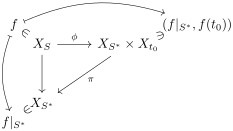
Observe first that \(X_{S}\) is homeomorphic to \(X_{S^*}\times X_{t_0}\) via the map
\begin{align*}
\phi\colon X_S \amp \rightarrow X_{S^*}\times X_{t_0}\\
f \amp \mapsto (f\vert_{S^*}, f(t_0))\text{.}
\end{align*}
Let
\(\pi\colon X_{S^*}\times X_{t_0}\rightarrow X_{S^*}\) be projection onto the first component. The commutative diagram below nicely summarizes the maps in play.
Since
\(X_{t_0}\) is compact, and since
\(g^*\) is a limit point of the net
\((f_i\vert_{S^*})_{i\in I}\) in
\(X_{S^*}\text{,}\) by
Lemma 1.23.4 the net
\((f_i\vert_{S^*}, f_i(t_0))_{i\in I}\) in
\(X_{S^*}\times X_{t_0}\) has a limit point of the form
\((g^*, x_{t_0})\text{.}\) Since
\(\phi\) is a homeomorphism, pulling everything back to
\(X_S\text{,}\) we see that the function
\(g\in \pi_{t\in S} X_t\) defined as
\begin{equation*}
g(s)=\begin{cases} g^*(s)\amp \text{if } s\in S^* \\
x_{t_0}\amp \text{if } s=t_0
\end{cases}
\end{equation*}
is a limit point of \((f_i\vert_{S})_{i\in I}\text{.}\) We conclude that \((S,g)\) is an element of \(\mathcal{F}\) and satisfies satisfies \((S,g)\geq (S^*, g^*)\) and \((S,g)\ne (S^*, g^*)\text{,}\) contradicting the fact that \((S^*, g^*)\) is a maximal element.