Section 1.10 Homeomorphisms
Consider the two spaces \(X=\{1,2\}\) and \(Y=\{3,4\}\text{,}\) both equipped with the discrete topology. As sets they are clearly not equal; and yet considered as topological spaces they are essentially the same. Indeed, we call both spaces the discrete topological space on a set of two elements. The notion of a homeomorphism gives us a rigorous way of determining when two spaces are “essentially the same thing, topologically speaking”.
Definition 1.10.1. Homeomorphism.
Let \(X\) and \(Y\) be topological spaces. A function \(f\colon X\rightarrow Y\) is a homeomorphism if the following conditions are satisfied:
\(f\) is continuous;
\(f\) is invertible (equivalently, \(f\) is bijective);
the inverse function \(f^{-1}\colon Y\rightarrow X\) is continuous.
Two spaces are homeomorphic if there is a homeomorphism between them.
Example 1.10.3. Homeomorphism: inverse must be continuous.
Let \(\R_{\operatorname{std}}\) and \(\R_{\operatorname{disc}}\) be the spaces obtained by equipping \(\R\) with the standard and discrete topologies, respectively. The identity function
\begin{align*}
\id_\R\colon \R_{\operatorname{disc}}\amp\rightarrow \R_{\operatorname{std}}\\
x\amp\mapsto x
\end{align*}
is clearly continuous and invertible. In fact, we have \(\id_\R^{-1}=\id_\R\text{.}\) However, \(\id_\R\colon \R_{\operatorname{std}}\rightarrow \R_{\operatorname{disc}}\) is not continuous. Indeed, \(U=[0,1)\) is open in \(\R_{\operatorname{disc}}\text{,}\) but \(\id_\R^{-1}(U)=[0,1)\) is not open in \(\R_{\operatorname{std}}\text{.}\) Thus \(\id_{\R_{\operatorname{disc}}}\colon \R_{\operatorname{std}}\rightarrow \R\) is an invertible continuous function that is not a homeomorphism.
Example 1.10.5. All open intervals of \(\R\) are homeomorphic.
In the following, all intervals are treated as metric spaces with the Euclidean metric on \(\R\text{.}\) Make use of any function whose continuity properties are well known.
Prove that any finite open interval \((a,b)\) is homeomorphic to \((0,1)\text{.}\)
Prove that \((-\pi/2, \pi/2)\) and \(\R\) are homeomorphic.
Prove that \((a,\infty)\) and \((-\infty, b)\) are both homeomorphic to \(\R\text{.}\)
Explain why we may now conclude that all open intervals of \(\R\) are homeomorphic.
Solution.
The function \(f\colon (0,1)\rightarrow (a,b)\) defined as \(f(x)=a+(b-a)x\) is linear (hence continuous) and has continuous inverse \(f^{-1}(x)=\frac{x-a}{b-a}\text{.}\)
The function \(\tan\colon (-\pi/2,\pi/2)\rightarrow \R\) is continuous and has continuous inverse \(f^{-1}(x)=\arctan x\text{.}\)
The functions \(f\colon (a,\infty)\rightarrow \R\text{,}\) \(f(x)=\ln(x-a)\text{,}\) and \(g\colon (-\infty, b)\rightarrow \R\text{,}\) \(g(x)=\ln(b-x)\) are continuous and have continuous inverses \(f^{-1}(x)=e^x+a\) and \(g^{-1}(x)=b-e^{x}\text{.}\)
This is now the result of the fact that being homeomorphic is an equivalence relation. In more detail, from (1) we know that all finite open intervals are homeomorphic; this in conjunction with (2) shows that all finite open intervals are homemorphic to \(\R\text{.}\) From (3) we conclude that all half-finite intervals are homeomorphic to \(\R\text{.}\) Since any open interval is either finite, half-finite, or equal to \(\R\text{,}\) we conclude that all open intervals are homeomorphic.
Definition 1.10.6. Open and closed maps.
Let \(f\colon X\rightarrow Y\) be a function between topological spaces.
\(f\) is open if for all open \(U\subseteq X\) we have \(f(U)\) open in \(Y\text{.}\)
\(f\) is closed if for all closed \(C\subseteq X\) we have \(f(C)\) closed in \(Y\text{.}\)
Theorem 1.10.7. Homeomorphism equivalences.
Let \(f\colon X\rightarrow Y\) be a function between topological spaces. The following statements are equivalent.
\(f\) is a homeomorphism.
\(f\) is continuous, invertible, and open.
\(f\) is continuous, invertible, and closed.
Proof.
Assume \(f\) is continuous and invertible throughout. To be a homeomorphism we need \(g=f^{-1}\) to be continuous. Since \(g(y)=x\) if and only if \(f(x)=y\text{,}\) we see that \(g^{-1}(A)=f(A)\text{.}\) Thus \(g\) continuous if and only if \(g^{-1}(U)\) is open for all open \(U\subseteq X\text{,}\) if and only if \(f(U)\) is open for all open \(U\subseteq X\text{,}\) if and only if \(f\) is open. The same argument with “closed” replacing “open” shows \(g\) is continuous if and only if \(f\) is closed. The equivalence of (1)-(3) now follows.
Definition 1.10.9. Topological properties.
Let \(\mathcal{P}\) be a property that is either satisfied or not satisfied by any given topological space. We say \(\mathcal{P}\) is a topological property if it is invariant under homeomorphisms: i.e., if \(X\) and \(Y\) are homeomorphic, then \(X\) satisfies \(\mathcal{P}\) if and only if \(Y\) satisfies \(\mathcal{P}\text{.}\)
Example 1.10.10. Topological properties.
It is easy to see that the properties of being discrete, \(T_1\text{,}\) Hausdorff, or a metric space are topological.
Theorem 1.10.11. Universal mapping property of product space.
Let \(\{X_i, \mathcal{T}_i\}_{i\in I}\) be a collection of topological spaces, and let \(X=\prod_{i\in I}X_i\) equipped with the product topology. Let \(\pi_i\colon X\rightarrow X_i\) be the \(i\)-th projection map: i.e., given \(\boldx=(x_j)_{j\in J}\text{,}\) we define \(\pi_i(\boldx)=x_i\text{.}\)
-
Projection maps.
For each \(i\in I\) the projection map \(\pi_i\) is continuous, open, and surjective.
-
Product universal mapping property.
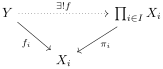
The space \(X\) together with its projection maps \(\{\pi_i\colon X\rightarrow X_i\}_{i\in I}\) satisfies the following universal mapping property: given any topological space \(Y\) and collection \(\{f_i\colon Y\rightarrow X_i\}_{i\in I}\) of continuous maps, there is a unique continuous map \(f\colon Y\rightarrow X\) satisfying \(f_i=\pi_i\circ f\) for all \(i\in I\text{.}\) In other words, there is a unique continuous function \(f\) making the diagram below commutative for all \(i\in I\text{.}\)
In fact, in this case we must have
\begin{equation}
f(y)=\left(f_i(y)\right)_{i\in I}\text{.}\tag{1.10.1}
\end{equation}
-
Unique up to homeomorphism.
The universal mapping property characterizes
\(X\) up to homeomorphism: i.e., if
\(X'\) is a topological space equipped with a collection of continuous maps
\(\{ \pi_i'\colon X'\rightarrow X_i\}_{i\in I}\) that together satisfy the
Product universal mapping property, then
\(X'\) is homeomorphic to
\(X\text{.}\)
Proof.
Fix any
\(i\in I\text{.}\) We showed
\(\pi_i\) is continuous in
Example 1.9.5. To see that
\(\pi_i\) is surjective, given any
\(x_i\in X_i\text{,}\) we have
\(\pi_i^{-1}(\{x_i\}=\{x_i\}\times \prod_{j\ne i} X_j\text{,}\) which is nonempty. Lastly, suppose
\(U\subseteq X\) is open. We wish to show that
\(\pi_i(U)\) is open in
\(X_i\text{.}\) To this end, given any
\(x_i=\pi_i(\boldx)\in \pi_i(U)\text{,}\) we have
\(x\in B\subseteq U\) for some open base set
\begin{equation*}
B=\prod_{i\in I}U_i\text{,}
\end{equation*}
where \(U_j\) is open in \(X_j\) and \(U_j=X_j\) for all but finitely many \(j\text{.}\) But then \(\pi_(\boldx)\in \pi_i(B)=U_i\subseteq \pi_i(U)\text{.}\) Since \(U_i\) is open, we have shown that given any \(x_i\in \pi_i(U)\text{,}\) there is an open set \(U_i\) such that \(x\in U_i\subseteq \pi_i(U)\text{.}\) It follows that \(\pi_i(U)\) is open, as desired.
First observe that equality for elements \(\boldx=(x_i)_{i\in I}, \boldy=(y_i)_{i\in I}\) in \(X\) can be expressed in terms of the projection maps as follows:
\begin{equation*}
\boldx=\boldy \iff x_i=y_i \text{ for all } i\in I \iff \pi_i(x)=\pi_i(y) \text{ for all } i\in I\text{.}
\end{equation*}
Using this fact, we see that given a function \(f\colon Y\rightarrow X\) we have
\begin{align*}
f_i=\pi_i\circ f \text{ for all } i\in I \amp \iff f_i(y)=\pi_i(f(y)) \text{ for all } y\in Y, i\in I \\
\amp \iff f(y)=(f_i(y))_{i\in I} \text{.}
\end{align*}
Thus the function \(f(y)=(f_i(y))_{i\in I}\) is the unique function from \(Y\) to \(X\) satisfying \(f_i=\pi_i\circ f\) for all \(i\in I\text{.}\) To see that this \(f\) is continuous, we show that \(f^{-1}(B)\) is open for any base open set \(B\subseteq X\text{.}\) For such a \(B\) we have \(B=\prod_{j=1}^n U_{i_j}\times \prod_{i\ne j}X_i\) for some open sets \(U_{i_j}\subseteq X_{i_j}\text{,}\) \(1\leq j\leq n\text{.}\) Note that for all \(1\leq j \leq n\) we have
\begin{equation*}
\pi_{i_j}^{-1}(U_{i_j})=U_{i_j}\times \prod_{i\ne i_j}X_i
\end{equation*}
from which it follows that
\begin{align*}
B=\prod_{j=1}^n U_{i_j}\times \prod_{i\ne j}X_i\amp = \bigcap_{j=1}^nU_{i_j}\times \prod_{i\ne i_j}X_i \\
\amp = \bigcap_{j=1}^n\pi_{i_j}^{-1}(U_{i_j})\text{.}
\end{align*}
Thus
\begin{align*}
f^{-1}(B) \amp =f^{-1}\left( \bigcap_{j=1}^n\pi_{i_j}^{-1}(U_{i_j})\right)\\
\amp = \bigcap_{j=1}^nf^{-1}(\pi_{i_j}^{-1}(U_{i_j}))\\
\amp = \bigcap_{j=1}^n(\pi_{i_j}\circ f)^{-1}(U_{i_j}) \amp \left((\pi_{i_j}\circ f)^{-1}(A)=f^{-1}(\pi_{i_j}^{-1}(A)) \right)\\
\amp = \bigcap_{j=1}^nf_{i_j}^{-1}(U_{i_j}) \amp (f_i=\pi_i\circ f \text{ for all } i\in I)\text{.}
\end{align*}
Since each \(f_{i_j}\) is continuous, this last set is a finite intersection of open sets. Thus \(f^{-1}(B)\) is open, as desired.
Let
\(X'\) together with continuous maps
\(\pi_i'\colon X\rightarrow X_i\) be any other space that satisfies
Product universal mapping property. Letting
\(Y\) be the space
\(X'\) together with its maps
\(\pi_i'\text{,}\) there is a continuous function
\(f\colon X'\rightarrow X\) satisfying
\(\pi_i'=\pi_i\circ f\) for all
\(i\text{.}\) Similarly, since
\(X'\) also satisfies the product mapping property, taking
\(Y=X\) along with its projection maps, we see there is a continuous map
\(g\colon X\rightarrow X'\) satisfying
\(\pi_i=\pi_i'\circ g\text{.}\) We claim
\(f\circ g=\id_X\) and
\(g\circ f=\id_{X'}\text{:}\) i.e.,
\(g=f^{-1}\) is a continuous inverse of
\(f\text{,}\) and thus
\(f\) is a homeomorphism between
\(X'\) and
\(X\text{.}\) To see why this is true, we use the
uniqueness claim in the product mapping property (twice). Indeed, the function
\(f\circ g\colon X\rightarrow X\) is continuous and satisfies
\begin{equation*}
\pi_i\circ (g\circ f)=(\pi_i\circ g)\circ f=\pi_i'\circ f=\pi_i
\end{equation*}
for all \(i\in I\text{.}\) But the function \(\id_X\colon X\rightarrow X\) also satisfies \(\pi_i=\pi_i\circ\id_X\) for all \(i\in I\text{.}\) By the uniqueness claim of the product mapping property, we conclude \(\id_X=f\circ g\text{,}\) as desired. The proof that \(g\circ f=\id_{X'}\) is nearly identical, now applying the product mapping property to maps into \(X'\text{.}\)
In order to give a plain English description of
Theorem 1.10.11 it helps to define the purely set-theoretic notion of a
product of maps.
Definition 1.10.12. Product of functions.
Given a collection of functions \(\{f_i\colon A\rightarrow B_i\}_{i\in I}\text{,}\) their product, denoted \(f=(f_i)_{i\in I}\) is the the function
\begin{align*}
f\colon A \amp \rightarrow \prod_{i\in I} B_i\\
x \amp\mapsto (f_i(x))_{i\in I} \text{.}
\end{align*}
For each \(i\in I\) we call \(f_i\) the \(i\)-th component function of \(f=(f_i)_{i\in I}\text{.}\)
Corollary 1.10.13. Universal mapping property of product space.
Let \(\{X_i, \mathcal{T}_i\}_{i\in I}\) be a collection of topological spaces, let \(X=\prod_{i\in I}X_i\) equipped with the product topology, and let \(\pi_i\) be the \(i\)-th projection map for all \(i\in I\text{.}\)
-
Products of continuous maps are continuous.
Given any collection of continuous functions \(\{f_i\colon Y\rightarrow X_i\}_{i\in I}\text{,}\) the product \(f=(f_i)_{i\in I}\) defined as
\begin{align*}
f\colon Y \amp \rightarrow X \\
y \amp \rightarrow (f_i(y))_{i\in I}
\end{align*}
is continuous.
-
Continuous maps to products are products.
Conversely, given any function \(f\colon Y\rightarrow X\text{,}\) we have \(f=(f_i)_{i\in I}\text{,}\) where \(f_i=\pi_i\circ f\text{.}\) Furthermore, the function \(f\) is continuous if and only if \(f_i\) is continuous for all \(i\in I\text{.}\)
Proof.
This is just a rewording of
Item 2 using the notion of a product of functions.
-
The fact that \(f=(\pi_i\circ f)_{i\in I}\) is purely set theoretic. Check for yourself.
If \(f\) is continuous, then since \(\pi_i\) is continuous we have \(f_i=\pi_\circ f\) continuous.
Conversely, if \(f_i\) is continuous, then the product \(f=(f_i)_{i\in I}\) by (1).
Example 1.10.15. Polar transformation.
Call the map
\begin{align*}
f\colon \R^2\amp\rightarrow \R^2 \\
(r,\theta) \amp\mapsto (r\cos\theta, r\sin\theta)
\end{align*}
the polar transformation.
-
Let \(U\subseteq \R^2\) be the infinite horizontal strip \(U=\{(r,\theta)\in \R^2\colon r> 0, -\pi < \theta < \pi\}\text{,}\) and let \(V=\R^2- \{(x,0)\colon x\leq 0\}\text{,}\) the plane with the nonpositive real axis deleted.
Prove that \(f\vert_U\colon U\rightarrow V\) is a homeomorphism.
-
Let \(U'\subseteq \R^2\) be the infinite horizontal strip \(U'=\{(r,\theta)\in \R^2\colon r> 0, 0 < \theta < 2\pi\}\text{,}\) and let \(V'=\R^2- \{(x,0)\colon x\geq 0\}\text{,}\) the plane with the nonnegative real axis deleted.
Prove that \(f\vert_U'\colon U'\rightarrow V'\) is a homeomorphism.
Conclude that “open polar rectangles” are open in \(\R^2-\{(0,0)\}\text{.}\) In other words, given any \(r_1,r_2,\theta_1,\theta_2\in \R\) satisfying \(0< r_1< r_2\) and \(\theta_1< \theta_2\text{,}\) the region \(R\subseteq \R^2\) consisting of all points with polar coordinates \((r,\theta)\) satisfying
\begin{align*}
r_1 \amp< r < r_2 \\
\theta_1 \amp < \theta < \theta_2
\end{align*}
is open. In fact, you can show that such polar rectangles form a basis for \(\R^2-\{(0,0)\}\text{.}\)
Solution.
We leave most of this as an exercise. Note that to show
\(f\) is continuous, by
Theorem 1.10.11 we need only show that the two “component functions”
\begin{align*}
f_1=\pi_1\circ f\colon \R^2\amp \rightarrow \R \amp f_2=\pi_2\circ f\colon \R^2\amp \rightarrow \R \\
(r,\theta)\amp \mapsto r\cos\theta \amp (r,\theta)\amp \mapsto r\sin\theta
\end{align*}
are continuous. To see that \(f_1\) is continuous, note that we have
\begin{equation*}
f_1=m\circ g
\end{equation*}
where \(g\colon \R^2\rightarrow \R^2 \) is the function \(g(r,\theta)=(r,\cos \theta)\) and \(m\colon \R^2\rightarrow \R\) is the multiplication map \(m(x,y)=xy\text{.}\) Both \(g\) and \(m\) are continuous: the two component functions of \(g\) are \(\pi_1\circ g=\pi_1\) and \(\pi_2\circ g=\cos\circ \pi_2\text{,}\) both of which are continuous; we showed in homework that more generally scalar multiplication \(m\colon \R\times \R^n\rightarrow \R^n\) is continuous for any \(n\text{.}\)
Example 1.10.16. Continuous bijection onto circle.
Let \(X=[0,1)\subseteq \R\) and \(S^1=\{(x,y)\in \R^2\colon x^2+y^2=1\}\subseteq \R^2\text{,}\) and equip each set with the subspace topology inherited from \(\R\) (resp. \(\R^2\)) with its Euclidean topology.
Prove: the function \(f\colon X\rightarrow S^1\) defined as \(f(t)=(\cos 2\pi t, \sin 2\pi t)\) is continuous and invertible, but not a homeomorphism.
Solution.
Recall first that on
\(\R^2=\R\times \R\) the product topology, Euclidean metric topology, and box topology are all equal. Since
\(f_1(x)=\cos 2\pi t\) and
\(f_2(x)=\sin 2\pi t\) are continuous, it follows from
Theorem 1.10.11 that the map
\(g\colon [0,1)\rightarrow \R\times \R=\R^2\) is continuous. Next, since
\(g=i\circ f\text{,}\) where
\(i\colon S^1\hookrightarrow \R^2\text{,}\) it follows that
\(f\) is continuous: indeed, for any open set
\(U\subseteq S^1\text{,}\) we have
\(U=U'\cap S^1\) for some open
\(U'\subseteq \R^2\text{,}\) and
\(f^{-1}(U)=g^{-1}(U')\text{,}\) which is open since
\(g\) is continuous.
The usual trigonometric arguments show that \(f\) is injective and surjective. However, \(f\) is not open, and hence not a homeomorphism. Indeed, let \(U=[0,1/2)\text{,}\) which is open in \([0,1)\text{.}\) The image \(f(U)\) is easily seen to be the upper half of the circle minus the point \(Q=(-1,0)\text{:}\) in particular, all points \(f(U)\) have nonnegative \(y\)-coordinates. On the other hand, we have \((1,0)\in f(U)\) and with respect to the subspace topology on \(S^1\) any open set containing \((1,0)\) contains elements of \(S^1\) whose \(y\)-coordinate is negative. It follows that \(f(U)\) is not open.
In light of
Theorem 1.10.11, it is natural to ask whether given topological spaces
\((X_i, \mathcal{T}_i)\) there is a space
\(X\) with continuous maps
\(X_i\rightarrow X\) that satisfies a dual mapping property to that of the product. Indeed, there is, and we call it the
coproduct of the
\(X_i\text{.}\)
Topological specimen 13. Coproduct space.
Let \(\{X_i, \mathcal{T}_i\}_{i\in I}\) be a collection of topological spaces. Let \(X\) be the disjoint union \(\coprod_{i\in I}X_i\) of the \(X_i\text{;}\) in more detail, for each \(i\in I\text{,}\) define \(\widetilde{X}_i=X_i\times \{i\}\text{,}\) and define
\begin{equation*}
\coprod_{i\in I}X_i=\bigcup_{i\in I}\widetilde{X}_i\text{.}
\end{equation*}
For each \(i\in I\) the function
\begin{align*}
\iota_i\colon X_i \amp \rightarrow \widetilde{X}_i\\
x \amp \mapsto (x,i)
\end{align*}
is a bijection between \(X_i\) and \(\widetilde{X}_i\text{,}\) and it is easy to see that the collection
\begin{equation*}
\widetilde{\mathcal{T}}_i=\iota_i(\mathcal{T}_i)=\{U\times\{i\}\colon U\in \mathcal{T}_i\}
\end{equation*}
is a topology on
\(\widetilde{X}_i\) making the map
\(\iota_i\colon X_i\rightarrow \widetilde{X}_i\) a homeomorphism.
1 The
coproduct topology on
\(X=\coprod_{i\in I}X_i\) is the topology
\(\mathcal{T}\) generated by the basis
\(\mathcal{B}\) defined as follows:
\begin{equation*}
\mathcal{B}=\{\iota_i(U)=U\times\{i\} \colon i\in I, U\in \mathcal{T}_i\} \text{.}
\end{equation*}
We call \(X\) together with the topology \(\mathcal{T}\) the coproduct of the \(X_i\text{.}\)
Theorem 1.10.17. Universal mapping property of coproduct space.
Let \(\{X_i, \mathcal{T}_i\}_{i\in I}\) be a collection of topological spaces, and let \(X=\coprod_{i\in I}X_i\) be their coproduct. For each \(i\in I\) let \(\iota_i\colon X_i\hookrightarrow X\) be the injective function
\begin{equation*}
\iota_i\colon X_i\rightarrow \widetilde{X}_i\subseteq X\text{.}
\end{equation*}
-
Injection maps.
For each \(i\in I\) the map \(\iota_i\colon X_i\rightarrow X\) is continuous, open, closed, and injective.
-
Coproduct universal mapping property.
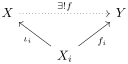
The space \(X\) together with the inclusion maps \(\{ \iota_i\colon X_i\rightarrow X\}_{i\in I}\) satisfies the following universal mapping property: given any topological space \(Y\) and collection \(\{f_i\colon X_i\rightarrow Y\}_{i\in I}\) of continuous maps, there is a unique continuous map \(f\colon X\rightarrow Y\) satisfying \(f_i=f\circ \iota_i\) for all \(i\in I\text{.}\) In other words, there is a unique continuous map \(f\colon X\rightarrow Y\) making the following diagram commutative for all \(i\in I\text{.}\)
-
Unique up to homeomorphism.
The universal mapping property characterizes
\(X\) up to homeomorphism: i.e., if
\(X'\) is a topological space equipped with a collection of continuous maps
\(\{ \iota_i'\colon X_i\rightarrow X'\}\) that together satisfy the
Coproduct universal mapping property, then
\(X'\) is homeomorphic to
\(X\text{.}\)
Proof.