
Math 344-1,2: Kursobjekt

Section 2.10 Jordan separation theorem

Definition 2.10.1. Arcs and simple closed curves.

An arc is a space that is homeomorphic to the unit interval \(I\text{;}\) a simple closed curve is a space homeomorphic to \(S^1\text{.}\)

Remark 2.10.2. Arcs and simple closed curves.

Let \(X\) be a Hausdorff space. A subspace \(C\subseteq X\) is an arc if and only if it is the image of an injective path \(\phi\colon I\rightarrow X\text{:}\) since \(I\) is compact and \(X\) is Hausdorff, the map \(\phi\) is guaranteed to be a homeomorphism onto \(C\text{.}\) Similarly, using the fact that \(S^1\) is homeomorphic to the quotient of \(I\) obtained by identifying its endpoints \(0\) and \(1\text{,}\) we see that \(C\subseteq X\) is a simple closed curve if and only if it is the image of a path \(\phi\) that is injective on \((0,1)\) and satisfies \(\phi(0)=\phi(1)\text{:}\) again, since \(I\) is compact and \(X\) is Hausdorff, the map \(\phi\) is guaranteed to be closed, hence a quotient map.

Definition 2.10.3.

Let \(A\) be a subspace of the connected space \(X\text{.}\) We say \(A\) separates \(X\) if \(X-A\) is not connected. Similarly, we say \(A\) separates \(X\) into \(n\) components if \(X-A\) has \(n\) connected components.
The goal of the next two lectures is to prove the Jordan curve theorem: any simple closed curve \(C\subseteq \R^2\) separates \(\R^2\) into two components. That this statement is true seems intuitively clear, painfully obvious even: like the circle, any simple closed curve \(C\) should have a well-defined “inside” and “outside”, giving us exactly two components of \(\R^2-C\text{.}\) All the more maddening, then, that a proof of this fact turns out to be rather difficult. On the other hand, the seemingly well-behaved notion of a path has surprised us with some pathological behavior on other occasions: forget not the space filling curve! First we include a useful result (not officially covered last quarter) about locally connected spaces.

Remark 2.10.5. Components of \(\R^2-C\).

Let \(C\subseteq \R^2\) be compact, and let \(U=\R^2-C\text{.}\) Let’s enumerate some important facts about \(U\text{.}\)
  1. \(U\) is open, since \(C\) is closed, and hence locally path connected, since \(\R^2\) is locally path connected.
  2. \(U\) is unbounded, since \(C\) is bounded.
  3. \(U\) has exactly one unbounded connected component.
To see why (2)-(3) are true, choose \(R> 0\) such that \(C\subseteq B_R(\boldzero)\text{.}\) The set \(X=\R^2-B_{R}(\boldzero)\) is connected and unbounded, hence must lie in some unbounded connected component \(V_\infty\) of \(U\text{.}\) Furthermore, if \(V\) is an unbounded connected component, then we must have \(U\cap X\ne \emptyset\) (essentially by the definition of unboundedness). But then \(V\cap V_\infty\ne \emptyset \text{.}\) Since connected components partition \(U\text{,}\) we must have \(V=V_\infty\text{.}\)

Proof.

Let \(U\) be a connected component of \(S^2-C\text{.}\) We first show that \(U-\{P\}\) is connected. This is trivial if \(P\notin U\text{,}\) so assume \(P\in U\text{.}\) Since \(U\) is open and \(S^2\) is a surface, we can find an open set \(W\) that is homeomorphic to an open ball in \(\R^2\) and which satisfies \(x\in W\subseteq U\text{.}\) (In fact, since \(U\) is a connected component and \(W\) is connected, if \(P\in W\text{,}\) then we automatically have \(W\subseteq U\text{.}\)) Assume by contradiction that \(U-\{P\}\) is not connected, and let \(U-\{P\}=A\cup B\) be a separation. Note that \(U-\{P\}\) is itself open, and thus so are \(A\) and \(B\text{.}\) Since \(W-\{P\}\) is connected (homeomorphic to punctured ball) and \(W-\{P\}\subseteq U-\{P\}\text{,}\) it must be contained in \(A\) or \(B\text{.}\) Assume without loss of generality that \(W-\{P\}\subseteq A\text{.}\) But then we have \(A\cup \{P\}=A\cup W\) is open, and thus \(U=(A\cup \{P\})\cup B\) is a separation: a contradiction.
Let \(\{U_\alpha\}_{\alpha\in I}\) be the connected components of \(S^2-C\text{.}\) By above, the sets \(U_{\alpha}-\{P\}\) are open, connected and disjoint. Thus the sets \(V_{\alpha}=h(U_{\alpha}-\{P\})\) are open connected and disjoint, and cover \(\R^2-h(C)\text{.}\) It follows that the \(V_\alpha\) are the components of \(\R^2-h(C)\text{,}\) and the correspondence
\begin{gather*} U_\alpha\mapsto V_\alpha=h(U_\alpha-\{P\}) \end{gather*}
is a bijection between the components of \(S^2-C\) and the components of \(\R^2-h(C)\text{.}\)
Lastly, let \(U_{\alpha_0}\) be the component of \(S^2-C\) containing \(P\text{.}\) Since \(S^2-U_{\alpha_0}\) is compact, \(h(S^2-U_{\alpha_{0})=\R^2-V_{\alpha_0}\) is bounded. Thus \(V_{\alpha_0}=h(U_{\alpha_0}-\{P\})\) is the unique unbounded component of \(\R^2-h(C)\text{.}\)

Proof.

Assume \(f\colon X\rightarrow S^2-\{P,Q\}\) where \(X\) is compact. Pick a homeomorphism \(h\colon S^2-\{P\}\rightarrow \R^2\) sending \(Q\) to \(\boldzero\text{,}\) and let \(g=h\circ f\text{.}\) Observe that if \(g\) is nullhomotopic via the homotopy \(H\colon X\times I\rightarrow \R^2\text{,}\) then \(f\) is nullhomotopic via the homotopy \(h^{-1}\circ H\text{.}\) Furthermore, using Lemma 2.10.6, we see that \(P\) and \(Q\) lie in the same component of \(S^2-f(X)\) if and only if \(h(Q)=\boldzero\) lies in the unbounded component of \(\R^2-h(f(X))\text{.}\) Thus it suffices to show that if \(X\) is compact and \(g\colon X\rightarrow \R^2-\{\boldzero\}\text{,}\) then \(g\) is nullhomotopic if \(\boldzero\) is in the unbounded component of \(\R^2-f(X)\text{.}\) We now show that this is the case.
Assume \(g\colon X\rightarrow \R^2-\{\boldzero\}\) with \(X\) compact, and that \(\boldzero\) lies in the unbounded component of \(\R^2-\{\boldzero\}\text{.}\) Since \(g(X)\) is compact, it is closed and bounded. Choose \(R> 0\) such that \(g(X)\subseteq B_R(\boldzero)\)and any point \(\boldy_0\notin B_R(\boldzero)\text{.}\) Since \(\R^2-g(X)\) is an open subspace of the locally path connected space \(\R^2\text{,}\) it is itself locally path connected. It follows that all the components of \(\R^2-g(X)\) are open and path connected. Let \(U_\infty\) be the unbounded component of \(\R^2-g(X)\text{.}\) Since \(\boldzero, \boldy_0\in U_\infty\) there is a path \(\alpha\in P(U_{\infty}; \boldzero, \boldy_0)\text{.}\) The map \(H\colon X\times I\rightarrow \R^2-\{\boldzero\}\) defined as \(H(x,t)=g(x)-\alpha(t)\) is a homotopy between \(g(x)\) and \(g(x)-\boldy_0\text{.}\) (Note that for \(t\in I\) we have \(g(x)-\alpha(t)\ne \boldzero\text{,}\) since \(\alpha(t)\in U_\infty\subseteq \R^2-g(X)\text{.}\)) This shows that \(g\) is homotopic to \(g(x)-\boldy_0\text{.}\) Lastly, consider the map \(G\) on \(X\times I\) defined as \(G(x,t)=tg(x)-\boldy_0\text{.}\) Since \(g(X)\subseteq B_R(\boldzero)\text{,}\) we have \(\norm{tg(x)}\leq R\) for all \(x\in X\) and \(t\in I\text{.}\) Since \(\norm{\boldy_0}> R\text{,}\) it follows that \(G(x,t)=tg(x)+\boldy_0\ne \boldzero\text{.}\) Thus \(G\colon X\times I\rightarrow \R^2-\{\boldzero\}\text{,}\) and it is easily seen that \(G\) is a homotopy from the constant function \(e_{-\boldy_0}\) to \(g(x)-\boldy_0\text{.}\) By transitivity, we conclude that \(g\) is nullhomotopic.

Proof.

First observe that the second statement follows from the first since any simple closed curve can be written as the union of two arcs intersecting at exactly their two endpoints.
Next, observe that under the given hypotheses we have \(C\subsetneq S^2\text{.}\) Indeed, the space \(C-\{P,Q\}\) is easily seen to be disconnected, whereas the doubly punctured sphere is connected.
Now assume by contradiction that \(S^2-C\) is connected. We will show that this implies \(\pi_1(S^2-\{P,Q\}, R)\) is trivial for any \(R\ne P,Q\text{:}\) an absurdity since \(S^2-\{P,Q\}\) is homeomorphic to the punctured plane, which has fundamental group isomorphic to \(\Z\text{.}\)
Let \(U=S^2-A_1\) and \(V=S^2-A_2\text{,}\) in which case we have
\begin{align*} U\cup V \amp = S^2-(A_1\cap A_2)=S^2-\{P,Q\}\\ U\cap V \amp = S^2-(A_1\cup A_2)=S^2-C\ne \emptyset\text{.} \end{align*}
Since \(U\cap V=S^2-C\) is connected (by assumption), and since \(S^2\) is locally path connected, \(U\cap V\) is path connected. This means we are in the position to use the weak Seifert-van Kampen theorem. Let \(i\colon U\subseteq S^2-\{P,Q\}\) and \(j\colon V\subseteq S^2-\{P,Q\}\) be the inclusion maps, and pick any \(R\in U\cap V=S^2-C\text{.}\) We will show that
\begin{align*} i_*\colon \pi_1(U, R) \amp \rightarrow \pi_1(S^2-\{P,Q\},R)\\ j_*\colon \pi_1(V, R) \amp \rightarrow \pi_1(S^2-\{P,Q\},R) \end{align*}
are both trivial maps, which would imply \(S^2-\{P,Q\}\) has trivial fundamental group: a contradiction.
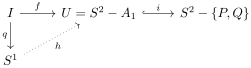
It will suffice by symmetry to show \(i_*\) is trivial. Recall that \(i_*([f])=[i\circ f]\) for any \([f]\in \pi_1(U,R)=\pi_1(S^2-A_1,R)\text{.}\) Since \(f\colon I\rightarrow U\) is a loop, letting \(q\colon I\rightarrow S^1\) be the standard quotient map, there is a map \(h\colon S^1\rightarrow U\) making the diagram below commutative.
described in detail following the image
Factorization of \(f\) through \(S^1\)
Consider the map \(i\circ h\colon S^1\rightarrow S^2-\{P,Q\}\text{.}\) Its image \(i\circ h(S^1)=h(S^1)\) lies in \(S^2-A_1\text{.}\) Since \(A_1\) is a connected set containing \(P\) and \(Q\text{,}\) we see that these two points lie in the same component of \(S^2-i\circ h(S^1)\text{.}\) We conclude from Lemma 2.10.7 that \(i\circ h\) is nullhomotopic. It now follows from Corollary 2.7.4 that the map \((i\circ h)_*\) is trivial. But then we have
\begin{align*} i_*([f]) \amp = [i\circ f]\\ \amp = [i\circ h\circ q] \amp (f=h\circ q)\\ \amp = (i\circ h)_*([q])\\ \amp = e \text{,} \end{align*}
since \((i\circ h)_*\) is the trivial map. This proves that \(i_*\) is trivial, as desired.

