Section 2.21 Classification of covering spaces
Definition 2.21.1. Maps of coverings.
Let
\(p\colon E\rightarrow B\) and
\(p'\colon E'\rightarrow B\) be covering maps. A
map of coverings is a continuous function
\(h\colon E\rightarrow E'\) satisfying
\(p=p'\circ h\text{.}\) An
equivalence of covering maps is a map of coverings that is a homeomorphism. The two covering maps
\(p\) and
\(p'\) are
equivalent if there is an equivalence of covering maps from
\(E\) to
\(E'\text{.}\)
Theorem 2.21.2. Covering spaces.
Let \(p\colon E\rightarrow B\) be a covering map satisfying \(p(e_0)=b_0\text{.}\) Assume \(E\) and \(B\) are path connected and locally path connected.
-
Lifting criterion.
Assume \(Y\) is path connected and locally path connected. If \(f\) is a continuous map satisfying \(f(y_0)=b_0\text{,}\) then \(f\) lifts to a map \(\widetilde{f}\colon Y\rightarrow E\) satisfying \(\widetilde{f}(y_0)=e_0\) if and only if
\begin{equation*}
f_*(\pi_1(Y,y_0))\subseteq p_*(\pi_1(E,e_0))\text{.}
\end{equation*}
Furthermore, the lifting \(\widetilde{f}\text{,}\) if it exists, is unique: i.e., there is at most one lifting \(\widetilde{f}\) satisfying \(\widetilde{f}(y_0)=e_0\text{.}\)
-
Equivalence of based coverings.
Let \(p'\colon E'\rightarrow B\) be another covering map satisfying \(p(e_0')=b_0\text{.}\) Assume \(E'\) is path connected and locally path connected. There is an equivalence of covering maps \(h\colon E\rightarrow E'\) satisfying \(h(e_0)=e_0'\) if and only if
\begin{equation*}
p_*(\pi_1(E,e_0))=p_*'(\pi_1(E',e_0'))\text{.}
\end{equation*}
Furthermore, the equivalence \(h\text{,}\) if it exists, is unique.
-
Equivalence of coverings.
Let \(p'\colon E'\rightarrow B\) be another covering map satisfying \(p'(e_0')=b_0\text{.}\) Assume \(E'\) is path connected and locally path connected. There is an equivalence of covering maps \(h\colon E\rightarrow E'\) if and only if the subgroups
\begin{align*}
H\amp =p_*(\pi_1(E,e_0))\amp H'\amp=p_*'(\pi_1(E',e_0'))
\end{align*}
are conjugate.
Lemma 2.21.3. Liftings of coverings.
Let \(p\colon E\rightarrow B\) and \(p'\colon E'\rightarrow B\) be coverings, and assume that \(E\text{,}\) \(E'\text{,}\) and \(B\) are path connected and locally path connected. Any map of coverings \(h\colon E\rightarrow E'\) is itself a covering.
Corollary 2.21.4. Covering spaces.
Let \(p\colon E\rightarrow B\) and \(p'\colon E'\rightarrow B\) be coverings. Assume \(E\text{,}\) \(E'\text{,}\) and \(B\) are path connected and locally path connected.
Let \(p(e_0)=b_0\) and \(p'(e_0')=b_0'\text{.}\) There is a covering \(h\colon E\rightarrow E'\) satisfying \(p=p'\circ h\) and \(h(e_0)=e_0'\) if and only if
\begin{equation*}
p_*(\pi_1(E,e_0))\leq p_*'(\pi_1(E',e_0'))\text{.}
\end{equation*}
Furthermore, the covering \(h\) is unique in this case.
Let \(p(e_0)=b_0\) and \(p'(e_0')=b_0'\text{.}\) There is a covering \(h\colon E\rightarrow E'\) satisfying \(p=p'\circ h\) if and only if the subgroup \(p_*(\pi_1(E,e_0))\) is contained in a conjugate of the subgroup \(p_*'(\pi_1(E',e_0'))\text{.}\)
Proof.
Definition 2.21.5. Universal covering space.
Let \(B\) be path connected and locally path connected. If \(p\colon E\rightarrow B\) is a covering map and \(E\) is simply connected, then \(p\) is called a universal covering of \(B\text{,}\) and \(E\) is called the universal covering space of \(B\text{.}\)
It turns out that a path connected and locally path connected space \(B\) has a universal covering space if and only if it is semilocally simply connected. Connected topological manifolds provide an important example of spaces satisfying this property.
Definition 2.21.8. Semilocally simply connected.
A space \(B\) is semilocally simply connected if for each \(b\in B\) there is a neighborhood \(U\) of \(b\) such that the homomorphism \(i_*\colon \pi_1(U,b)\rightarrow \pi_1(B,b) \) induced by inclusion is trivial.
Theorem 2.21.9. Universal covering space.
Let \(B\) be path connected and locally path connected. There is a universal covering space of \(B\) if and only if \(B\) is semilocally simply connected.
The existence of a universal covering space is really a special case of the more general theorem below, where we take \(H=\{e\}\text{.}\)
Theorem 2.21.10. Covering space correspondence.
Assume \(B\) is semilocally simply connected. Fix an element \(b_0\in B\) and let \(G=\pi_1(B,b_0)\text{.}\)
-
A surjection.
Given any subgroup \(H\leq G\) there is a path connected and locally path connected pointed covering \(p\colon (E,e_0)\rightarrow (B,b_0)\) satisfying \(p_*(E,e_0)=H\text{.}\) In other words the map
\begin{equation*}
(E,e_0)\xrightarrow{p}(B,b_0) \longmapsto p_*(E,e_0)
\end{equation*}
is a surjection from the set of all path connected and locally path connected pointed coverings of \(B\) and subgroups of \(G\text{.}\)
-
A bijective correspondence.
Given a covering \(E\xrightarrow{p}B\) where \(E\) is path connected and locally path connected, let \([E\xrightarrow{p}B]\) be the set of all coverings equivalent to \(p\text{.}\) Similarly, given a subgroup \(H\leq G\text{,}\) let \([H]\) denote the set of all conjugates of \(H\text{.}\) The recipe
\begin{equation}
[E\xrightarrow{p}B]\longmapsto [p_*(E,e_0)]\text{,}\tag{2.21.1}
\end{equation}
where \(e_0\) is any element of the fiber \(p^{-1}(\{b_0\})\text{,}\) is a well-defined bijective function from the set of all equivalence classes of coverings of \(B\) by path connected and locally path connected spaces and subgroups of \(H\text{.}\)
-
Arrows respected.
The bijection
(2.21.1) “respects arrows” in the following sense. Suppose the equivalence classes
\([E\xrightarrow{p} B]\) and
\([E'\xrightarrow{p'}B]\) correspond to the conjugacy classes
\([H]\) and
\([H']\) via
(2.21.1). There is a covering
\(h\colon E\rightarrow E'\) satisfying
\(p=p'\circ h\) if and only if
\(H\leq gH'g^{-1}\) for some
\(g\in G\text{.}\)
Example 2.21.11. Coverings of \(S^1\).
The space
\(S^1\) is semilocally simply connected, path connected, and locally path connected. What does
Theorem 2.21.10 say in this case?
Let \(P=(1,0)\text{,}\) and identify \(\pi_1(S^1, P)=\Z\text{.}\) Since \(\Z\) is abelian, we have \([H]=\{H\}\) for all subgroups \(H\leq \Z\text{.}\) Thus we have a bijective correspondence between subgroups of \(\Z\) and equivalence classes of coverings of \(S^1\) by path connected and locally path connected spaces.
Next, for any subgroup
\(H\leq \Z\) there is a unique nonnegative integer
\(n\) such that
\(H=\langle n\rangle\text{.}\) Furthermore, we have
\(\langle n\rangle \leq \langle m\rangle\) if and only if
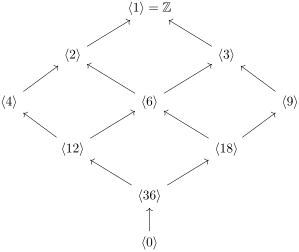
\(m\mid n\text{.}\) This means that the subgroups generated by prime integers are maximal, and the lattice of subgroups of
\(\Z\) is ordered via divisibility. Here is a portion of this lattice corresponding to the divisors of
\(36\text{.}\) An arrow
\(H\rightarrow H'\) in this diagram indicates that
\(H\leq H'\text{.}\) Next, for each postive integer
\(n\) it is easy to see that the
\(n\)-fold covering
\begin{align*}
f_n\colon S^1 \amp \rightarrow S^1\\
z \amp \mapsto z^n
\end{align*}
satisfies
\((f_n)_*(\pi_1(S^1, P))\cong\angvec{n}\text{.}\) Defining
\(f_0\colon \R\rightarrow S_1\) to be the usual covering map
\(f_0(s)=(\cos 2\pi s, \sin 2\pi s)\text{,}\) we see that up to equivalence, the maps
\(f_n\) are all the coverings of
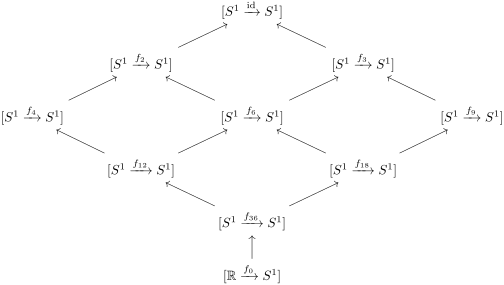
\(S^1\text{.}\) Furthermore, the lattice of subgroups above corresponds to the following lattice of coverings. Here an arrow between equivalence classes indicates the existence of a map of coverings.
Not surprisingly, given coverings
\(f_n\colon S^1\rightarrow S^1\) and
\(f_m\colon S^1\rightarrow S^1\) with
\(n\mid m\text{,}\) we can pick the corresponding map of coverings
\(h\colon S^1\rightarrow S^1\) to be the cover
\(f_{m/n}\colon S^1\rightarrow S^1\text{!}\)
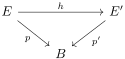 An equivalence of covering maps is a map of coverings that is a homeomorphism. The two covering maps \(p\) and \(p'\) are equivalent if there is an equivalence of covering maps from \(E\) to \(E'\text{.}\)