A continuous function \(f\colon X\rightarrow Y\) is a homotopy equivalence if there exists a continuous map \(g\colon Y\rightarrow X\) such that \(f\circ g\simeq \id_Y\) and \(g\circ f\simeq \id_X\text{.}\)
When this is the case \(f\) and \(g\) are called homotopy inverses one another; and \(X\) and \(Y\) are said to be homotopy equivalent and have the same homotopy type.
Example2.7.2.Deformation retract.
Show that if \(A\subseteq X\) is a deformation retract, then the inclusion map \(j\colon A\hookrightarrow X\) is a homotopy equivalence.
Solution.
Let \(H\colon X\times I\rightarrow I\) be a deformation retraction from \(X\) to \(A\text{.}\) We have seen that the function \(r(x)=H(x,1)\) is a contraction to \(A\) satisfying \(r\circ j=\id_A\) (and hence \(r\circ j\simeq \id_A\)) and \(j\circ r\simeq \id_X\text{.}\)
Our goal is to show that if \(f\colon (X,x_0)\rightarrow (Y,y_0)\) is a homotopy equivalence, then \(f_*\colon \pi_1(X,x_0)\rightarrow \pi_1(Y,y_0)\) is an isomorphism. To do so we need a strengthening of Lemma 2.6.1.
Lemma2.7.3.Homotopic maps and fundamental group revisited.
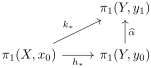
Let \(h,k\colon X\rightarrow Y\) be homotopic, and let \(H\) be a homotopy from \(h\) to \(k\text{.}\) Fix \(x_0\in X\text{,}\) set \(y_0=h(x_0)\) and \(y_1=k(x_0)\text{,}\) and let \(h_*\colon \pi_1(X,x_0)\rightarrow \pi_1(Y,y_0)\) and \(k_*\colon \pi_1(X,x_0)\rightarrow \pi_1(Y,y_1)\) be the corresponding group homomorphisms. We have
where \(\widehat{\alpha}\colon \pi_1(Y,y_0)\rightarrow \pi_1(Y,y_1)\) is the group isomorphism arising from the path \(\alpha\in P(Y; y_0,y_1)\) defined as \(\alpha(t)=H(x_0,t)\text{.}\)
Corollary2.7.4.Homotopic maps and fundamental groups.
Suppose \(h,k\colon X\rightarrow Y\) are homotopic. Fix \(x_0\in X\text{,}\) let \(y_0=h(x_0)\) and \(y_1=h(x_1)\text{,}\) and let \(h_*\colon \pi_1(X,x_0)\rightarrow (Y,y_0)\) and \(k_*\colon \pi_1(X,x_0)\rightarrow \pi_1(Y,y_1)\) be the corresponding group homomorphisms. The group homomorphism \(h_*\) is injective (resp. surjective, resp. trivial) if and only if \(k_*\) is injective (resp. surjective, resp. trivial). In particular, if \(h\) is nullhomotopic, then \(h_*\) is trivial.
Theorem2.7.5.Homotopy equivalence and fundamental groups.
Assume \(f\colon X\rightarrow Y\) is a homotopy equivalence. Given \(x_0\in X\text{,}\) let \(y_0=f(x_0)\text{.}\) The map \(f_*\colon \pi_1(X,x_0)\rightarrow \pi_1(Y,y_0)\) is an isomorphism.