Assume by contradiction that \(\R^2-C\) is not connected. This means that among the connected components of \(\R^2-C\text{,}\) in addition to the unbounded connected component \(U_\infty\text{,}\) there is a bounded component \(U\text{.}\)
Now observe that we have \(\partial U=\overline{U}-U\subseteq C\text{.}\) This is because we have \(\overline{U}\cap U'=\emptyset\) for any connected component \(U'\ne U\text{,}\) since \(U'\) is open and disjoint from \(U\text{.}\)
Since \(C\) is bounded, we can pick an element \(\boldu\in U\) and \(R> 0\) such that \(C\subseteq B_R(\boldu)\text{.}\) Since \(\R^2-B_R(\boldu)\) is unbounded and connected, we must have \(\R^2-B_R(\boldu)\subseteq U_\infty\) and hence \(U\subseteq B_R(\boldu)\text{.}\) Let \(B=\overline{B}_R(\boldu)\) (homeomorphic to \(B^2\)) and let \(S=\partial B\) (homeomorphic to \(S^1\)). Observe that \(S\subseteq U_\infty\text{.}\)
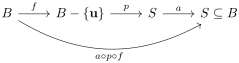
Since \(C\) is a closed subset of the normal space \(B\text{,}\) the Tietze extension theorem implies that the identity function \(\id\colon C\rightarrow C\) extends to retraction \(r\colon B\rightarrow C\text{.}\) Define \(f\colon B\rightarrow B-\{\boldu\}\) as follows:
Since \(\overline{U}\cap U^c=\partial U\subseteq C\text{,}\) and since \(r\vert_C=\id\text{,}\) the function \(f\) is well-defined and continuous by the closed pasting lemma. We cannot have \(f(\boldx)=\boldu\) since \(\boldr(\boldx)\in C\) for all \(\boldx\in \overline{U}\) and \(f(\boldx)=\boldx\) for all \(\boldx\notin U\text{.}\)
Finally, consider the map \(a\circ p\circ f\colon B\rightarrow S\subseteq B\text{,}\) where \(p\colon B-\{\boldu\}\rightarrow S\) is the usual retraction map of the ball onto the circle, and \(a\colon S\rightarrow S\) is the antipodal map on \(S\text{.}\)
This map has no fixed point, contradicting Brouwer’s fixed point theorem. Indeed, since \(a\circ p\circ f(B)\subseteq S\text{,}\) any candidate for a fixed point would have to be an element of \(S\text{;}\) but for any \(\boldx\in S\text{,}\) we have
since \(a(\boldx)\) is the antipode of \(\boldx\text{.}\)
Since we have reached a contradiction, we conclude that \(\R^2-C\) must be connected.
Theorem2.11.2.Complementary Seifert-van Kampen.
Let \(X=U\cup V\text{,}\) where \(U\) and \(V\) are open, and \(U\cap V=A\cup B\) is a separation. Assume \(a\in A\) and \(b\in B\text{,}\) and that there are paths \(\alpha\in P(U; a, b)\) and a path \(\beta\in P(V; b, a)\text{.}\) Let \(f=\alpha*\beta\in P(X; a,a)\text{.}\)
The subgroup \(\langle [f]\rangle\subseteq \pi_1(X, a)\) is infinite cyclic. Furthermore, if \(\pi_1(X,a)\cong \Z\text{,}\) then \(\pi_1(X,a)=\langle [f]\rangle\text{.}\)
Suppose \(a'\in A\) and we have paths \(\gamma\in P(U; a,a')\) and \(\delta\in P(V; a', a)\text{.}\) Setting \(g=\gamma*\delta\text{,}\) we have \(\langle [f]\rangle\cap \langle [g]\rangle=\{e\}\text{.}\)
Proof.
Theorem2.11.3.Jordan curve theorem.
Let \(C_1\) and \(C_2\) be closed connected subsets of \(S^2\) whose intersection consists of two points. If neither \(C_1\) nor \(C_2\) separates \(S^2\text{,}\) then \(C_1\cup C_2\) separates \(S^2\) into exactly two components.
As a consequence, if \(C\subseteq S^2\) is simple closed curve, then \(C\) separates \(S^2\) into exactly two components, \(W_1, W_2\text{.}\) Furthermore, we have \(C=\partial W_1=\partial W_2\text{.}\)