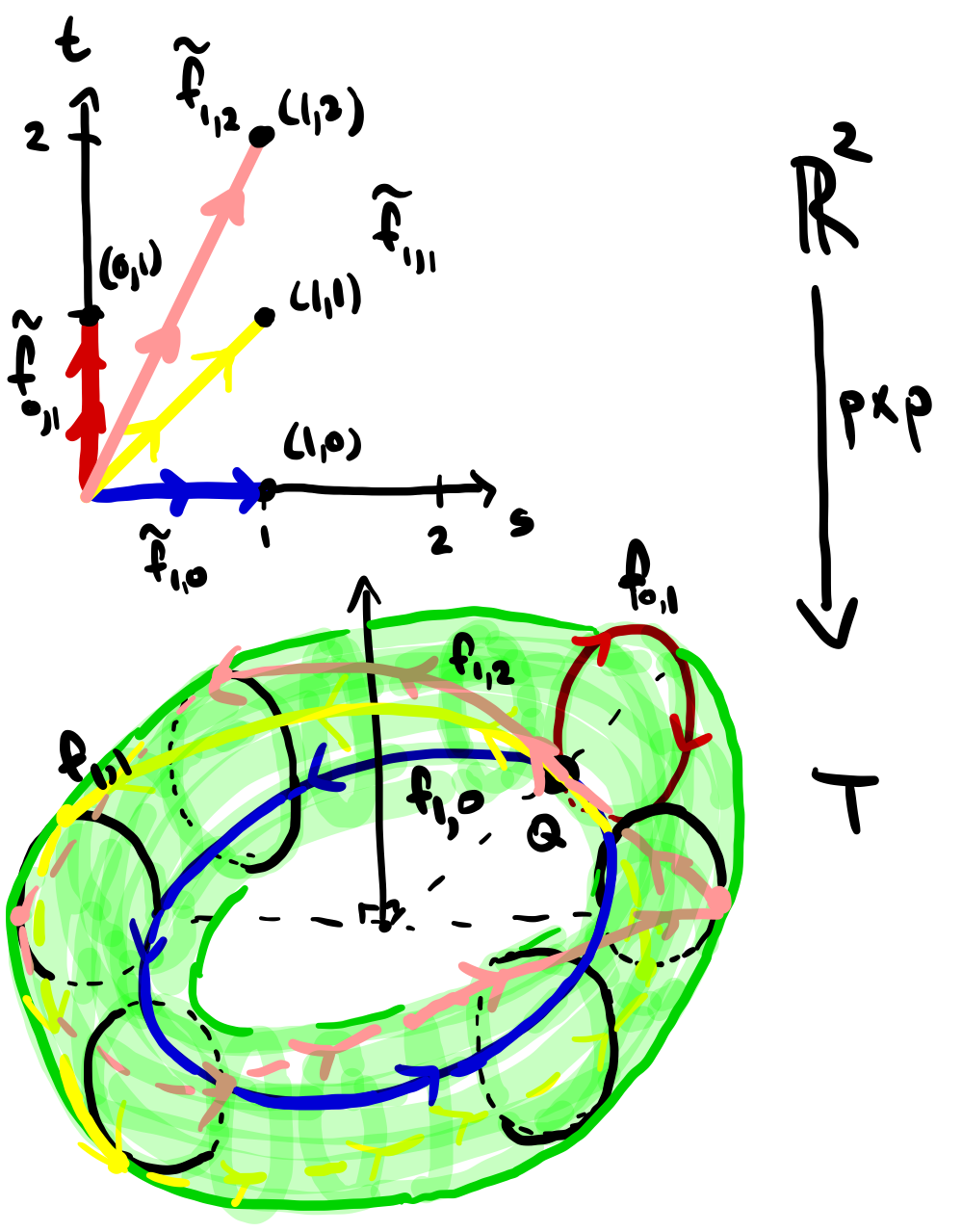
The argument here is essentially isomorphic to the one given above, though some minor subtleties creep in due to the slightly more complex domain in play (
\(I\times I\) as opposed to
\(I\)). Note first that once again the uniqueness property described follows immediately from
Lemma 2.4.2.
Let
\(\{U_{\alpha}\}_{\alpha\in I}\) be a cover of
\(B\) by open sets evenly covered by
\(p\text{.}\) Since
\(I\times I\) is compact, the open cover
\(\{F^{-1}(U_{\alpha)\}_{\alpha\in I}\) has a
Lebesgue number \(\delta\text{.}\) Pick a subdivision of
\(I\)
\begin{equation*}
s_0=0< s_1< \cdots < s_n=1
\end{equation*}
fine enough so that the diameter of each subrectangle \(R_{k,l}=[s_{k-1}, s_k]\times [s_{l-1}, s_{l}]\) in the resulting subdivision of \(I\times I\) is less than \(\delta\text{.}\) It follows that for all \(1\leq k,l\leq n\) we have \(F(R_{k,l})\subseteq U_\alpha\) for some \(\alpha\in I\text{.}\)
We now endeavor to build a lifting of \(F\) subrectangle by subrectangle, from the bottom row of subrectangles to the top, working from left to right along each row. In more detail for each pair \(1\leq k,l\leq n\) let the region \(A_{k,l}\) be the union of the rectangle \(R_{k,l}\) along with all rectangles \(R_{i,j}\) to the left or below it. We will show by induction that for all \(1\leq k,l\leq n\) there is a lifting \(\widetilde{F}_{k,l}\colon A_{k,l}\rightarrow E\) of \(F\vert_{A_{k,l}}\) satisfying \(\widetilde{F}_{k,l}(0,0)=e_0\text{.}\) Since \(I\times I=A_{n,n}\) the lifting \(\widetilde{F}=\widetilde{F}_{n,n}\) gives us what we want.
Base case. We have \(A_{1,1}=R_{1,1}\text{,}\) the lower left corner of \(I\times I\text{.}\) By construction, we have \(F(R_{1,1})\subseteq U\text{,}\) where \(U\) is an open set evenly covered by \(p\text{.}\) Let \(p^{-1}(U)=\bigcup_{\beta\in J}V_\beta\) be the corresponding partition into slices, and let \(V=V_{\beta}\) be the slice containing \(f(0,0)=e_0\text{.}\) Define \(\widetilde{f}_{1,1}\colon A_{1,1}=R_{1,1}\rightarrow E\) as \(\widetilde{F}_{1,1}=(p\vert_V)^{-1}\circ f\text{.}\) It is easy to see that \(p\circ \widetilde{F}_{1,1}(s,t)=F(s,t)\) for all \((s,t)\in A_{1,1}=R_{1,1}\text{.}\) Since \(p\) is 1-1 on \(V\) and \(p(\widetilde{F}(0,0))=p(e_0)=b_0\text{,}\) we see that \(\widetilde{F}_{1,1}(0,0)=e_0\text{.}\)
Induction step. Pick any pair \(1\leq k,l\leq n\) with \((k,l)\ne (n,n)\) and assume that \(\widetilde{F}_{k,l}\) is a lifting of \(F\vert_{A_{k,l}}\) that satisfies \(\widetilde{F}_{k,l}(0,0)=e_0\text{.}\) The “next” region in our procedure is either (a) \(A_{k+1,l}=A_{k,l}\cup R_{k+1,l}\) if \(k\ne n\) (“move to right if you can”), or (b) \(A_{1,l+1}=A_{n,l}\cup R_{1,l+1}\) (“move up a row and start at left”). We show in case (a) that we can extend \(\widetilde{F}_{k,l}\) to this larger region; the argument for case (b) is very similar.
In case (a) we have \(A_{k+1,l}=A_{k,l}\cup R_{k+1,l}\text{.}\) Let
\begin{equation*}
C=A_{k,l}\cap R_{k+1,l}=\{s_k\}\times [s_{l-1},s_l]\cup [s_k,s_{k+1}]\times {s_{l-1}}\text{,}
\end{equation*}
a connected set formed as the union of the left and bottom edges of \(R_{k+1, l}\text{.}\) By construction we have \(F(R_{k+1,l})\subseteq U \) for some open set evenly covered by \(p\text{.}\) Let \(p^{-1}(U)=\bigcup_{\beta\in J} V_{\beta}\) be its partition into slices. Since \(C\subseteq A_{k,l}\) and \(C\) is connected, we must have \(\widetilde{F}_{k,l}(C)\subseteq V_\beta\) for one of the slices \(V=V_\beta\text{.}\) (Otherwise we would have a separation of the connected set \(\widetilde{F}_{k,l}(C)\text{.}\)) Define \(g\colon R_{k+1,l}\rightarrow E\) as \(g=(p\vert_V)^{-1}\circ F\text{.}\) Arguments very similar to the ones in the previous proof show that \(g\vert_C=\widetilde{F}_{k,l}\vert_C\) and thus the two functions can be pasted together to form the desired lifting \(\widetilde{F}_{k+1,l}\) of \(F\vert_{A_{k+1,l}}\text{.}\)
Lastly we show that if \(F\) is a path homotopy, then \(\widetilde{F}\) is a path homotopy. Assume \(F(0,t)=b_0\) and \(F(1,t)=b_1\) for all \(t\in I\text{.}\) We have \(\widetilde{F}(0,0)=e_0\in p^{-1}(\{b_0\})\) by assumption; let \(e_1=\widetilde{F}(1,0)\in p^{-1}(\{b_1\})\text{.}\) We must show that \(\widetilde{F}(0,t)=e_0\) and \(\widetilde{F}(1,t)=e_1\) for all \(t\in I\text{.}\) Let \(H(t)=\widetilde{F}(0,t)\text{.}\) This is a continuous function from \(I\) to the preimage \(p^{-1}(\{b_0\})\text{.}\) Since its image is connected, and since \(p^{-1}(\{b_0\})\) is discrete, this image must be a singleton. Since \(H(0)=\widetilde{F}(0,0)=e_0\)We conclude that \(H(t)=\widetilde{F}(0,t)=e_0\) for all \(t\in I\text{.}\) A similar argument, using \(H(t)=\widetilde{F}(1,t)\) shows that \(\widetilde{F}(1,t)=e_1\) for all \(t\in I\text{.}\)