The Dummit and Foote text does not include axiom (iii), since rings there are not assumed to be unital. Additionally, (iii) does not follow logically form (i) and (ii): e.g., the zero map between any two rings satisfies (i) and (ii), but not (iii) necessarily.
The last statement of Proposition 2.5.3 follows immediately from the fact that a ring homomorphism \(\phi\colon R\rightarrow S\) is in particular a group homomorphism with respect to the additive structures of \(R\) and \(S\text{.}\) This is one of many examples where we will exploit the group structure of rings to obtain useful results (or steps toward a result) in the context of rings.
Assume by contradiction that \(\phi\colon \Z/3\Z\rightarrow \Z/2\Z\) is a ring homomorphism. Since in particular \(\phi\) is a group homomorphism, \(\phi([1]_3)\) is an element of \(\Z/2\Z\) of order dividing \(3\text{.}\) (See Proposition 1.24.3.) But \([0]_2\) is the only such element. Thus \(\phi([1]_3)=[0]_2\text{:}\) a contradiction, since \([0]_2\ne 1\) in \(\Z/2\Z\text{.}\)
Let \(R\) be a ring. There is a unique ring homomorphism \(\phi\colon \Z\rightarrow R\text{,}\) defined as \(\phi(n)=n\cdot 1_R\) for all \(n\in \Z\text{.}\) In particular, \(\Hom(\Z,R)=\{\phi\}\) is a singleton.
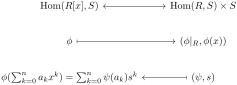
Let \(R\) and \(S\) be commutative rings. A ring homomorphism \(\phi\colon R[x]\rightarrow S\) is uniquely determined by its restriction \(\phi_R\) to the subring \(R\subseteq R[x]\) and the value \(\phi(x)\in S\text{.}\) Conversely, given a ring homomorphism \(\psi\colon R\rightarrow S\) and an element \(s\in S\text{,}\) there is a unique ring homomorphism \(\phi\colon R[x]\rightarrow S\) such that \(\phi_R=\psi\) and \(\phi(x)=s\text{.}\) Thus we have the following bijection:
Given a ring homomorphism \(\phi\colon R[x]\rightarrow S\) corresponding to the pair \((\psi, s)\in \Hom(R,S)\times S\text{,}\) if the map \(\psi\) is clear from the context, we will often call \(\phi\) the evaluation at \(s\) homomorphism.
Similarly, if \(R\) and \(S\) are nontrivial commutative rings, and if \(\psi\colon R\rightarrow S\) is a ring homomorphism, identifying \(\psi\) with the map \(R\rightarrow S[x]\) obtained by composing with the subring inclusion \(S\subseteq S[x]\text{,}\) we will often use \(\phi\) (or its name) to refer to the corresponding ring homomorphism \(\phi\colon R[x]\rightarrow S[x]\text{.}\)
From Theorem 2.5.7 we know there is a bijection between \(\Hom(\Z[x], R)\) and \(\Hom(\Z, R)\times R\text{.}\) From Theorem 2.5.6, on the other hand, we know that \(\Hom(\Z, R)=\{\phi}\text{,}\) where \(\phi(n)=n\cdot 1_R=n\in R\) for all \(n\in \Z\text{.}\) The result follows since \(\{\phi\}\times R\) is in bijective correspondence with \(R\text{.}\) More explicitly, all homomorphisms \(\phi\colon \Z[x]\rightarrow R\) are of the form
is a ring homomorphism. We call this a change of coefficient homomorphism on \(R[x]\text{,}\) and denote \(f^\phi(x)=\sum_{k=0}^n\phi(a_k)x^k\text{:}\) i.e., \(f^\phi\) is the result of applying \(\phi\) to the coefficients of \(f\text{.}\)
As a special case of the change of coefficient homomorphism, given an ideal \(I\subseteq R\) and corresponding quotient map \(\pi\colon R\rightarrow R/I\text{,}\) writing \(\overline{r}\) for \(\pi(r)\text{,}\) we call the change of coefficient homomorphism
the reduction modulo \(I\) map. In this setting will often write \(\overline{f}\) or \(f\boldmod I\) for \(f^\pi\text{.}\) Moreover, in the special case of a nonzero ideal \((n)\subseteq \Z\text{,}\) we may also write \(f\boldmod n\) instead of \(f\boldmod (n)\text{.}\)
Remark2.5.10.Change of coefficient and evaluation.
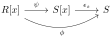
With our new terminology in hand, we can now reformulate Theorem 2.5.7 as follows: every ring homomorphism \(\phi\colon R[x]\rightarrow S\text{,}\) where \(S\) is commutative, can be written uniquely in the form
where \(\psi\colon R\rightarrow S\) is a ring homomorphism and \(s\in S\text{.}\) In other words the homomorphism \(\phi\) decomposes uniquely as follows:
Here by abuse of notation \(\psi\) names the change of coefficient map \(f\mapsto f^\psi\text{,}\) and \(\epsilon_s\) is the evaluation at \(s\) map from \(S[x]\) to \(S\text{.}\)
Let \(R\) be a nontrivial commutative ring, and let \(G\) be a finite group. Prove that the augmentation map \(\phi\colon R\, G\rightarrow R\) is a surjective ring homomorphism.
It is easy to see that \(\phi\) is group homomorphism, \(\phi(1)=1_R\text{,}\) and moreover that it is surjective (since \(\phi(r\, e)=r\) for any \(r\in R\)). It remains only to show that it is multiplicative. Given elements \(r=\sum_{g\in G}a_g\, g\text{,}\)\(s=\sum_{g\in G}b_g\, g\) of \(R\, G\text{,}\) we have \(rs=\sum_{g\in G}c_g\, g\text{,}\) where
Given a ring \(R\text{,}\) the sets \(\{0\}\) and \(R\) are easily seen to be ideals of \(R\text{.}\) We will call these trivial ideals. Additionally we will call an ideal \(I\) nonzero if \(I\ne \{0\}\text{,}\) and proper if \(I\ne R\text{.}\)
We leave all but (3) to the reader. For (3), it is clear that \(IJ\) as defined is a subgroup of \((R,+)\text{.}\) Given any \(r,s\in R\text{,}\) and element \(a=\sum_{k=1}^ni_kj_k\in IJ\text{,}\) with \(i_k\in I\) and \(j_k\in J\) for all \(k\text{,}\) we have
Let \(A\) be a subset of a ring \(R\text{.}\) The ideal generated by \(A\), denoted \((A)\text{,}\) is the intersection of all ideals of \(R\) containing \(A\text{:}\) i.e.,
If \(A=\{a_1,a_2,\dots, a_n\}\text{,}\) we wite \((A)=(a_1,a_2,\dots, a_n)\) for \(A\text{;}\) similarly, if \(A=(a_1,a_2,\dots, )\text{,}\) we write \((A)=(a_1,a_2,\dots)\text{.}\)
An ideal \(I\) is finitely generated if we have \(I=(a_1,a_2,\dots, a_n)\) for some elements \(a_i\in R\text{;}\) it is principal if \(I=(a)\) for some \(a\in R\text{.}\)
\((A)\) is the smallest ideal of \(R\) containing \(A\) in the following sense: if \(I\) is an ideal of \(R\) containing \(A\text{,}\) then \((A)\subseteq I\text{.}\)
\((A)\) is the set of all finite sums of elements of the form \(r a s\text{,}\) where \(r,s\in R\) and \(a\in A\text{:}\) i.e., letting \(T=\{ras\mid a\in A, r,s\in R\}\text{,}\) we have \((A)=\angvec{T}\text{.}\)
Let \(\phi\colon R\rightarrow S\) be a ring homomorphism. For any set \(A\subseteq R\text{,}\) we have \((A)\subseteq \ker\phi\) if and only if \(\phi(a)=0\) for all \(a\in A\text{.}\)
Let \(I\) be an ideal of \(\Z\text{.}\) Since in particular \(I\) is a subgroup of \(\Z\text{,}\) we know that \(I\) can be written uniquely as
\begin{align*}
I \amp =\angvec{n}\\
\amp =\{kn\mid k\in \Z\}
\end{align*}
for some nonnegative integer \(n\in \Z_{\geq 0}\text{.}\) It is easy to see, using Proposition 2.5.17, that \(\angvec{n}=(n)\text{,}\) the principal ideal generated by \((n)\text{.}\) We conclude that the correspondence
\begin{align*}
n \amp \leftrightarrow (n)
\end{align*}
gives a bijective correspondence between nonnegative integers of \(\Z\) and ideals of \(\Z\text{.}\) In particular, all ideals of \(\Z\) are principal.
Recall that for any ring \(R\text{,}\) there is a unique ring homomorphism \(\phi\colon \Z\rightarrow R\text{:}\) namely, \(\phi(n)=n\cdot 1_R\) for all \(n\in R\text{.}\) We can define the characteristic of a ring using this homomorphism.
Let \(R\) be a nonzero ring. The characteristic of \(R\text{,}\) denoted \(\ch R\text{,}\) is defined as the nonnegative integer \(n\) such that \(\ker \phi = (n)\text{,}\) where \(\phi\colon \Z\rightarrow R\) is the unique ring homomorphism from \(\Z\) to \(R\text{.}\) Equivalently, \(\ch R\) is either the smallest positive integeger \(n\) satisfying \(n\cdot 1_R=0\text{,}\) or 0 if no such integer exists.
Let \(R\) be a commutative ring with \(\ch R=p\) for some prime integer \(p\text{.}\) For all positive integers \(n\) and elements \(a,b\in R\text{,}\) we have
Let \(I\) be an ideal of \(D\) that is not the zero ideal, and let \(a\in I\) be any nonzero element. Since \(D\) is a division ring, there is an element \(b\in D\) satisfying \(ab=ba=1\text{.}\) It follows that for any \(r\in D\text{,}\) we have
\begin{align*}
r \amp =r\cdot 1= r(ba)=(rb)a\in I\text{,}
\end{align*}
From the previous examples, we see that fields, division rings more generally, and also matrix rings over fields are all examples of simple rings. One useful property of simple rings is that any nontrivial homomorphism out of a simple ring is injective.
Since \(S\) is nonzero, the ideal \(\ker\phi\) is not equal to \(R\text{.}\) It follows that \(\ker\phi=(0)\text{,}\) and hence that \(\phi\) is injective (by group homomorphism properties).
Let \(R\) be a commutative ring. An \(R\)-algebra (or algebra over \(R\)) is a nonzero ring \(S\) together with a ring homomorphism \(\phi\colon R\rightarrow S\) such that \(\im\phi=\phi(R)\) is contained in the center of \(S\) (i.e., elements of the subring \(\phi(R)\subseteq S\) commute with all elements of \(S\)). We write \(S/R\) to denote that \(S\) is an \(R\)-algebra.
It is easy to see that our constructions \(R\, G\text{,}\)\(M_n(R)\text{,}\)\(R[x]\text{,}\) and \(R[[x]]\) are all examples of \(R\)-algebras. Furthermore, in these examples, the corresponding ring homomorphism defining the \(R\)-algebra structure is injective, allowing us to identify \(R\) as a subring of the given \(R\)-algebra. This of course is not always the case, simply because a ring homomorphism need not be injective. However, it is always the case with algebras \(S/F\) where \(F\) is a field. This is because nontrivial ring homomorphisms \(\phi\colon F\rightarrow S\) are injective by Proposition 2.5.25