Section 1.14 Isomorphism theorems: second and third

Proof.

  1. Consider the map of sets
    \begin{equation*} f\colon H\times K\rightarrow HK \end{equation*}
    defined by \(\phi(h,k)=hk\text{.}\) This map is surjective by definition of \(HK\text{.}\) Given any \(g=hk\in HK\text{,}\) we have
    \begin{align*} f\left((h',k')\right)=hk \amp \iff h'k'=hk \\ \amp \iff h^{-1}h'=k(k')^{-1}\text{.} \end{align*}
    Let \(t=h^{-1}h'=k(k')^{-1}\text{,}\) and notice that \(t\in H\cap K\text{.}\) It follows easily that for all \(g=hk\in HK\text{,}\) we have
    \begin{equation*} f^{-1}(g)=\{(ht,t^{-1}k)\mid t\in H\cap K\}\text{.} \end{equation*}
    Furthermore, the map
    \begin{align*} H\cap K \amp \rightarrow f^{-1}(hk)\\ t \amp\longmapsto (ht,t^{-1}k) \end{align*}
    can be shown to be a bijection.
    Now, if \(H\) and \(K\) are finite, then \(HK\) and \(H\cap K\) are finite, and we have
    \begin{align*} \abs{H}\times \abs{K} \amp =\abs{H\times K}\\ \amp =\abs{\bigcup_{g\in HK}f^{-1}(g)}\\ \amp =\sum_{g\in HK}\abs{f^{-1}(g)}\\ \amp = \sum_{g\in HK}\abs{H\cap K}\\ \amp =\abs{HK}\cdot \abs{H\cap K}\text{,} \end{align*}
    as desired.
    Moreover, if either \(H\) or \(K\) is infinite, then so is \(HK\text{,}\) in which case the equality \(\abs{HK}\abs{H\cap K}=\abs{H}\abs{K}\) still holds.
  2. Left as an exercise.
  3. Left as an exercise.

Proof.

First we prove \(K\normalin HK\text{.}\) Given \(k\in K\) and \(g=hk'\in HK\text{,}\) we have
\begin{align*} gkg^{-1} \amp = hk'k(k')^{-1}h^{-1}\\ \amp =hk''h^{-1} \text{ for some } k''\in K \amp (K \text{ subgroup}) \\ \amp =k''' \text{ for some } k'''\in K \amp \amp (H\subseteq N_G(K)) \text{.} \end{align*}
To prove the stated isomorphism, we start with the quotient map
\begin{equation*} \pi\colon HK\rightarrow HK/K \end{equation*}
and let \(\psi=\pi\vert_H\text{,}\) its restriction to the subgroup \(H\leq HK\text{.}\) We have
\begin{align*} \ker \psi \amp = H\cap \ker\pi \amp (\psi=\pi\vert_H)\\ \amp =H\cap K \amp (\ker\pi=K)\text{.} \end{align*}
By the first isomorphism theorem, we have \(H/H\cap K\cong \im\psi\text{.}\) It remains to show that \(\im\psi=\im\pi=HK/K\text{.}\) Given any \(gK\in HK/K\text{,}\) we have \(g=hk\) for some \(h\in H\) and \(k\in K\text{,}\) in which case
\begin{equation*} gK=hkK=hK\text{.} \end{equation*}
It follows that
\begin{equation*} gK=\pi(h)=\psi(h)\text{.} \end{equation*}
This proves \(\psi\) is surjective, and hence that \(\im\psi=HK/K\text{.}\)

Remark 1.14.3. Second isomorphism theorem.

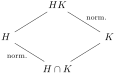
The lattice diagram below nicely summarizes the second isomorphism theorem. For this reason, this isomorphism theorem is sometimes called the diamond isomorphism theorem.
Lattice diagram of second isomorhphism theorem
Figure 1.14.4. Lattice diagram of second isomorhphism theorem
TheoremΒ 1.14.2 further tells us that \(H/H\cap K\cong HK/K\text{.}\)

Proof.

Notation 1.14.6. Images under quotients.

Let \(N\) be a normal subgroup of \(G\text{.}\) Given any subset \(A\subseteq G\text{,}\) we denote by \(A/N\) its image under the quotient map \(\pi\colon G\rightarrow G/N\text{.}\)