Section 2.10 Localizations and fraction fields

Definition 2.10.1. Localization.

Let \(R\) be a nonzero commutative ring. A subset \(S\subseteq R\) is multiplicative if the following conditions hold.
  1. \(1\in S\text{.}\)
  2. If \(s,t\in S\text{,}\) then \(st\in S\text{.}\)
Given a multiplicative subset \(S\subseteq R\) we define an equivalence relation \(\sim\) on the set \(R\times S\) as follows:
  • we formally write \((r,s)=r/s\) for all \((r,s)\in R\times S\text{;}\)
  • define \(r/s\sim r'/s'\) if there exists \(t\in S\) satisfying
    \begin{align} t(s'r-sr') \amp = 0\text{,}\tag{2.10.1} \end{align}
    or equivalently,
    \begin{align} ts'r=tsr' \amp \text{.}\tag{2.10.2} \end{align}
The localization of \(R\) by \(S\) (or ring of fractions of \(R\) by \(S\)), denoted \(S^{-1}R\) is the set of all equivalence classes of \(R\times S\) with respect to \(\sim\text{:}\) i.e.,
\begin{align*} S^{-1}R \amp =\{[r/s]_{\sim}\mid (r,s)\in R\times S\}\text{.} \end{align*}
By abuse of notation, we will write \(r/s\) instead of \([r/s]_{\sim}\text{,}\) and \(r/s=r'/s'\) instead of \(r/s\sim r'/s'\text{.}\)

Remark 2.10.2. \(\Q\) as localization of \(\Z\).

The definition of a localization \(S^{-1}R\) should remind you immediately of the construction of \(\Q\) from \(\Z\text{.}\) Indeed, with our new notation, we have \(\Q=S^{-1}\Z\text{,}\) where
\begin{align*} S \amp =\Z-\{0\}\text{.} \end{align*}

Remark 2.10.3. Localization equivalence relation.

The extra \(t\) appearing in the equivalence relation definition (2.10.1) tends to bum people out. It is not used in the usual construction of \(\Q\text{,}\) so why is it included here? It turns out, you need this even to show that \(\sim\) is an equivalence relation! The issue becomes apparent when you try to verify the transitivity property. Note, however, that if all elements of \(S\) are nonzero and are not zero divisors, then the \(t\) can be cancelled in (2.10.1), and we recover the more familiar definition of β€œequality”.

Specimen 29. Localization by \(S\).

Let \(S\) be a multiplicative subset of the nonzero commutative ring \(R\text{.}\) The rules
\begin{align} r/s+r'/s' \amp = (s'r+r's)/ss'\tag{2.10.3}\\ r/s\cdot r'/s' \amp = rr'/ss'\tag{2.10.4} \end{align}
yield well-defined binary operations \(+\) and \(\cdot\) on \(S^{-1}R\text{,}\) turning it into a commutative ring. The additive and multiplicative identities with respect to this ring structure are \(0=0/1\) and \(1=1/1\text{.}\)
Additionally we call the map \(\lambda\colon R\rightarrow S^{-1}R\) defined as \(\lambda(r)=r/1\) the localization map with respect to \(S\text{.}\)

Remark 2.10.5. Localization.

Predictably, given a ring \(R\) and multiplicative subset \(S\subseteq R\text{,}\) we will often want to identify \(S^{-1}R\) as a familiar ring or quotient thereof (or product thereof). TheoremΒ 2.10.9 below will provide our main technical tool for establishing isomorphisms. However, we also want to develop some intuition about what \(S^{-1}R\) might be in different cases. The proposition above, combined with the concrete construction of \(S^{-1}R\) partially spells out this intuition: the ring \(S^{-1}R\) should be thought of as the result of adjoining inverses \(1/s\) to all elements of \(S\text{.}\) Equivalently, \(S^{-1}R\) is the result of inverting all elements of \(S\text{.}\) To refine this intuition somewhat, the mapping property articulated in TheoremΒ 2.10.9 below can be interpreted as saying that \(S^{-1}R\) is the β€œsmallest” ring β€œcontaining” \(R\) in which all elements of \(S\) are units.
That interpretation seems straightforward enough, but there are often unforeseen consequences to inverting elements of \(S\text{.}\) For example, if \(S\) contains a zero divisor, then according to PropositionΒ 2.10.4, if \(r\in R\) satisfies \(sr=0\text{,}\) then \(r/1=0\) in the localization \(S^{-1}R\text{.}\) This reveals a cruel reality of the localization process, at least as it pertains to zero divisors: for every \(s\in S\) that is granted an inverse \(1/s\) in \(S^{-1}R\text{,}\) there is potentially a zero divisor \(r\) that is killed in the process!

Proof.

  1. Let \(S=R-\{0\}\text{,}\) the set of all nonzero elements of \(R\text{.}\) Clearly \(1\in S\text{.}\) And \(S\) is closed under multiplication because \(R\) is an integral domain.
  2. First observe that \(r/s= 0=0/0\) in \(S^{-1}R\) if and only if there is a \(t\in S\) such that \(tr=0\text{.}\) Since \(R\) is integral and \(S=R-\{0\}\text{,}\) we see that this is true if and only if \(r=0\text{.}\) Thus, given nonzero \(r/s\text{,}\) we may assume \(r\ne 0\text{,}\) in which case \(r\in S=R-\{0\}\text{.}\) But then the element \(s/r\) is easily seen to be an inverse of \(r/s\text{.}\)

Definition 2.10.7. Fraction field.

Let \(R\) be an integral domain, and let \(S=R-\{0\}\text{.}\) The field \(S^{-1}R\) is called the fraction field of \(R\text{,}\) denoted \(\Frac R\text{.}\)

Example 2.10.8. Fraction fields.

Give a description of the fraction fields of the following integral domains. Do you recognize these as objects you saw before in your mathematical youth?
  1. \(\Z\text{.}\)
  2. \(F[x]\text{,}\) where \(F\) is a field.
Solution.
These two fraction fields are precisely the rational numbers \(\Q\text{,}\) and the so-called field of rational functions over \(F\text{,}\) respectively.

Specimen 30. Rational functions over field.

Given a field \(F\text{,}\) the field of rational functions over \(F\) in the indeterminate \(x\text{,}\) denoted \(F(x)\) is defined as the fraction field of \(F[x]\text{:}\) i.e.,
\begin{align} F(x)\amp = \Frac F[x] \text{.}\tag{2.10.7} \end{align}
When the fraction field of an integral domain is not something familiar to us (based solely on the construction as a localization ring), we will want to identify it as a familiar field. To do so, the following mapping property of localizations is essential.

Proof.

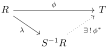
Given such a map \(\phi\text{,}\) if \(\phi^*\) exists making the diagram commutative, then in particular, we must have
\begin{align*} \phi^*(r/1) \amp =\phi(r) \end{align*}
for all \(r\in R\text{.}\) Since \(\phi^*\) is a ring homomorphism, we must have
\begin{align*} \phi(r/s) \amp =\phi(r/1\cdot 1/s)\\ \amp \phi^*(r/1\cdot (s/1)^{-1}) \\ \amp =\phi^*(r/1)\cdot (\phi^*(s/1))^{-1}\\ \amp = \phi(r)\phi(s)^{-1}\text{,} \end{align*}
as claimed.
To finish the proof, we simply show that the proposed formula gives rise to a well-defined ring homomorphism \(\phi^*\colon S^{-1}R\rightarrow T\) satisfying \(\phi=\phi^*\circ \lambda\text{.}\) We first check that we get a well-defined function. Suppose \(r/s=r'/s'\text{,}\) so that there exists an element \(s''\in S\) satisfying \(s''s'r=s''sr'\text{.}\) We then have
\begin{align*} \phi(s''s'r)=\phi(s''sr') \amp\implies \phi(s'')phi(s')\phi(r)=\phi(s'')\phi(s)\phi(r') \\ \amp \implies \phi(r)\phi(s)^{-1}=\phi(r')\phi(s')^{-1} \amp (x\in S\implies \phi(x)\in T^*) \\ \amp \implies \phi^*(r/s)=\phi^*(r'/s')\text{.} \end{align*}
As is often the case in these situations, having establish well-definedness of \(\phi^*\text{,}\) the remaining desired properties are easily verified. Here is a quick verification of all the properties we need:
\begin{align*} \phi^*(\lambda(r)) \amp =\phi^*(r/1)\\ \amp =\phi(r)\phi(1)^{-1}=\phi(r) \\ \phi^*(r/s+r'/s') \amp =\phi^*((s'r+r's)/ss')\\ \amp \phi(s'r+r's)\phi(ss')^{-1} \\ \amp =(\phi(s')\phi(r)+\phi(r')\phi(s))\phi(s)^{-1}\phi(s')^{-1}\\ \amp =\phi(r)\phi(s)^{-1}+\phi(r')\phi(s')^{-1} \\ \amp =\phi(r/s)+\phi(r'/s')\\ \phi^*(r/s\cdot r'/s') \amp =\phi^*(rr'/ss')\\ \amp = \phi(rr')\phi(ss')^{-1}\\ \amp =\phi(r)\phi(s)^{-1}\phi(r')\phi(s')\\ \amp = \phi^*(r/s)\phi^*(r'/s')\\ \phi^*(1) \amp =\phi^*(1/1)\\ \amp =\phi(1)\phi(1)^{-1}=1\text{.} \end{align*}
The next corollary is a useful summary of TheoremΒ 2.10.9 that will help when computing the set of ring homomorphisms out of a localization ring.
As a special case, we can consider an integral domain \(R\) and with multiplicative set \(S=R-\{0\}\text{.}\) In this case, we have \(S^{-1}R=\Frac R\text{,}\) immediately yielding the following result.

Remark 2.10.12. Fraction field mapping property.

With the set up as in CorollaryΒ 2.10.11, if we identify \(R\) with its isomorphic image \(\lambda(R)\) in \(\Frac R\text{,}\) then we obtain the following version of this result: given any ring homomorphism \(\phi\colon R\rightarrow K\text{,}\) where \(K\) is a field, there is a unique extension \(\phi^*\colon \Frac R\rightarrow K\text{.}\) This property is summarized by the following diagram, obtained simply by replacing the map \(\lambda\) in TheoremΒ 2.10.9 with the inclusion relation.
Diagram summarizing mapping property of fraction field
Since the maps \(\phi\) and \(\phi^*\) are both injective, this property is often summarized by saying that \(\Frac R\) is the smallest field containing \(R\text{.}\)

Notation 2.10.13. Special types of localizations.

Let \(R\) be a commutative ring. Given a nonzero element \(x\in R\text{,}\) we define \(R_x=S^{-1}R\text{,}\) where
\begin{align*} S= \amp \{x^n\mid n\in \Z_{\geq 0}\}=\{1,x,x^2,\dots\}\text{.} \end{align*}
Loosely speaking, \(R_x\) is the ring obtained from \(R\) by adjoining an inverse of \(x\text{.}\)
Given a prime ideal \(P\subseteq R\text{,}\) we define \(R_P=S^{-1}P\text{,}\) where
\begin{align*} S \amp = \{x\in R\mid x\notin P\}\text{.} \end{align*}
Note that the primality of \(P\) implies \(S\) is multiplicative: since \(P\ne R\text{,}\) \(1\notin P\text{,}\) and hence \(1\in S\text{;}\) and \(S\) is closed under multiplication because if \(s\) and \(t\) are not elements of \(P\text{,}\) then neither is \(st\text{.}\)
The localization \(R_P\) is called the localization of \(R\) at the prime ideal \(P\text{.}\) It can be thought of as the ring obtained from \(R\) by inverting all elements outside of \(P\text{.}\)
We now proceed to some examples illustrating how to use TheoremΒ 2.10.9 in order to identify localizations as familiar rings. Since we will be interested in establishing isomorphisms, we will want to know when the map \(\phi^*\) is injective. The following proposition is helpful in that regard.

Proof.

This follows directly from the definition of \(\phi^*\) and the fact that \(\phi(S)\subseteq T^*\text{:}\) we have
\begin{align*} \phi^*(r/s)=0 \amp \iff \phi(r)\phi(s)^{-1}=0\\ \amp \iff \phi(r)=0 \amp (\phi(s)\in T^*)\\ \amp \iff r\in \ker\phi\text{,} \end{align*}
as desired.

Remark 2.10.15. Kernel of \(\phi^*\).

Getting ahead of ourselves somewhat, using the notation and results of TheoremΒ 2.10.18, we can summarize PropositionΒ 2.10.14 as follows:
\begin{align*} \ker\phi^* \amp =S^{-1}\ker\phi\\ \amp = (\lambda(\ker\phi))\text{.} \end{align*}

Example 2.10.16. Localizing at an element: \(\Z_2\).

Identify \(\Z_2\) (up to isomorphism) as a subring of a familiar ring. To be clear, \(\Z_2=S^{-1}\Z\text{,}\) where \(S=\{1,2,2^2,\dots\}\text{.}\)
Solution.
Using the intuitive idea of \(\Z_2\) as the β€œsmallest” ring obtained from \(\Z\) by adding an inverse to \(2\) (and hence all of its powers), and observing that \(\Q\) is precisely such a ring, we guess that \(\Z_2\) might be isomorphic to some subring of \(\Q\text{.}\) Let’s use TheoremΒ 2.10.9 to make things precise (and rigorous). We let \(\phi\colon \Z\rightarrow \Q\) be the inclusion map.
Let \(S=\{1,2,2^2,\dots\}\text{,}\) since \(\phi(S)=S\subseteq \Q^*\text{,}\) we have a ring homomorphism \(\phi^*\colon \Z_2\rightarrow \Q\) defined as
\begin{align*} \phi^*(m/2^r)\amp =\phi(m)\phi(2^r)^{-1}\\ \amp =m(2^r)^{-1}\\ \amp =\frac{m}{2^r}\text{.} \end{align*}
By PropositionΒ 2.10.14, since \(\phi\) is injective, so is \(\phi^*\text{.}\) By the first isomorphism theorem, we have
\begin{align*} \Z_2 \amp \cong \phi^*(\Z_2)=\{q\in \Q\mid q=m/2^r \text{ for some } m\in \Z, r\geq 0\}\text{.} \end{align*}

Example 2.10.17. Localization of \(\Z[x]\).

Define the subset \(S\) of \(\Z[x]\) as
\begin{align*} S \amp =\Z-\{0\}\text{,} \end{align*}
where as usual, we identify \(\Z\) with the subring of \(\Z[x]\) consisting of the constant polynomials. Identify \(S^{-1}\Z[x]\) (up to isomorphism) with a familiar ring.
Solution.
Again, working intuitively, we ask ourselves what would be the result of taking the ring \(\Z[x]\) and inverting all nonzero integers. The resulting ring should then contain \(\Q\text{.}\) But a ring that contains \(\Q\) and \(\Z[x]\text{,}\) then you should probably containg \(\Q[x]\text{,}\) right? So we guess that \(S^{-1}\Z[x]\cong \Q[x]\text{.}\) Let \(\phi\colon \Z[x]\rightarrow \Q[x]\) be the usual inclusion map. We have \(\phi(S)=\Z-\{0\}\subseteq \Q[x]^*\text{,}\) since in general the units of a polynomial ring \(F[x]\) are precisely the nonzero constant polynomials. Since \(\phi\) is injective, so is the associated map \(\phi^*\colon S^{-1}\Z[x]\rightarrow \Q[x]\text{.}\) Thus we have
\begin{align*} S^{-1}\Z[x] \amp \cong \phi^*(\Z[x])\\ \amp = \{\phi^*(f/m)\mid f\in \Z[x], m\in \Z-\{0\}\}\\ \amp = \{\phi(f)\phi(m)^{-1}\mid f\in \Z[x], m\in \Z-\{0\}\}\\ \amp = \{f/m\mid f\in \Z[x], m\in \Z-\{0\}\}\\ \amp = \Q[x]\text{.} \end{align*}
For the last equality, the \(\subseteq\) inclusion is clear. For the reverse inclusion, given any \(g\in \Q[x]\text{,}\) we have
\begin{align*} g(x) \amp = \frac{p_n}{q^n}x^n+\cdots +\frac{p_1}{q_1}x+\frac{p_0}{q_0}, \ p_i, q_i\in \Z \\ \amp = \frac{1}{q_nq_{n-1}\cdots q_0}(\sum_{k=0}^np_k\prod_{j\ne k}q_jx^k)\\ \amp = \frac{1}{m}f(x)\text{,} \end{align*}
where \(m=\prod_{k=0}^nq_i\text{,}\) and \(f=\sum_{k=0}^np_k\prod_{j\ne k}q_jx^k\in \Z[x]\text{.}\)

Proof.

  1. Let \(J=\{i/s\mid i\in I\}\text{.}\) We wish to show that \(J=S^{-1}=(\lambda(I))\text{.}\) We leave it to the reader that \(J\) is an ideal of \(S^{-1}R\) (simple fraction arithmetic). Since \(\lambda(I)=\{i/1\mid i\in I\}\text{,}\) we have \(\lambda(I)\subseteq J\text{.}\) Since \((\lambda(I))\) is the smallest ideal of \(S^{-1}R\) containing \(\lambda(I)\text{,}\) we conclude that \(\lambda(I)\subseteq J\text{.}\) For the reverse inclusion, given any \(i/s\in J\) with \(i\in I\text{,}\) we have
    \begin{align*} i/s \amp =i/1\cdot 1/s\in (\lambda(I))\text{.} \end{align*}
One important consequence of TheoremΒ 2.10.18 is the complete description of the prime ideals of \(\Z[x]\) given in CorollaryΒ 2.10.20. We are tantalizingly close to being able to prove this result in full: there is one key point missing, and we point this out in the proof below. That portion of the proof dips into regions that we examine more thoroughly, and more generally in SectionΒ 2.14. In particular, the notion of a primitive polynomial defined below is generalized in that section.

Definition 2.10.19. Primitive polynomial in \(\Z[x]\).

A nonconstant polynomial \(f\in \Z[x]\) is primitive if the coefficients of \(f\) are relatively prime.

Proof.

As mentioned above this proof is not quite complete. (See the last paragraph.) We include it now as an illustration of the importance of TheoremΒ 2.10.18, and hence of localizations in general.
First note that if \(P\) is a prime ideal of \(\Z[x]\text{,}\) then \(P\cap \Z\) is a prime ideal of \(\Z\text{.}\) This is because the inclusion map \(\phi\colon \Z\rightarrow \Z[x]\) is a ring homomorphism, and \(P\cap \Z=\phi^{-1}(P)\text{.}\) (Inverse images of prime ideals are prime ideals.) It follows that \(P\cap \Z=(0)\) or \(P\cap \Z=(p)\text{.}\)
We showed in homework that if \(P\cap \Z=(p)\text{,}\) then \(P=(p)\) (the principal ideal generated by \(p\) in \(\Z[x]\)), or \(P=(p, f(x))\) where \(f\) is an irreducible polynomial of \(\F_p[x]\text{.}\) We summarize the argument used there, which is an application of the fourth isomorphism to \(\Z[x]/(p)\cong \F_p[x]\text{,}\) giving us a correspondence between prime ideals \(P\) of \(\Z[x]\) containing \((p)\) and prime ideals of \(\F_p[x]\text{.}\) The zero ideal of \(\F_p[x]\) corresponds to \(P=(p)\) in \(\Z[x]\text{.}\) Since \(\F_p\) is a field, the nonzero prime ideals of \(\F_p[x]\) are principal, and generated by an irreducible polynomial of \(\F_p[x]\text{.}\) Factoring out the leading term, this polynomial can be chosen to be monic. Lastly, since such a polynomial can be expressed as \(\overline{f}\) for some monic polynomial \(f\in \Z[x]\text{,}\) we have \(P=(p,f)\) in this case.
It remains to tackle the second case: \(P\cap \Z=(0)\text{.}\) Letting \(S=\Z-\{0\}\text{,}\) such a prime satisfies \(P\cap S=\emptyset\text{,}\) and hence by TheoremΒ 2.10.18, such primes are in bijective correspondence with the prime ideals of the localization
\begin{align*} S^{-1}\Z[x] \amp \cong \Q[x] \end{align*}
via the correspondence
\begin{align*} P \amp\leftrightarrow S^{-1}P=\{f/n\mid f\in P, n\in \Z-\{0\}\} \text{.} \end{align*}
Once again, since \(\Q\) is a field, the nonzero prime ideals of \(\Q[x]\) are of the form \((f)\text{,}\) where \(f\) is an irreducible polynomial of \(\Q[x]\text{.}\) Furthermore, it is possible to write \(f=cg\) for some constant \(c\in \Q\text{,}\) where \(g\in \Z[x]\) (factor out the LCM of the denominators of the coefficients of \(f\)), and then further to write \(g=cg_0\text{,}\) where \(g_0\in \Z[x]\) is primitive (factor out the GCD of the coefficients of \(g\)). Thus without loss of generality, we can assume that \(P\) corresponds to a prime ideal of \(\Q[x]\) of the form \((f)\text{,}\) where \(f\) is a primitive polynomial of \(\Z[x]\text{:}\) i.e., that \(S^{-1}P=(f)\subseteq \Q[x]\text{,}\) where \(f\) is a primitive polynomial that is irreducible as an element of \(\Q[x]\text{.}\) We desperately want to say that \(P=(f)\text{.}\) Shall we try proof by wish fulfillment? Let \(I=(f)\text{,}\) the ideal generated by \(f\) in \(\Z[x]\text{.}\) It is clear that
\begin{align*} S^{-1}I \amp =\{g/n\mid g\in (f), n\in \Z-\{0\}\}=(f)\subseteq \Q[x]\text{.} \end{align*}
Furthermore, we know that \(S^{-1}P=(f)\text{.}\) Thus \(S^{-1}I=S^{-1}P\text{.}\) If we knew that \(I=(f)\) were a prime ideal of \(\Z[x]\text{,}\) we would be done, since the correspondence \(I\rightarrow S^{-1}I\) is injective on the set of prime ideals of \(\Z[x]\text{.}\) In fact, \(I=(f)\) is a prime ideal, since (a) \(f\) is irreducible as an element of \(\Z[x]\text{,}\) and (b) irreducible elements of \(\Z[x]\) are prime. It is not hard to show (a) with our current tool set, but (b) requires more work. Both are shown in greater generality in SectionΒ 2.14.