
Section 1.13 First isomorphism theorem

Proof.

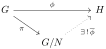
First consider the uniqueness claim. If \(\overline{\phi}\) satisfies
\begin{equation*} \overline{\phi}\circ\pi=\phi\text{,} \end{equation*}
then since \(gN=\pi(g)\) for all \(g\in G\text{,}\) we must have
\begin{equation*} \overline{\phi}(gN)=\overline{\phi}\circ \pi (g)=\phi(g)\text{.} \end{equation*}
Thus there is at most one such homomorphism \(\overline{\phi}\text{,}\) in fact we must define \(\overline{\phi}(gN)=\phi(g)\text{.}\)
We now show that this formula gives rise to a well-defined map \(\overline{\phi}\colon G/N\rightarrow H\text{.}\) We must show that if \(gN=g'N\text{,}\) then \(\phi(g)=\phi(g')\text{.}\) We have
\begin{align*} gN=g'N \amp \implies g'=gn \text{ for some } n\in N \\ \amp \implies \phi(g')=\phi(gn) \\ \amp \implies \phi(g')=\phi(g)\phi(n)\\ \amp \implies \phi(g')=\phi(g) \amp (N\leq \ker\phi\implies \phi(n)=e)\text{.} \end{align*}
Having shown \(\overline{\phi}\) is well defined, it is easy to how that it is a group homomorphism. We have
\begin{align*} \overline{\phi}(gN\, g'N) \amp =\overline{\phi}(gg'N)\\ \amp =\phi(gg') \amp\\ \amp =\phi(g)\phi(g')\\ \amp =\overline{\phi}(gN)\overline{\phi}(g'N)\text{.} \end{align*}
Lastly, \(\overline{\phi}\) satisfies (1.13.1) essentially by definition, since
\begin{equation*} \overline{\phi}(\pi(g))=\overline{\phi}(gN)=\phi(g) \end{equation*}
for all \(g\in G\text{.}\)

Proof.

Assume \(\phi\colon G\rightarrow H\) is a group homomorphism. Setting \(N=\ker\phi\text{,}\) TheoremΒ 1.13.1 implies that the map \(\overline{\phi}\colon G/N\rightarrow H\) is a homomorphism. Furthermore, it is easy to see that \(\im\overline{\phi}=\im\phi\) and hence that
\begin{equation*} \overline{\phi}\colon G/N\rightarrow \im\phi \end{equation*}
is surjective. We claim that \(\overline{\phi}\) is injective and hence that the map above is an isomorphism, showing \(G/N\cong \im \phi\text{.}\)
According to LemmaΒ 1.13.4, it suffices to show that \(\ker\overline{\phi}=\{e_{G/N}\}\text{.}\) By definition, we have
\begin{align*} gN\in \ker\overline{\phi} \amp \iff \overline{\phi}(gN)=e_H\\ \amp \iff \phi(g)=e_H\\ \amp \iff g\in \ker\phi=N\\ \amp \iff gN=N\\ \amp \iff gN=e_{G/N}\text{,} \end{align*}
as desired.

Proof.

  1. We have
    \begin{align*} \phi(g')=h=\phi(g) \amp \iff \phi(g)=\phi(g')\\ \amp \iff (\phi(g))^{-1}\phi(g')=e_H\\ \amp \iff \phi(g^{-1}g')=e_H\\ \amp \iff g^{-1}g'\in \ker\phi\\ \amp \iff g'\in g\,\ker\phi\text{.} \end{align*}
    Thus \(\phi^{-1}(h)=g\, \ker\phi\text{.}\)
  2. If \(\phi\) is injective, then \(\phi(g)=e_H\) if and only if \(g=e_G\text{,}\) showing that \(\ker\phi=\{e_G\}\text{.}\) Inversely, if \(\phi\) is not injective, then we can find \(g\ne g'\) such that \(\phi(g)=\phi(g')=h\text{.}\) But then \(\abs{h^{-1}(h)}=\abs{g\ker\phi}> 1\text{.}\) Since \(\abs{g\ker\phi}=\abs{\ker\phi}\) it follows that \(\abs{\ker\phi}> 1\) and hence \(\ker\phi\ne \{e_G\}\text{.}\)

Example 1.13.5. First isomorphism theorem.

Let \(N=\{e,(12)(34),(13)(24),(14)(23)\}\text{,}\) a normal subgroup of \(S_4\text{.}\) Use the first isomorphism theorem to identify \(S_4/N\) with a familiar group.
Solution.
We convinced ourselves earlier that \(S_4/N\) was isomorphic to \(D_3\text{,}\) which is isomorphic to \(S_3\text{.}\) That argument involved finding appropriate generators of the quotient group that gave us the \(D_3\) relations. Let’s see how the first isomorphism theorem can clean things up a bit.
Consider the set \(D=\{D_1,D_2,D_3\}\) where
\begin{align*} D_1 \amp =\{\{1,2\},\{3,4\}\}\\ D_2 \amp =\{\{1,3\},\{2,4\}\}\\ D_3 \amp =\{\{1,4\},\{2,3\}\}\text{.} \end{align*}
In other words, \(D\) is the set of all partitions of \(\{1,2,3,4\}\) into two disjoint sets of cardinality 2. It is easy to see that $S_4$ acts on \(D\) as
\begin{equation*} \sigma\cdot \{\{a,b\},\{c,d\}\}=\{\{\sigma(a),\sigma(b)\},\{\sigma(c),\sigma(d)\}\}\text{.} \end{equation*}
As such we get a homomorphism \(\phi\colon S_4\rightarrow S_3\) that associates to each \(\sigma\in S_4\) its corresponding permutation of the elements of \(D\text{.}\) The first isomorphism theorem tells us that \(S_4/\ker\phi\cong \im \phi\text{.}\) We will show that \(\ker\phi=N\) and \(\im\phi=S_A\text{,}\) from whence it follows that
\begin{equation*} S_4/N\cong S_D\cong S_3\text{,} \end{equation*}
where the last isomorphism follows from the fact that \(\abs{D}=3\text{.}\)
Let’s see why \(\ker\phi=N\text{.}\) Note that by definition for an element \(\sigma\) to lie in \(\ker\phi\text{,}\) we need
\begin{align*} \sigma\cdot D_1 \amp =D_1 \amp \sigma\cdot D_2\amp=D_2 \amp \sigma\cdot D_3\amp= D_3\text{.} \end{align*}
An argument similar to the ones we used to compute normalizers and centralizers in \(S_4\) shows that given \(d=\{\{a,b\},\{c,d\}\}\in D\text{,}\) we have
\begin{equation*} \sigma\cdot d=d \iff \sigma\in \angvec{(a\ c\ b\ d),(a\ b)}=\{e, (ab),(cd),(ac)(bd),(ad)(bc),(acbd),(ab)(cd),(adbc)}\text{.} \end{equation*}
It follows that \(\sigma\cdot D_i=D_i\) for all \(1\leq i\leq 3\) if and only if \(\sigma\in N\text{.}\) Thus \(\ker\phi=N\text{.}\)
Having proved that \(N=\ker\phi\text{,}\) the first isomorphism tells us that \(S_4/N\cong \im\phi\text{,}\) and in particular
\begin{equation*} \abs{\im\phi}=\abs{S_4/N}=\frac{24}{4}=6\text{.} \end{equation*}
Since \(\abs{S_A}=6\text{,}\) we conclude that \(\im\phi=S_A\text{,}\) and hence that \(S_4/N\cong S_A\text{,}\) as claimed.

Example 1.13.6. First isomorphism theorem: \(\SL_n(R)\).

Let \(R\) be one of our familiar rings: i.e., \(R=\Z,\Q,\R,\C\) or \(R=\Z/m\Z\) for some positive integer \(m\text{.}\) Fix a positive integer \(n\) and define
\begin{equation*} \SL_n(R)=\{A\in \GL_n(R)\mid \det A=1\}\text{.} \end{equation*}
Show that \(\SL_n(R)\) is normal in \(\GL_n(R)\) and identify the quotient \(\GL_n(R)/\SL_n(R)\) with a familiar group.
Solution.
The determinant map \(\det \GL_n(R)\rightarrow R^*\) is a group homomorphism, and it is easy to see that it is surjective: given \(r\in R^*\) the diagonal matrix \(A\) with \(r\) in the first diagonal entry and 1’s elsewhere satisfies \(\det A=r\text{.}\)
By definition we have \(\SL_n(R)=\ker \det\text{.}\) It follows that \(\SL_n(R)\normalin \GL_n(R)\) and we have
\begin{equation*} \GL_n(R)/\SL_n(R)\cong \im \det =R^* \end{equation*}
by the first isomorphism theorem.

Example 1.13.7. First isomorphism theorem: \(\R/\Z\).

Let \(S_1=\{z\in \C\mid \abs{z}=1\}\text{,}\) and let \(U=\{z\in \C\mid z^n=1 \text{ for some } n\in \Z_{> 0}\}\)
  1. Prove that \(S^1\) is a subgroup of \(\C^*\) and that \(U\) is a subgroup of \(S_1\text{.}\)
  2. Prove that \(\R/\Z\cong S^1\text{.}\)
  3. Prove that \(\Q/\Z\cong U\text{.}\)
Solution.
This example relies on the following notions from complex arithmetic.
  • Given \(z=a+bi\in \C\text{,}\) with \(a,b\in \R\text{,}\) we define its modulus as \(\abs{z}=\sqrt{a^2+b^2}\text{.}\) Geometrically, this is just the length of the vector \(v=(a,b)\in \R^2\text{.}\)
  • Given \(z=a+bi\text{,}\) if the point \((a,b)\) has polar coordinates \((r,\theta)\text{,}\) then we have \(z=r\cos\theta+r\sin\theta\, i=r(\cos\theta+\sin\theta\, i)\text{.}\) Defining
    \begin{equation*} e^{i\theta}=\cos\theta+i\sin\theta\text{,} \end{equation*}
    we have \(z=re^{i\theta}\text{.}\) If we specify that \(r\geq 0\text{,}\) then we have
    \begin{equation*} r=\sqrt{a^2+b^2}=\abs{z}\text{.} \end{equation*}
  • Given \(z=re^{i\theta}\) and \(w=se^{i\psi}\text{,}\) we have
    \begin{equation*} zw=(rs)e^{i(\theta+\psi)}\text{.} \end{equation*}
    In other words, geomtrically speaking, two multiply two complex numbers, we (a) multiply their moduli, and (b) add their angles.
Using these properties, we see that the map \(\phi\colon \R\rightarrow S^1\) defined as \(\phi(t)=e^{2\pi i\ t}\) is a group homomorphism with kernel \(\Z\text{.}\) We leave the details to discussion section.

Specimen 12. Circle group and roots of unity.

The sets
\begin{align*} S^1\amp =\{z\in \C\mid \abs{z}=1\} \amp U=\{z\in \C\mid z^n=1 \text{ for some } n\in \Z_{> 0} \} \end{align*}
are subgroups of \(\C^*\) called the circle group and roots of unity of \(\C\text{,}\) respectively.
