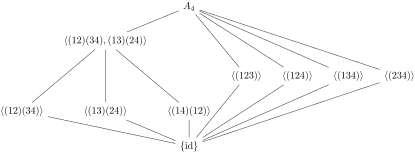
Let’s first describe all elements of \(A_4\text{.}\) Below we look at all cycle types of elements in \(S_4\text{,}\) determine their parity, and count the number of elements of that cycle type.
\begin{equation*}
\begin{array}{ccc}
\text{Cycle type} \amp \text{Parity} \amp \text{Number of elements}\\
\hline
(abcd) \amp \text{odd} \amp 6\\
(abc) \amp \text{even} \amp 8\\
(ab)(cd) \amp \text{even} \amp 3\\
(ab) \amp \text{odd} \amp 6\\
\id \amp \text{even} \amp 1
\end{array}\text{.}
\end{equation*}
If \(H\) is a subgroup of \(A_4\text{,}\) then since \(\abs{A_4}=12\text{,}\) we have
\begin{equation*}
\abs{H}\in \{1,2,3,4,6,12\}\text{.}
\end{equation*}
There are \(3\) cardinality-2 subgroups generated by the elements of the form \((ab)(cd)\text{.}\) There are exactly \(4\) cyclic subgroups of cardinality \(3\text{:}\) one for each pair \(\{(abc),(acb)\}\text{.}\) Furthermore, as we have seen before, we have
\begin{equation*}
\angvec{(12)(34),(13)(24)}=\{1, (12)(34),(13)(24),(14)(23)\}\text{,}
\end{equation*}
a cardinality-4 subgroup isomorphic to the Klein 4-group. Since conjugation preserves cycle type, and since this subgroup contains
all elements of type
\((ab)(cd)\text{,}\) it is easy to see that it is normal. This gives rise to the the lattice of subgroups in
Figure 1.16.7. We claim that this is the complete lattice of subgroups. It suffices to argue that any subgroup of
\(A_4\) containing an element of the form
\((ab)(cd)\) and an element of the form
\((efg)\) must be all of
\(A_4\text{.}\) It is not difficult to show this just by computing some products of elements of order 2 and 3. Below you find a slightly slicker argument.
Suppose we had a subgroup
\(H'\ne A_4\) containing $H=\angvec{(12)(34)}$ and
\(K=\angvec{(123)}\text{.}\) It would follow that
\(H'\geq HK\text{.}\) Since
\(\abs{H}=2\) and
\(\abs{K}=3\text{,}\) we have
\(\abs{H\cap K}=1\) and thus
\(\abs{HK}=\abs{H}\abs{K}=6\text{.}\) But then we must have
\(\abs{H'}=6\text{,}\) in which case
\(H'\) is normal in
\(A_4\) since
\([A_4\colon H']=2\text{.}\) Since all elements of type
\((ab)(cd)\) are conjugate in
\(A_4\) (as one can easily verify), we’d have
\(\angvec{(12)(34),(13)(24)}\leq H'\text{.}\) This is a contradiction, since
\(\abs{\angvec{(12)(34),(13)(24)}}=4\nmid 6\text{.}\) Thus there is no such
\(H'\text{.}\)