
Section 2.15 Multivariate polynomial rings and monoid algebras

Subsection 2.15.1 Multivariate polynomial rings

Specimen 32. Multivariate polynomial rings.

Let \(R\) be a nonzero commutative ring. We define the polynomial ring in the indeterminates \(x_1,x_2,\dots, x_n\) recursively as follows:
  • \(R[x_1]\) is the usual polynomial ring in the indeterminate \(x_1\text{.}\)
  • \(R[x_1,x_2,\dots, x_n]=R[x_1,x_2,\dots, x_{n-1}][x_n]\) for all \(n\geq 2\text{.}\)
When wishing to make the indeterminates explicit, we will write \(f(x_1,x_2,\dots, x_n)\) for an element \(f\in R[x_1,x_2,\dots, x_n]\)
The recursive definition of multivariable polynomial rings allows us to use proof by induction in many situations, as the following results illustrate.

Proof.

The proof is by induction on \(n\text{.}\)
Base case: \(n=1\text{.}\) TheoremΒ 2.14.6 implies that if \(R\) is a UFD, then so is \(R[x_1]\text{.}\) Conversely, if \(R[x_1]\) is a UFD, it is easy to see that \(R\) is a UFD as well: using a degree argument, irreducible factorizations of an element \(c\in R\) corresponds bijectively to irreducible factorizations of the constant polynomial \(f(x)=c\) in \(R[x]\text{.}\)
Induction step: let \(n> 1\text{,}\) and assume the result is true for \(n-1\text{.}\) We have
\begin{align*} R[x_1,x_2,\dots, x_n] \text{ a UFD} \amp \iff R[x_1,\dots, x_{n-1}][x_n] \text{ a UFD}\amp (\text{def.})\\ \amp \iff R[x_1,\dots, x_{n-1}] \text{ a UFD} \amp (\text{base case}) \\ \amp \iff R \text{ a UFD} \amp (\text{induction})\text{.} \end{align*}
By definition, an element \(f\) of \(R[x,y]=R[x][y]\) is a formal expression of the form
\begin{align*} f(x,y) \amp =\sum_{k=0}^n f_k(x)y^k=f_n(x)y^n+f_{n-1}(x)y^{n-1}+\cdots +f_1(x)y+f_0(x)\text{.} \end{align*}
Since each \(f_k(x)\) is an \(R\)-linear combination of powers of \(x\text{,}\) after distributing \(y^k\) through \(f_k(x)\) for each \(k\) and then collecting like terms, we can rewrite \(f\) as an \(R\)-linear combination of monomials
\begin{align*} f(x,y) \amp =\sum_{\boldi=(i_1,i_2)\in \Z_{\geq 0}^2}a_\boldi x^{i_1}y^{i_2} \text{,} \end{align*}
where \(a_\boldi=0\) for all but finitely many \(\boldi\in \Z_{\geq 0}^2\text{.}\) We make this observation more precise and more general in PropositionΒ 2.15.3. Since the notation gets rather unwieldy as the number of indeterminates increases, we are well served by introducing some notation and terminology.

Definition 2.15.2. Monomials and multivariate indices.

Let \(R\) be a nonzero commutative ring, and let \(n\) be a positive integer. A monomial of \(S=R[x_1,x_2,\dots, x_n]\) is an element of \(S\) of the form \(x_1^{i_1}x_2^{i_2}\cdots x_{n}^{i_n}\text{,}\) where \(i_k\in \Z_{\geq 0}\) for all \(k\text{.}\) The tuple \(\boldi=(i_1,i_2,\dots, i_n)\) is called the multidegree of the monomial.
To ease notation we adopt the following conventions.
  • \(\N=\Z_{\geq 0}\text{.}\)
  • We write \(R[\boldx]\) for \(R[x_1,x_2,\dots, x_n]\) and \(f(\boldx)\) for \(f(x_1,x_2,\dots, x_n)\text{.}\)
  • Given any \(\boldi=(i_1,i_2,\dots, i_n)\in \N^n\text{,}\) we define \(\boldx^\boldi\) as
    \begin{align*} \boldx^{\boldi}\amp =x_1^{i_1}x_2^{i_2}\cdots x_{n}^{i_n}\in R[\boldx] \text{.} \end{align*}
  • Similarly, if \(T\) is any ring, and \(\boldt=(t_1,t_2,\dots, t_n)\in T^n\) any tuple of elements of \(T\text{,}\) given any \(\boldi=(i_1,i_2,\dots, i_n)\in \N^n\text{,}\) we define \(\boldt^\boldi\) as
    \begin{align*} \boldt^\boldi\amp =t_1^{i_1}t_2^{i_2}\cdots t_{n}^{i_n} \in T\text{.} \end{align*}
With this terminology and notation place, we can now give a precise description of monomial expansion in multivariate polynomial rings.

Proof.

The proof is by induction on \(n\text{.}\)
Base step: \(n=1\text{.}\) The statement in this case is just a reformulation of the definition of \(R[x_1]\text{.}\)
Induction step: assume \(n> 1\) and that the statement holds for all polynomial rings in \(n-1\) variables. By definition, an element \(f\in R[\boldx]=(R[x_1,\dots, x_{n-1}][x_n]\) can be expressed in the form
\begin{align*} f \amp = \sum_{k=0}^{m}f_k(x_1,x_2,\dots, x_{n-1})x^k\text{,} \end{align*}
where \(f_k\in R[x_1,\dots, x_{n-1}]\text{.}\) By induction, for each \(k\) we have
\begin{align*} f_k \amp = \sum_{\boldi\in \N^{n-1}}a_{k,\boldi}\, x_1^{i_1}x_2^{i_2}\cdots x_{n-1}^{i_{n-1}} \amp (\boldi=(i_1,\dots, i_{n-1}))\text{,} \end{align*}
and thus
\begin{align*} f_k(x_1,x_2,\dots, x_{n-1})x_n^n \amp = \sum_{\boldi\in \N^{n-1}}a_{k,\boldi}\, x_1^{i_1}x_2^{i_2}\cdots x_{n-1}^{i_{n-1}}x_n^k\text{.} \end{align*}
Summing the terms \(f_k x_n^k\) yields a monomial expansion of \(f\) as described in the statement of the proposition. We now show that this expansion is unique. Suppose we have monomial expansions
\begin{align*} f(\boldx) \amp =\sum_{\boldi\in \N^n}a_\boldi\, \boldx^\boldi = \sum_{\boldi\in \N^n}b_\boldi\, \boldx^\boldi \text{.} \end{align*}
For each \(\boldi=(i_1,i_2,\dots, i_n)\in \N^n\text{,}\) let \(\boldi(n-1)=(i_1,i_2,\dots, i_{m-1})\text{,}\) let \(\boldi(n)=i_n\text{,}\) and let \(\boldx^{\boldi(n-1)}=x_1^{i_1}\cdots x_{n-1}^{i_{n-1}}\text{.}\) We have
\begin{align*} f=\sum_{\boldi\in \N^n}a_\boldi\, \boldx^\boldi \amp = \sum_{\boldi\in \N^n}a_\boldi\, \boldx^{\boldi(n-1)}x_n^{\boldi(n)} \\ \amp = \sum_{k\in \N}\left(\sum_{\substack{\boldi\in \N^n\\ \boldi(n)=k}}a_\boldi\,\boldx^{\boldi(n-1)}\right)x_n^k\text{,} \end{align*}
and similarly
\begin{align*} f=\sum_{\boldi\in \N^n}b_\boldi\, \boldx^\boldi \amp = \sum_{k\in \N}\left(\sum_{\substack{\boldi\in \N^n\\ \boldi(n)=k}}b_\boldi\,\boldx^{\boldi(n-1)}\right)x_n^k\text{.} \end{align*}
By definition of \(R[x_1,\dots, x_{n-1}][x_n]\text{,}\) and in particular corresponding notion of equality in this ring, we conclude that
\begin{gather*} \sum_{\substack{\boldi\in \N^n\\ \boldi(n)=k}}a_\boldi\,\boldx^{\boldi(n-1)}=\sum_{\substack{\boldi\in \N^n\\ \boldi(n)=k}}b_\boldi\,\boldx^{\boldi(n-1)} \text{.} \end{gather*}
Since the line above is an equality of monomial expansions in the ring \(R[x_1,x_2,\dots, x_{n-1}]\text{,}\) the induction hypothesis implies \(a_\boldi=b\boldi\) for all \(k\in \N\) and all \(\boldi\in \N^n\) satisfying \(\boldi(n)=k\text{.}\) But for all \(\boldi\in \N^n\text{,}\) there is a \(k\in \N\) such that \(\boldi(n)=k\text{.}\) Thus \(a_\boldi=b_\boldi\) for all \(\boldi\in \N\text{,}\) as desired.
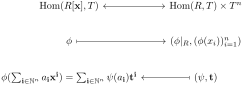
The monomial expansion description of elements of a multivariate polynomial ring \(R[\boldx]\) allows us to give a complete and concrete description of all ring homomorphisms from \(R[\boldx]\text{.}\) The proof, on the other hand, will use induction once again.

Proof.

Left as an exercise. Use a proof by induction along the lines used in the proofs for the two results above.

Definition 2.15.5. Noetherian ring.

A commutative ring \(R\) is Noetherian if every ideal of \(R\) is finitely generated.

Proof.

It is clear that the zero ideal \(I=(0)\) is finitely generated. Let \(I\) be any nonzero ideal \(I\text{.}\) Define the following subsets of \(R\text{:}\)
\begin{align*} L(I) \amp = \{0\}\cup\{a\in R\mid a \text{ is leading coeff. of some } f\in I\}\\ L_d(I) \amp =\{0\}\cup\{a\in R\mid a \text{ is leading coeff. of some } f\in I, \deg f=d\}\text{.} \end{align*}
It is straightforward to show the sets \(L\) and \(L_d\) are in fact ideals of \(R\text{.}\) The general idea used for both cases is the following: if \(a\) is the leading coefficient of \(f\in I\) and \(b\) is the leading coefficient of \(g\in I\text{,}\) then \(a+b\) is either equal to zero, or is the leading coefficient of \(f+g\in I\text{;}\) and \(ra\) is either equal to zero, or is the leading coefficient of \(rf\in I\) for any \(r\in R\text{.}\)
By assumption, \(R\) is Noetherian. Thus we have
\begin{align} I \amp =(a_1,a_2,\dots, a_n)\tag{2.15.2}\\ I_d \amp =(b_{1,d},b_{2,d},\dots, b_{n_d,d})\text{,}\tag{2.15.3} \end{align}
where \(a_i\) is the leading coefficient of some polynomial \(f\in I\) for all \(1\leq i\leq n\text{,}\) and similarly, \(b_{j,d}\) is the leading coefficient of some polynomial \(g_{j,d}\in I\) of degree \(d\text{.}\) Let \(m=\max\{ \deg f_i\mid 1\leq i\leq n\}\text{,}\) and define
\begin{align*} A \amp =\{f_1,f_2,\dots, f_n\}\cup_{d=0}^m\{g_{j,d}\mid 1\leq j\leq n_d\}\text{.} \end{align*}
We claim that \(I=(A)\text{,}\) and hence that \(I\) is finitely generated, since \(A\) is a finite set. It is clear that \((A)\subseteq I\text{,}\) since \(A\subseteq I\text{.}\) Assume by contradiction that \(I-(A)\) is nonempty. It follows that there is an element (necessarily nonzero) \(f\in I-(A)\) of minimal degree.
Case 1: \(\deg f\geq m\text{.}\) Let \(\deg f_i=n_i\text{.}\) By assumption \(n_i\leq m\leq \deg f\) for all \(1\leq i\leq n\text{.}\) The leading coefficient \(a\) of \(f\) is an element of \(L(I)\text{,}\) and thus can be expressed as
\begin{align*} a \amp =\sum_{i=1}^nc_ia_i \end{align*}
for some \(c_i\in R\text{.}\) Let \(g(x)=\sum_{i=1}^{n} c_i x^{\deg f-\deg f_i}f_i\text{.}\) Note that \(g\in (A)\text{,}\) from whence it follows that \(f-g\notin (A)\) (since otherwise \(f\in (A)\)). But then \(f-g\) is an element of \(I-(A)\) of degree less than \(\deg f\text{,}\) contradicting the choice of \(f\text{.}\)
Case 2: \(\deg f^lt; m\text{.}\) In this case the leading coefficient \(a\) of \(f\) is an element of \(L_d(I)\text{,}\) where \(d=\deg f\text{,}\) and similarly as above, the poly

Subsection 2.15.2 Degree functions

For general multivariate polynomial rings, there are a number of different ways to define a notion of degree. One of these comes automatically from our recursive definition: since \(R[\boldx]=R[x_1,x_2,\dots, x_{n-1}][x_n]\text{,}\) given \(f\in R[\boldx]\text{,}\) we can define its degree with respect to \(x_n\) as its degree as a polynomial in \(x_n\) with coefficients in \(R[x_1,x_2,\dots, x_{n-1}]\text{.}\) More generally, given any one of the indeterminates \(x_k\text{,}\) we can define the \(x_k\)-degree of \(f\) to be its degree as a polynomial in the indeterminate \(x_k\) with coefficients in the ring \(R[(x_i)_{i\ne j}]\text{.}\) As is easily shown using the mapping property of multivariate polynomial rings, we have \(R[\boldx]\cong R[(x_i)_{i\ne j}][x_j]\text{,}\) where the isomorphism is given by the first natural map that comes to your mind. It follows that all the usual properties of degree functions of polynomial rings are ported over to the notion of \(x_k\)-degree.

Example 2.15.8. Prime ideal in \(R[x,y]\).

Let \(R\) be an integral domain. Prove that the ideal \((x^2-y^3)\) is prime in \(R[x,y]\text{.}\)
Solution.
Another notion of degree is given by the so-called total degree of a polynomial.

Definition 2.15.9. Total degree.

Let \(R\) be a nonzero commutative ring, and let \(n\) be a positive integer. The total degree of a monomial \(\boldx^{\boldi}=x_1^{i_1}x_2^{i_2}\cdots x_n^{i_n}\text{,}\) denoted \(\deg \boldx^{\boldi}\text{,}\) is defined as
\begin{align} \deg \boldx^{\boldi} \amp =\sum_{k=1}^ni_k\text{.}\tag{2.15.4} \end{align}
Given a nonzero polynomial , we define the total degree of \(f\) is maximum total degree of any monomial appearing in the monomial expansion of \(f\text{:}\) i.e., if \(f=\sum_{\boldi\in \N^n}a_\boldi \boldx^{\boldi}\text{,}\) then
\begin{align*} \deg f \amp = \max\{\deg \boldx^{\boldi}\mid a_\boldi\ne 0\} \text{.} \end{align*}
Lastly, if \(f=0\text{,}\) we define \(\deg f=-\infty\text{.}\)
The total degree function on \(R[\boldx]\) satisfies some of the same properties of the usual degree function on a polynomial ring in one variable.
Unfortunatley, one important difference between the total degree and the usual degree, is that when \(n> 1\) the total degree function does not satisfy the division algorithm condition, as the next example illustrates.

Example 2.15.11. Failure of division algorithm.

Let \(R\) be a nonzero commutative ring.
  1. Establish an isomorphisn between \(R[x,y]/(x-y)\) and a familiar ring.
  2. Show that we cannot write \(x\) as \(x=q(x,y)(x-y)+r(x,y)\) for any \(r(x,y)\in R[x,y]\) with \(\deg r(x,y)< \deg (x-y)\text{.}\)
Solution.

Subsection 2.15.3 Monoid algebras

Definition 2.15.12. Monoid.

A monoid is a pair \((M,\cdot)\text{,}\) where \(M\) is a nonempty set, and \(\cdot \colon M\times M\rightarrow M\) is an associative operation for which a multiplicate identity element \(e\in M\) exists: i.e., there is an element \(e\in M\) satisfying \(e\cdot m=m\cdot e=m\) for all \(m\in M\text{.}\)

Example 2.15.13. Monoid examples.

Here are some familiar monoids:
  1. \((G,\cdot)\text{,}\) where \(G\) is a group with respect to the operation \(\cdot\text{.}\)
  2. \((R,\cdot)\text{,}\) where \(R\) is any ring and \(\cdot\) is the ring multiplication.
  3. \((R-\{0\}, \cdot)\text{,}\) where \(R\) is any integral domain and \(\cdot\) is the ring multiplication.
  4. \((\mathbb{N}, +)\text{,}\) where \(\mathbb{N}=\Z_{\geq 0}\) and \(+\) is the usual addition.
  5. \((\mathbb{N}^r, +)\text{,}\) where addition is defined componentwise: \((a_i)_{i=1}^r+(b_i)_{i=1}^r=(a_i+b_i)_{i=1}^r\text{.}\)
  6. \((\mathbb{N}^I, +)\text{,}\) where \(I\) is any nonempty index set, and addition is defined componentwise: \((a_i)_{i\in I}+(b_i)_{i\in I}=(a_i+b_i)_{i\in I}\text{.}\)

Specimen 33. Monoid algebra.

Let \(R\) be a nonzero commutative ring, and let \((M, \cdot)\) be a monoid. Define \(R[M]\) to be the set of all formal expressions
\begin{align*} r \amp =\sum_{m\in M}r_m\, m \end{align*}
where \(r_m=0\) for all but finitely many \(m\in M\text{.}\) We define binary operations \(+\) and \(\cdot\) on \(R[M]\) as follows:
\begin{align} \sum_{m\in M}r_m\, m+\ \sum_{m\in M}s_m\, m \amp =\sum_{m\in M}(r_m+s_m)\, m\tag{2.15.5}\\ \sum_{m\in M}r_m\, m \cdot \sum_{m\in M}s_m\, m \amp = \sum_{m\in M} t_m\, m \amp t_m=\sum_{\substack{m',m''\in M\\ m'\cdot m''=m}}r_{m'}s_{m''}\text{.}\tag{2.15.6} \end{align}
Note that the sum defining \(t_m\) is in fact finite, since only finitely many of the products \(r_{m'}s_{m''}\) are nonzero. The triple \((R[M], +, \cdot)\) is a ring called the monoid algebra of \(M\) over \(R\text{.}\)

