Section 2.20 PID-module structure theorems: proofs

Subsection 2.20.1 Proof of uniqueness

We first examine the uniqueness claims in Theorem 2.19.2 and Theorem 2.19.7. In proving this we will assume existence of decompositions of the given form.
Let’s first see why the Betti number \(n\) is uniquely determined. If we have
\begin{align*} M \amp \cong R^n \oplus \Tor M\text{,} \end{align*}
then
\begin{align*} \Tor M \amp \cong \Tor(R^n)\oplus \Tor (\Tor M)\cong \{0\}\oplus \Tor M \end{align*}
and thus
\begin{align*} M/\Tor(M) \amp \cong (R^n\oplus \Tor(M))/(\{0\}\oplus \Tor M)\cong R^n\text{.} \end{align*}
Thus \(n\) is the rank of the free module \(M/\Tor M\text{.}\) Since the rank of a free module is well defined, we see that \(n\) is uniquely determined by the module \(M\text{.}\) More explicitly, we have
\begin{align*} M \cong R^m\oplus \Tor M\amp \iff m=\rank M/\Tor M\text{.} \end{align*}
It remains to show that each of the two distinct decompositions of \(\Tor M\) described in Theorem 2.19.2 and Theorem 2.19.7 satisfy the specified uniqueness claims. First observe that the we can obtain the elementary divisor form from the invariant factor form using the Chinese remainder theorem: given \(a=\prod_{i=1}^rp_i^{n_i}\text{,}\) with \(p_i\) pairwise nonassociate irreducibles, the ideals \((p_i^{n_i})\) are pairwise coprime, and thus
\begin{align} R/(a) \amp \cong \bigoplus_{i=1}^rR/(p_i^{n_i})\text{.}\tag{2.20.1} \end{align}
Expanding out all the invariant factor quotients \(R/(a_i)\) in this way and then grouping all associate irreducible factors together, we obtain the elementary divisor form from the invariant factor form. Conversely, with a little bit of care you can group the elementary factor quotients together in such a way to get the invariant factor form. It is worth at least looking at one example of this reverse direction to see what the subtleties are. Consider the case \(R=\Z\) and the group
\begin{align*} A \amp \cong \Z/2\Z\oplus \Z/2^2\Z\oplus \Z/2^2\Z \oplus \Z/3\Z\oplus \Z/3\Z\text{.} \end{align*}
We have
\begin{align*} A \amp \cong \Z/2\Z\oplus (\Z/2^2\Z\oplus \Z/3\Z)\oplus (\Z/2^2\Z\oplus \Z/3\Z) \\ \amp \cong \Z/2\Z \oplus \Z/12\Z \oplus \Z/12\Z\text{.} \end{align*}
It thus suffices to show that the uniqueness claim for the elementary divisor form holds. Since this decomposition is a decomposition of \(\Tor M\text{,}\) we will assume \(M=\Tor M\) is torsion. Suppose we have a decomposition
\begin{align*} M \amp \cong \bigoplus_{i=1}^r \bigoplus_{j=1}^{m_j}R/(p_i^{n_{ij}}) \end{align*}
where the \(p_i\) are pairwise nonassociate irreducible elements. In general, if \(p\) and \(q\) are nonassociate irreducible elements, then \(p\) and \(q^n\) are coprime for any positive integer \(n\text{,}\) from which it follows that multiplication by \(p\) is an automorphism of \(R/(q^n)\text{.}\) It follows that the \(p\)-primary component of \(R/(q^n)\) is \(\{0\}\) for any irreducible \(q\) not associate to \(p\) and positive integer \(n\text{.}\) Since \(p\)-primary components behave well with direct sums, we conclude that given the composition of \(M\) above, we have
\begin{align*} M(p_i^\infty) \amp \cong \bigoplus_{i=1}^{m_i}R/(p_i^{n_{ij}}) \end{align*}
for all \(i\text{.}\) In other words, not surprisingly, we extract \(M(p_i^\infty)\) from the decomposition above by taking just the direct summands that involve \(p_i\text{.}\) Since \(M(p_i^\infty)\) is (up to isomorphism) uniquely determined by \(M\text{,}\) we have thus reduced the uniqueness problem to showing that each of these \(p_i\)-primary component decompositions is unique in the stipulated sense. From now on, we assume that \(p\) is an irreducible element, and that we have a module \(M\) with decomposition
\begin{align*} M \amp \cong \bigoplus_{i=1}^m R/(p^{n_i})\text{.} \end{align*}
The uniqueness of the \(n_i\) appearing in such a decomposition is now given by the following result, which actually tells us how to compute the sequence \(n_1\leq n_2\leq\dots \leq n_m\text{.}\)
Proof.

  1. First observe that for any \(R\)-module \(N\) and element \(a\in R\) (irreducible or not), we have
    \begin{align*} (a)M \amp = (\{ram\mid r\in R, m\in M\})=aM=\{am\mid m\in M\} \text{.} \end{align*}
    Now take \(p\) irreducible in \(P\text{.}\) For each \(k\geq 0\text{,}\) the set \(p^kM\) is an \(R\)-submodule of \(M\text{,}\) and we have \(p(p^kM)\subseteq p^{k+1}M\text{.}\) As always, the quotient module \(p^kM/p^{k+1}M\) is a group with respect to coset addition. To show it is an \(R/(p)\)-module we must define a scalar multiplication by elements \(r+(p)\) of \(R/(p)\text{.}\) We do so as follows: given \(r+(p)\in R/(p)\) and \(m+p^{k+1}M\in p^kM/p^{k+1}M\text{,}\) we define
    \begin{align*} (r+(p))\cdot (m+p^{k+1}M) \amp = rm+p^{k+1}M\text{.} \end{align*}
    As always, once we show that this operation is well defined, that it satisfies the four scalar multiplication axioms then follows from the fact that \(M\) is an \(R\)-module. If we have \(r+(p)=r'+(p)\) and \(m+p^{k+1}M=m'+p^{k+1}M\text{,}\) then \(r'=r+sp\) for some \(s\in R\) and \(m'=m+p^{k+1}m''\) for some \(m''\in M\text{.}\) But then we have
    \begin{align*} r'm'\amp = (r+sp)(m+p^{k+1}m'') \\ \amp = rm+spm+p^{k+2}(sm'')\text{.} \end{align*}
    Since \(m\in p^kM\text{,}\) \(pm\in p^{k+1}M\text{,}\) and thus \(spm+p^{k+2}sm''\in p^{k+1}M\text{.}\) We conclude that \(r'm'+p^{k+1}M=rm+p^{k+1}M\text{,}\) as desired.
  2. Note that \(M=R/(p^n)=R/p^nR\text{.}\) If \(k\geq n\text{,}\) then since \(p^ka\in (p^k)\subseteq (p^n)\) for all \(a\in R\text{,}\) we have \(p^k(a+p^nR)=0\in R/(p^n)\text{,}\) and thus \(p^kM=\{0\}\text{.}\) It follows that \(p^kM/p^{k+1}M=\{0\}\text{.}\)
    Now assume that \(k< n\text{,}\) in which case \((p^n)\subseteq (p^{k+1})\subseteq (p^k)\text{.}\) Using coset notation, we have
    \begin{align*} p^j M \amp = \{ rp^j+(p^n)\mid r\in R\} \\ \amp = (p^j)/(p^n) \end{align*}
    for all \(j\text{.}\) Since \((p^n)\subseteq (p^{k+1})\subseteq (p^k)\text{,}\) the third isomorphism theorem implies
    \begin{align*} p^kM/p^{k+1}M \amp \cong (p^k)/(p^n)\, / (p^{k+1})/(p^n)\\ \amp \cong (p^{k})/(p^{k+1})\text{.} \end{align*}
    Lastly, the homomorphism \(\phi\colon R\rightarrow (p^k)/(p^{k+1})\) defined as \(\phi(r)=rp^k+(p^{k+1})\) is clearly surjective with kernel \((p)\text{.}\) Thus
    \begin{align*} R/(p) \amp \cong (p^k)/(p^{k+1})\cong p^kM/p^{k+1}M\text{,} \end{align*}
    as desired.
  3. First note that given any direct sum \(\bigoplus_{i\in I} M_i\text{,}\) we have
    \begin{align*} p^k\left( \bigoplus_{i\in I}M_i\right) \amp =\bigoplus_{i\in I} p^kM_i \text{.} \end{align*}
    Thus given \(M=\bigoplus_{i=1}^m R/(p^{n_i})\text{,}\) we have
    \begin{align*} p^kM \amp = \bigoplus_{i=1}^m (p^k)/(p^{n_i}) \amp p^{k+1}M\amp =\bigoplus_{i=1}^m (p^{k+1})/(p^{n_i}) \text{,} \end{align*}
    and thus
    \begin{align*} p^kM/p^{k+1}M \amp \cong \bigoplus_{i=1}^m (p^k)/(p^{n_i}) / \bigoplus_{i=1}^m (p^{k+1})/(p^{n_i}) \\ \amp \cong \bigoplus_{i=1}^m(p^k)/(p^{n_i})/(p^{k+1})/(p^{n_i})\\ \amp \cong \bigoplus_{j\in \{j\mid k< n_j\}}(p^k)/(p^{k+1}) \\ \amp \cong \bigoplus_{j\in \{j\mid k< n_j\}}F_p\\ \amp \cong F_p^{r_k}\text{,} \end{align*}
    where \(r_k=\abs{\{j\mid k< n_j\}}\text{,}\) the number of exponents \(n_j\) that are (strictly) greater than \(k\text{.}\) It follows that \(\dim_{F_p}p^kM/p^{k+1}M=r_k\text{,}\) and thus that
    \begin{align*} \dim_{F_p}p^{k-1}M/p^{k}M-\dim_{F_p}p^{k}M/p^{k+1}M \amp= r_{k-1}-r_k \text{,} \end{align*}
    where \(r_{k-1}-r_k\) is the number of exponents \(n_j\) that are greater than \(k-1\text{,}\) but not greater than \(k\text{.}\) This is precisely the number of exponents \(n_j\) equal to \(k\text{.}\)
Let’s see the dimension formula (2.20.2) at work in the setting \(R=\Z\text{,}\) where an \(R\)-module is nothing more than an abelian group.

Example 2.20.2. \(p\)-primary components.

Verify formula (2.20.2) for the \(\Z\)-module \(M=\Z/3\Z\oplus \Z/3\Z\oplus \Z/3^3\Z\text{.}\)
Solution.
We compute
\begin{align*} 3M \amp = 3(\Z/3\Z)\oplus 3(\Z/3\Z)\oplus \oplus 3\Z/3^3\Z\cong \{0\}\oplus \{0\}\oplus (3)/(3^3) \\ 3^2 M \amp =\{0\}\oplus \{0\} \oplus (3^2)/(3^3)\\ 3^3 M \amp = \{0\} \end{align*}
and thus
\begin{align*} M/3M \amp \cong \Z/3\Z\oplus \Z/3\Z \oplus \Z/(3^3)/(3)/(3^3)\\ \amp \cong \Z/3\Z\oplus \Z/3\Z\oplus \Z/3\Z\\ 3M/3^2M \amp \cong (3)/(3^3)\, /\, (3^2)/(3^3)\cong \Z/3\Z\\ 3^2M/3^3M \amp \cong (3^2)/(3^3)\cong \Z/3\Z\\ 3^kM/3^{k+1}M \amp =\{0\} \text{ for all } k\geq 3\text{.} \end{align*}
We conclude that
\begin{align*} \dim_{\F_3} M/3M \amp =3\\ \dim_{\F_3}3M/3^2M \amp =1\\ \dim_{\F_3}3^2M/3^3M \amp = 1\\ \dim_{\F_3}3^kM/3^{k+1}M \amp =0 \text{ for all } k\geq 3\text{.} \end{align*}
Following the argument in the proof of Theorem 2.20.1, these dimensions tells us that the decomposition of \(M\) has 3 summands of the form \(\Z/3^j\Z\) with \(j\geq 1\text{,}\) 1 summand of the form \(\Z/3^j\Z\) with \(j\geq 2\text{,}\) and 1 summand of the form \(\Z/3^j\Z\) with \(j\geq 3\text{.}\) Lastly, we have
\begin{align*} \dim_{\F_3}M/3M-\dim_{\F_3}3M/3^2M \amp =2\\ \dim_{\F_3}3M/3^2M-\dim_{\F_3}3^2M/3^3M \amp =0\\ \dim_{\F_3}3^2M/3^3M-\dim_{\F_3}3^3M/3^4M \amp =1\\ \dim_{\F_3}3^{k-1}M/3^kM-\dim_{\F_3}3^{k}M/3^{k+1}M \amp = 0 \text{ for all } k\geq 4\text{.} \end{align*}
As per Theorem 2.20.1, this means \(M\) has exactly 2 summands of the form \(\Z/3\Z\text{,}\) no summands of the form \(\Z/3^2\Z\text{,}\) and exactly 1 summand of the form \(\Z/3^3\Z\text{.}\) This is precisely the decomposition we started with.

Subsection 2.20.2 Aligned bases

We now set about proving that the decompositions described in Theorem 2.19.2 exists for any finitely generated \(R\)-module, where \(R\) is a PID. Let \(M=(m_1,m_2,\dots, m_n)\) be a finitely generated \(R\)-module. From the surjective \(R\)-module homomorphism
\begin{align*} \phi\colon R^n \amp \rightarrow M\\ (a_1,a_2,\dots, a_n) \amp \rightarrow \sum_{i=1}^n a_i m_i\text{,} \end{align*}
we conclude from the first isomorphism theorem that \(M\cong R^n/N\text{,}\) where \(N=\ker\phi\text{.}\) We desire a nice computational technique for determining the quotient \(R^n/N\text{:}\) one that will hopefully give us the decomposition of \(M\) as in Theorem 2.19.2. The next theorem provides exactly this.

Proof.

This is a consequence of Theorem 2.20.8 and Theorem 2.20.13, which are discussed in the next subsection. In more detail, since \(M\) is free, and since our statements are invariant under isomorphism, we may assume \(M=R^m\) for some positive integer \(m\text{,}\) and that \(N\subseteq R^m\) is a submodule. By Theorem 2.20.8, \(N\) is finitely generated. Thus we have \(N=(m_1,m_2, \dots, m_n)\) for some elements \(m_j\in R^m\text{.}\) Letting \(A\) be the matrix whose \(j\)-th column is \(m_j\) (considered as a column vector), and letting \(\phi=\phi_A\) be the corresponding homomorphism from \(R^n\) to \(R^m\text{,}\) we have \(N=\im \phi\text{.}\) Theorem 2.20.13 then tells us that there is an aligned basis of \(R^m\) with respect to \(N\text{.}\)

Definition 2.20.4. Aligned basis.

Let \(R\) be a commutative ring, let \(M\) be a free \(R\)-module, and let \(N\) be a free submodule of \(M\text{.}\) An aligned basis for \(M\) and \(N\) is a basis \(B=(m_i)_{i\in I}\) of \(M\) such that there is a subset \(J\subseteq I\) and tuple \((a_j)_{j\in J}\) of elements in \(R\) such that \(B'=(a_jm_j)_{j\in J}\) is a basis of \(N\text{.}\)

Example 2.20.5. Aligned basis for \(\Z[i]\) as \(\Z\)-module.

Let \(R=\Z[i]\text{,}\) the ring of Gaussian integers, and let \(\alpha=1+2i\text{.}\)
  1. Show that \(M=\Z[i]\text{,}\) considered as a \(\Z\)-module, is free of rank 2.
  2. Let \(N\) be the ideal of \(\Z[i]\) generated by \(\alpha\text{:}\) i.e., \(N=\alpha\Z[i]\text{.}\) Show that \(N\) is a free \(\Z\)-module of rank 2, and that \((1+2i, -2+i)\) is a \(\Z\)-basis of \(N\text{.}\)
  3. Note that the standard \(\Z\)-basis \((1,i)\) of \(\Z[i]\) is not an aligned basis of \(M\) and \(N\text{.}\) Show that \((1+2i,i)\) is an aligned basis for \(M\) and \(N\text{.}\)
Solution.
  1. The tuple \((1,i)\) is easily seen to be a \(\Z\)-basis of \(\Z[i]\text{.}\) Thus \(\Z[i]\cong \Z^2\text{.}\)
  2. The map \(f_\alpha\colon \Z[i]\rightarrow \Z[i]\) defined as \(f_\alpha(\beta)=\beta\alpha\) is an \(\Z\)-module homomorphism:
    \begin{gather*} f_{\alpha}(m\beta+n\gamma)=(m\beta+n\gamma)\alpha=m\beta\alpha+n\beta\alpha=mf_{\alpha}(\beta)+nf_\alpha(\gamma)\text{.} \end{gather*}
    The image is \(\{\beta\alpha\mid \beta\in \Z[i]\}\text{,}\) which is precisely the ideal generated by \(\alpha\) in \(\Z[i]\text{.}\) In other words, \(\im f_\alpha=N\text{.}\) The kernel of \(f_\alpha\) is trivial since \(\Z[i]\) is an integral domain! Thus \(f_\alpha\) is an isomorphism of \(\Z[i]\) with \(N\text{.}\) It follows that \(N\cong \Z^2\text{.}\) In more detail, since \(B=(1,i)\) is a basis of \(\Z[i]\text{,}\) its image \(f_\alpha(B)=(f_{\alpha}(1), f_{\alpha}(i))=(\alpha, i\alpha)=(1+2i, -2+i)\) is a \(\Z\)-basis of \(N\text{.}\)
  3. Suppose by contradiction that \((1,i)\) is an aligned basis of \(\Z[i]\) with respect to \(N\text{.}\) This would mean that there are integers \(a,b\in \Z\) with \(a\mid b\) such that \((a,bi)\) is a generating set of \(N\text{.}\) However, \(N\) is the ideal generated by \(1+2i\text{,}\) which an irreducible element of \(\Z[i]\) lying over \(5\text{.}\) It follows that \(N\cap \Z=(5)\text{.}\) Since \(a\in N\cap \Z\text{,}\) we must have \(5\mid a\) and \(5\mid b\text{.}\) But then \(5\mid m+ni\) for all elements of \((a,bi)\text{:}\) a contradiction, since \(5\nmid 1+2i\text{.}\)
    The tuple \(B'=(1+2i, i)\) is easily seen to be linearly independent. Since
    \begin{align*} 1 \amp =1(1+2i)+(-2)i\\ i \amp =0(1+2i)+1i\text{,} \end{align*}
    it follows that \(B'\) is a spanning set of \(\Z[i]\) as a \(\Z\)-module. Lastly, we show that \(B''=(1+2i, 5i)\) is a basis of \(N\text{.}\) Since it is obtained from \(B'\) simply by scaling each basis element by a nonzero scalar, it is clearly linearly independent. Since
    \begin{align*} 1+2i \amp =1(1+2i)+0\cdot 5i\\ -2+i \amp =-2(1+2i)+1\cdot 5i \end{align*}
    and since \(N=(1+2i, -2+i)\text{,}\) it follows that \(B''\) is a spanning set of \(N\text{.}\)

Remark 2.20.6. Aligned bases.

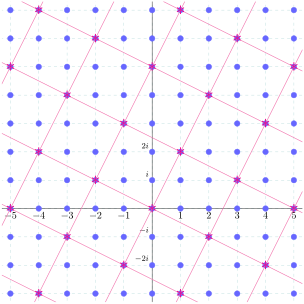
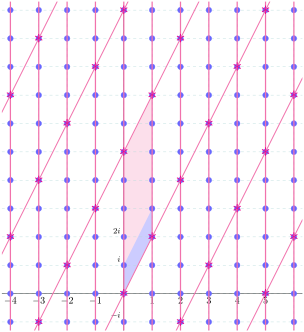
Figure 2.20.7 allows us to visualize what is special about an aligned basis. In Figure 2.20.7.(b) we see how the shaded parallelogram formed by the nonstandard basis \((\alpha_1, \alpha_2)=(1+2i, i)\) of \(\Z[i]\) fits nicely into one of the fundamental parallelograms of the aligned basis \((\beta_1,\beta_2)=(1+2i, 5i)\) of \(N\text{.}\) Indeed, we see that exactly 5 of the smaller parallelograms combine to form the larger one. This is a reflection of the algebraic relation between the two bases:
\begin{align*} \beta_1 \amp = 1\cdot \alpha_1\\ \beta_2 \amp = 5\cdot \alpha_2\text{.} \end{align*}
Lattice picture of basis (1+2i, -2+i)
(a) Lattice picture of basis \((1+2i, -2+i)\) of \(N\)
Lattice picture of basis 1+2i, 5i
(b) Lattice picture of aligned bases \((1+2i, i)\) and \((1+2i, 5i)\)
Figure 2.20.7. Lattice picture of bases of \(\Z[i]\) and \(N\)
We postpone a proof of the existence of aligned bases to the next subsection. We will end the current section with a proof of the existence of the decompositions described in Theorem 2.19.2 assuming the existence of aligned bases.

Proof of invariant factor decomposition, assuming existence of aligned bases.

Let \(M\) be a finitely generated module over the PID \(R\text{.}\) Given spanning tuple \((m_1,m_2,\dots, m_n)\) for \(M\text{,}\) the \(R\)-module homomorphism \(\phi\colon R^n\rightarrow M\) defined as \(\phi((a_1,a_2,\dots, a_n))=\sum_{i=1}^na_im_i\) is surjective, and thus we have \(M\cong_R R^n/\ker\phi\text{.}\) From Theorem 2.20.3, there is a basis \(B=(f_1,f_2,\dots, f_n)\) of \(R^n\) and nonzero elements \(a_1,a_2,\dots, a_r\in R\text{,}\) such that \(a_i\mid a_{i+1}\) for all \(1\leq i\leq r-1\text{,}\) and \(B'=(a_1f_1,a_2f_2,\dots, a_rf_r)\) is a basis of \(N\text{.}\) (In particular, \(N\) is itself free of rank \(r\text{.}\)) We claim \(R^n/N\cong R^{n-r}\oplus \bigoplus_{i=1}^r R/(a_i)\text{.}\) Indeed, let \(\psi\colon R^n\rightarrow R^{n-r}\oplus \bigoplus_{i=1}^r R/(a_i)\) be the \(R\)-module homomorphism defined as
\begin{align} \psi(\sum_{i=1}^r c_i f_i+\sum_{i=1}^{n-r}b_if_{r+i}) \amp = (b_1,b_2,\dots, b_{n-r},\overline{c_1},\overline{c_2},\dots, \overline{c_r}) \text{,}\tag{2.20.5} \end{align}
where \(\overline{c_i}=c_i+(a_i)\in R/(a_i)\) for all \(1\leq i\leq r\text{.}\) The usual mapping properties of \(R^n\) guarantee that \(\psi\) is an \(R\)-module homomorphism, and clearly \(\psi\) is surjective. Lastly, given \(m=\sum_{i=1}^r c_i f_i+\sum_{i=1}^{n-r}b_if_{r+i}\in R^n\text{,}\) we have
\begin{align*} \psi(m)=0 \amp \iff b_i=0, c_j\in (a_i) \text{ for all } 1\leq i\leq n-r, 1\leq j\leq r\\ \amp \iff m=\sum_{j=1}^r d_ja_j f_j \\ \amp \iff m\in N\text{.} \end{align*}
This shows that \(\ker\psi=N\) and thus that
\begin{align*} M \amp \cong R^n/N\cong R^{n-r}\oplus \bigoplus_{i=1}^r R/(a_i)\text{,} \end{align*}
as desired.

Subsection 2.20.3 Proof of existence of aligned bases

According to to the aligned basis theorem, every submodule \(N\) of a finite free module \(M\) over a PID \(R\) is itself finite free. In particular, it follows that \(N\) should be finitely generated as an \(R\)-module. This weaker condition is in fact true in much greater generality, as the following result indicates. We omit the proof here for now, despite it being not too difficult. You can check the text.

Proof.

The next result allows us to identify a submodule \(N\) of \(R^m\) as the image \(\im \phi\) for some \(R\)-module homomorphism \(\phi\colon R^n\rightarrow R^m\text{,}\) and thus any finitely generated module \(M\) as \(R^m/\im \phi\text{.}\) This will be useful to us, as we can compute \(\im \phi\) essentially as the column space of a matrix \(A\in M_{m\times n}(R)\) using a method much like Gaussian elimination.

Proof.

Writing \(M=(v_1,v_2,\dots, v_m)\text{,}\) the map \(\psi\colon R^m\rightarrow M\) defined as
\begin{align*} \psi(a_1,a_2,\dots, a_m) \amp =\sum_{i=1}^ma_iv_i \end{align*}
is a surjective \(R\)-module homomorphism. Since \(N=\ker\psi\) is a submodule of \(R^m\text{,}\) it is finitely generated by Theorem 2.20.8. Thus we have \(N=(w_1,w_2,\dots, w_n)\) for some \(w_i\in N\text{.}\) Define the homomorphism \(\phi\colon R^n\rightarrow R^m\) as
\begin{align*} \phi(a_1,a_2,\dots, a_n) \amp =\sum_{i=1}^na_iw_i\text{.} \end{align*}
It is clear that \(\im\phi=(w_1,w_2,\dots, w_n)=N\text{.}\) Since \(N=\ker\phi\text{,}\) we conclude that
\begin{align*} M \amp \cong R^m/\ker\psi=R^m/\im\phi\text{.} \end{align*}

Definition 2.20.10. Standard matrix representation.

Let \(R\) be a commutative ring, let \(\phi\in \Hom_R(R^n, R^m)\text{,}\) and let \(B=(e_j)_{j=1}^n\text{,}\) \(B'=(f_i)_{i=1}^m\) be the standard bases of \(R^n\) and \(R^m\text{,}\) respectively. The standard matrix of \(\phi\) is the matrix \(A=[a_{ij}]\in M_{m\times n}(R)\text{,}\) where the coefficients \(a_{ij}\in R\) are the unique scalars satisfying
\begin{align*} \phi(e_j) \amp =\sum_{i=1}^m a_{ij}f_i \end{align*}
for all \(1\leq j\leq n\) and \(1\leq i\leq m\text{.}\)
The next result can be summarized as saying that the standard matrix of a homomorphism \(\phi\in \Hom_R(R^n, R^m)\) tells us everything we want to know about \(\phi\text{.}\) This is a straightforward generalization of results about matrix representations of linear transformations you probably have seen in a linear algebra course.

Proof.

Statements (1) and (2) are proven exactly as with the corresponding results for matrix representations of linear transformations of vectors spaces. Statement (3) is equivalent to (1)+(2); and statement (4) is a consequence of (3), and the fact that the tuple \((c_j)_{j=1}^{n}\) of columns of a matrix \(A\in M_n(R)\) is equal to the tuple \((Ae_j)_{j=1}^n\) obtained by applying \(A\) to the standard basis \(B=(e_j)_{j=1}^n\) of \(R^n\text{.}\)

Proof.

  1. In Procedure 2.20.17 we describe an algorithm for reducing \(A\) to the diagonal matrix \(D\) of the desired form using a series of elementary row and column operations. This is done only for Euclidean domains \(R\text{,}\) but the procedure can be generalized for general PIDs. (Search up Smith normal form for PIDs.) Just as in linear algebra, a row operation can be represented as multiplication on the left by a certain invertible matrix; similarly, a column operation can be represented as multiplication on the right by a certain invertible matrix. As a result the sequence of row operations can be represented by multiplication on the left by an invertible matrix \(Q\text{,}\) and the sequence of column operations can be represented as multiplication on the right by an invertible matrix \(P\text{.}\)
  2. In what follows, we conflate tuples with column vectors and homomorphisms with matrices, as in Fiat 2.20.12. In particular, we make the identification \(\phi=A\text{.}\)
    First observe that we have
    \begin{align*} w\in \im A \amp \iff w=Av \text{ for some } v\in R^n\\ \amp \iff w=APv' \text{ for some } v'\in R^n\text{,} \end{align*}
    since \(P\) is invertible. This shows that \(\im A=\im AP\text{.}\)
    In a similar vein, we have
    \begin{align*} w\in Q(\im A) \amp \iff w=Q(\im AD)\\ \amp \iff w=QAPv \text{ for some } v\in R^n\\ \amp \iff w\in Dv \text{ for some } v\in R^n \\ \amp \iff w\in \im D\text{.} \end{align*}
    We conclude that \(Q(\im A)=\im D\text{.}\) Since \(Q\) is invertible, it thus defines an isomorphism
    \begin{align*} Q\colon \im A \amp \rightarrow \im D \end{align*}
    with inverse
    \begin{align*} Q^{-1}\colon \im D \amp \rightarrow \im A\text{.} \end{align*}
    Since \(Q^{-1}\) is invertible, its columns \((v_1,v_2,\dots, v_m)\) form a basis of \(R^m\text{.}\) Since \(D\) is diagonal, it is easy to see that \(\im D\) has spanning set \((d_1e_1, d_2e_2,\dots, d_ke_k)\text{,}\) where as usual \(e_i\) is the \(i\)-th standard basis element of \(R^m\text{.}\) Since \(Q^{-1}\colon \im D\rightarrow \im A\) is an isomorphism, applying \(Q^{-1}\) to the spanning set \((d_ie_i)_{i=1}^k\) yields the spanning set
    \begin{align*} (Q^{-1}(d_iei))\amp =(d_iQ^{-1}(e_i))=(d_iv_i) \end{align*}
    of \(\im A\text{.}\) It follows that \((v_i)_{i=1}^m\) is an aligned basis of \(R^m\) with respect to \(\im A\text{,}\) as claimed.
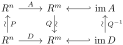
    The commutative diagram in Figure 2.20.14 summarizes the relationship between \(\im A\) and \(\im D\text{,}\) as goverened by the invertible matrices \(Q\) and \(P\text{.}\)
Commutative diagram relating image of A and image of D=QAP
Figure 2.20.14. \(\im A\) versus \(\im D\text{,}\) \(D=QAP\)

Definition 2.20.15. Elementary operations.

Let \(R\) be a commutative ring, and let \(m\) and \(n\) be positive integers. Recall that \(E_{ij}\in M_{m\times n}(R)\) is the matrix whose \((i,j)\)-th entry is 1, and all of whose other entries are zero. The following operations on \(M_{m\times n}(R)\) are called the elementary row and column operations.
  • Scale by unit.
    The scaling operation multiplies all elements of a single row (or single column) of a matrix by a unit \(c\in R^*\text{.}\)
  • Row/column swap.
    A row swap replaces the \(i\)-th row with the \(j\)-th and replaces the \(j\)-th row with the \(i\)-th for some \(1\leq i\ne j\leq m\text{.}\)
    Similarly, a column swaw replaces the \(k\)-th column with the \(\ell\)-th and replaces the \(\ell\)-th column with the \(k\)-th for some \(1\leq k\ne \ell\leq n\text{.}\)
  • Row/column addition.
    A row addition operation replaces the \(i\)-th row with the \(i\)-th row plus any scalar multiple of the \(j\)-th row for some \(1\leq i\ne j\leq m\)
    Similarly, a column addition replaces the \(k\)-th column with the \(\ell\)-th column plus any scalar multiple of the \(k\)-th column for some \(1\leq k\ne \ell\leq n\text{.}\)

Remark 2.20.16. Elementary operations.

As in “normal” linear algebra, the elementary row operations can be represented by multiplication on the left (for rows) or right (for columns) by the matrix obtained by performing the same operation on the identity matrix of appropriate dimension. Such matrices are easily shown to be invertible (with inverse matrix corresponding to the “reverse” operation), and are called elementary matrices.

Remark 2.20.18. Smith normal form for general PID.

A similar procedure can be used in the case where \(R\) is a PID, and not necessarily a Euclidean domain. In this case we replace the Euclidean size function with the function \(s\colon R-\{0\}\rightarrow \N_\geq 0\) defined as follows: given nonzero \(a\text{,}\) if \(a\) is a unit, then define \(s(a)=0\text{;}\) otherwise, define \(s(a)\) to be the number of irreducible factors (counting multipliciy) in an irreducible factorization of \(a\text{.}\) This function is well defined thanks to the uniqueness property of irreducible factorizations in a PID. Although \(s\) does not necessarily satisfy the division algorithm, for any two nonzero elements \(a\) and \(b\) with \(s(a)\leq s(b)\text{,}\) if \(a\nmid b\text{,}\) then \(s(c)< s(a)\text{,}\) for any GCD of \(a\) and \(b\text{.}\) Since \(R\) is a PID, we can write \(c=ra+sb\) for some \(r,s\in R\text{.}\) Using this fact, we can modify Procedure 2.20.17 to show that \(QAP=D\) for some invertible matrices \(Q\in \GL_m(R)\) and \(P\in \GL_n(R)\text{.}\)

Example 2.20.19. Aligned bases.

Find an aligned basis for the given free module \(M\) and submodule \(N\text{.}\)
  1. \(M=\Z^2\text{,}\) \(N=((7,9),(8,10))\)
  2. \(M=\Z^3\text{,}\) \(N=((6,-10,4),(0,2,-2),(-6,6,0))\)
Solution.

Example 2.20.20. Computing a cokernel.

Let \(M=\Z^3\text{,}\) and let \(\phi\in \End_\Z(M)\) be the homomorphism with standard matrix
\begin{align*} A \amp = \begin{amatrix}[rrr] 3\amp 1\amp -4 \\ 2\amp -3 \amp 1\\ -4\amp 6\amp -2 \end{amatrix}\text{.} \end{align*}
Express \(M/\im\phi\) as a direct sum of cyclic groups (up to isomorphism.)
Solution.